
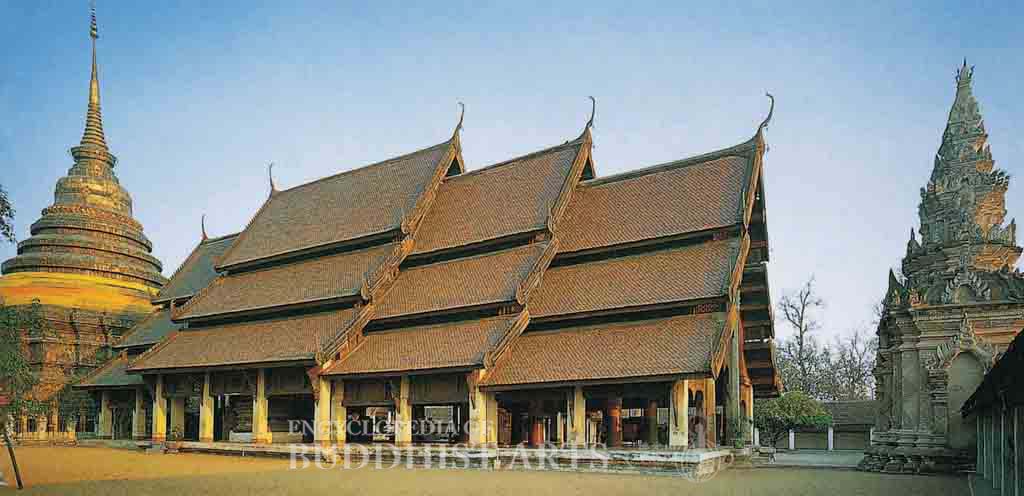
Wat Phra That Lampang Luang
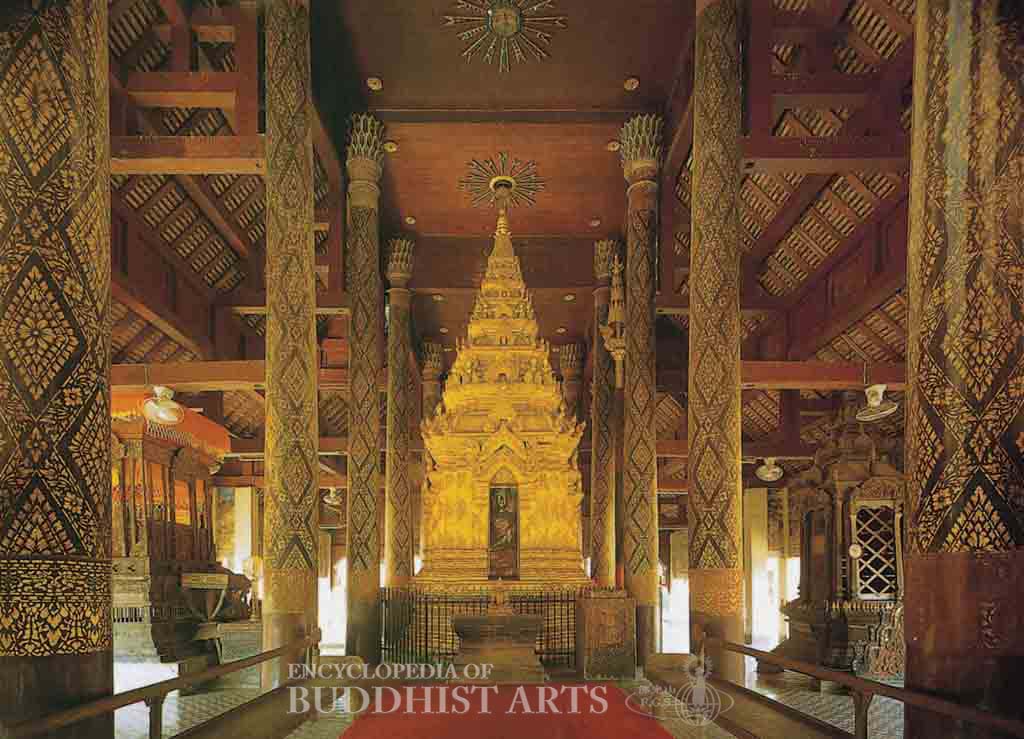
Wat Phra That Lampang Luang: Main Hall (interior)
Wat Phra That Lampang Luang
THAILAND, Lampang
Wat Phra That Lampang Luang means the Great Relic Temple of Lampang. Its original date of construction is unknown, but some of the buildings within the temple date back to the 13th century. The temple underwent many renovations and expansions between the 16th and 19th centuries, and the major buildings were reconstructed in the 20th century.
The temple faces east. Along the central axis, there are the main temple gate, main hall, stupa, and Phra Sao Sila Hall. On the south side of the temple, there are the Phra Put Hall, ordination hall, and Hall of the Buddha’s Footprint. In the north, there are the Ton Kaeo Hall and Nam Tam Hall. There are colonnades along the boundary walls. The staircase leading to the main temple gate has balustrades decorated with nagas and the stuccoed gateway is in the form of a stupa. After passing through the gateway, the first building is the main hall, which is the most exceptional wooden structure of its type from the kingdom of Lanna (circa 1259–1558). The hall has no walls but the grand roof is supported by square columns on the outside and decorated circular columns in the interior. The roof consists of three-tier eaves and four sections of overlapping ridges. The ridge ends are decorated with garudas, and the ends of the bargeboards are adorned with nagas. Inside the hall there is a gilded stupa-like structure containing a statue of Sakyamuni Buddha, named Phra Chao Lan Thong. The Phra Put Hall, with colored glass inlay work covering the entire facade, holds a gilded brick Buddha statue that is 5.3 m high.
For more details, go to the Encyclopedia of Buddhist Arts: Architecture T-Z, page 1244.
Cite this article:
author = Hsingyun and Youheng and Johnson, Peter and Mankuang and Lancaster, Lewis,
booktitle = {Encyclopedia of Buddhist Arts: Architecture T-Z},
pages = 1244,
title = {{Wat Phra That Lampang Luang}},
volume = 4,
year = {2016}}