
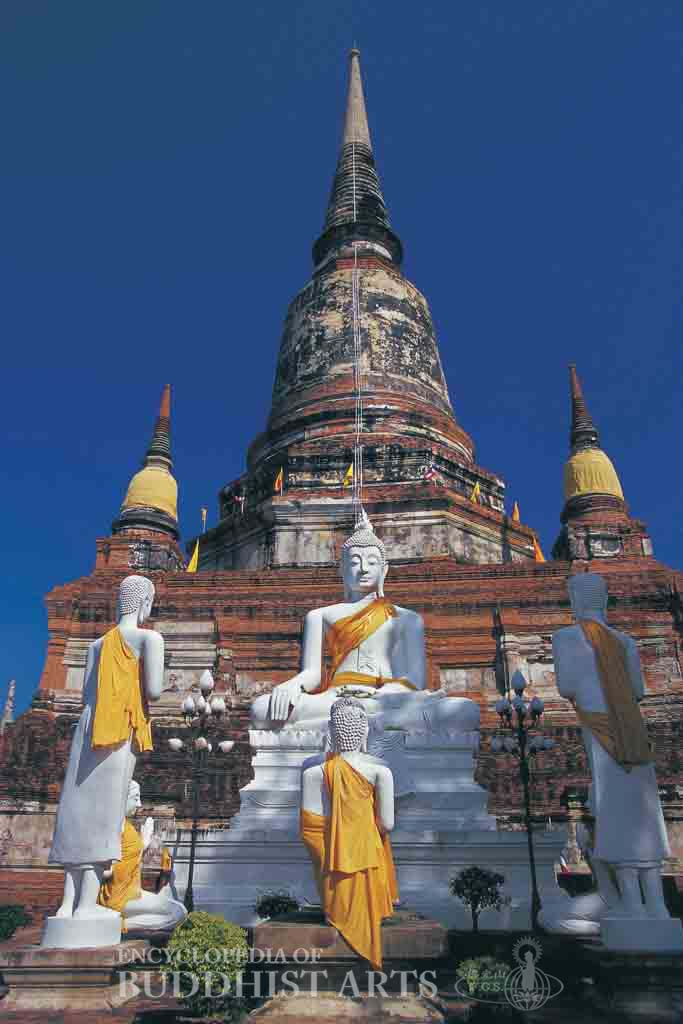
Wat Yai Chai Mongkon: Main Stupa
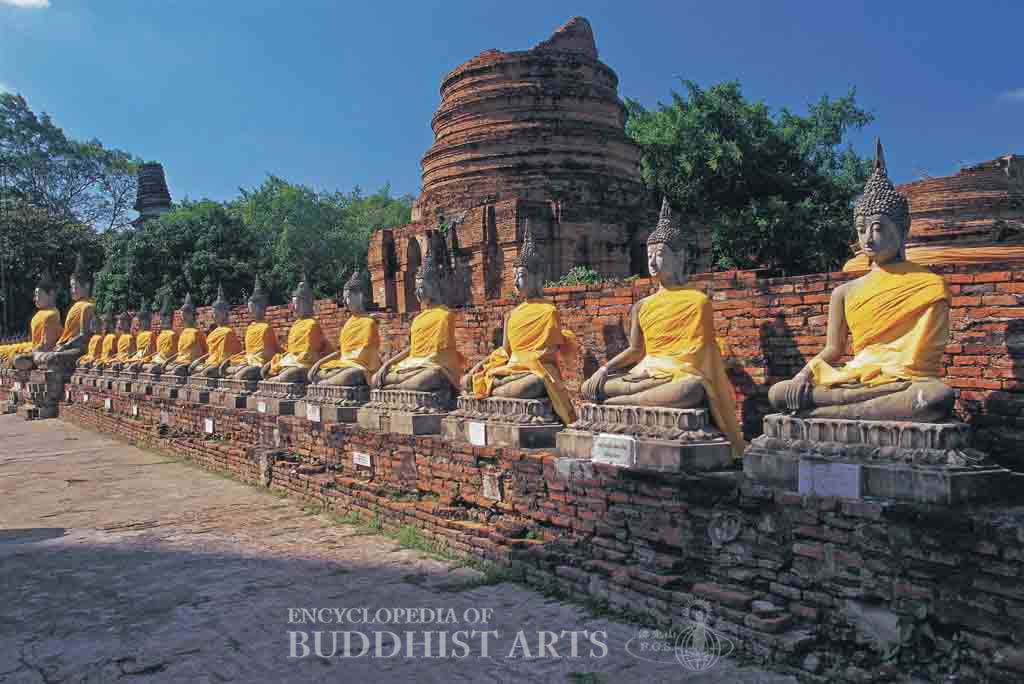
Wat Yai Chai Mongkon: Seated Buddhas
Wat Yai Chai Mongkon
THAILAND, Ayutthaya
Wat Yai Chai Mongkon means Temple of the Great Victory. It was formerly known as Wat Pa Kaso and Wat Chao Phraya Thai (Temple of the Chief Monk). It was built in 1357 by King Ramathibodi I (reigned 1351–1369). In 1592, a large Thai-style stupa named Phra Chedi Chai Mongkon was added by King Naresuan (reigned 1590–1605). This stupa is one of the largest from the Ayutthaya Kingdom (circa 1350–1767), and is also the most significant structure in the temple. As part of the Historic City of Ayutthaya, it was listed as a UNESCO World Heritage Site in 1991.
Apart from the main stupa, other structures within the temple include the ordination hall, the Reclining Buddha Hall, and a number of stupas in various sizes and styles. The main stupa is approximately 60 m high. It was built on a square base platform 32.4 m wide and 15 m high. There are four smaller stupas located at the corners of the base platform. A two-layer octagonal base stands on the base platform. Above the base, there is the stupa body in the form of a bell, which is surmounted by an octagonal harmika followed by a spire made of stacked rings. In front of the main stupa there are two pavilions, in which Buddha images are enshrined. The main stupa and the two pavilions are enclosed by a gallery, which is lined with Buddha statues. Located near the main stupa there is the Reclining Buddha Hall, where a reclining Buddha statue and ruins of columns and outer walls are all that remain. The reclining Buddha lies on his right side with eyes open, and has a distinctive facial expression. The statue was sculpted in the Ayutthaya Kingdom and was restored in modern times. It is one of the largest statues of the Ayutthaya Kingdom.
For more details, go to the Encyclopedia of Buddhist Arts: Architecture T-Z, page 1265.
Cite this article:
author = Hsingyun and Youheng and Johnson, Peter and Mankuang and Lancaster, Lewis,
booktitle = {Encyclopedia of Buddhist Arts: Architecture T-Z},
pages = 1265,
title = {{Wat Yai Chai Mongkon}},
volume = 4,
year = {2016}}