
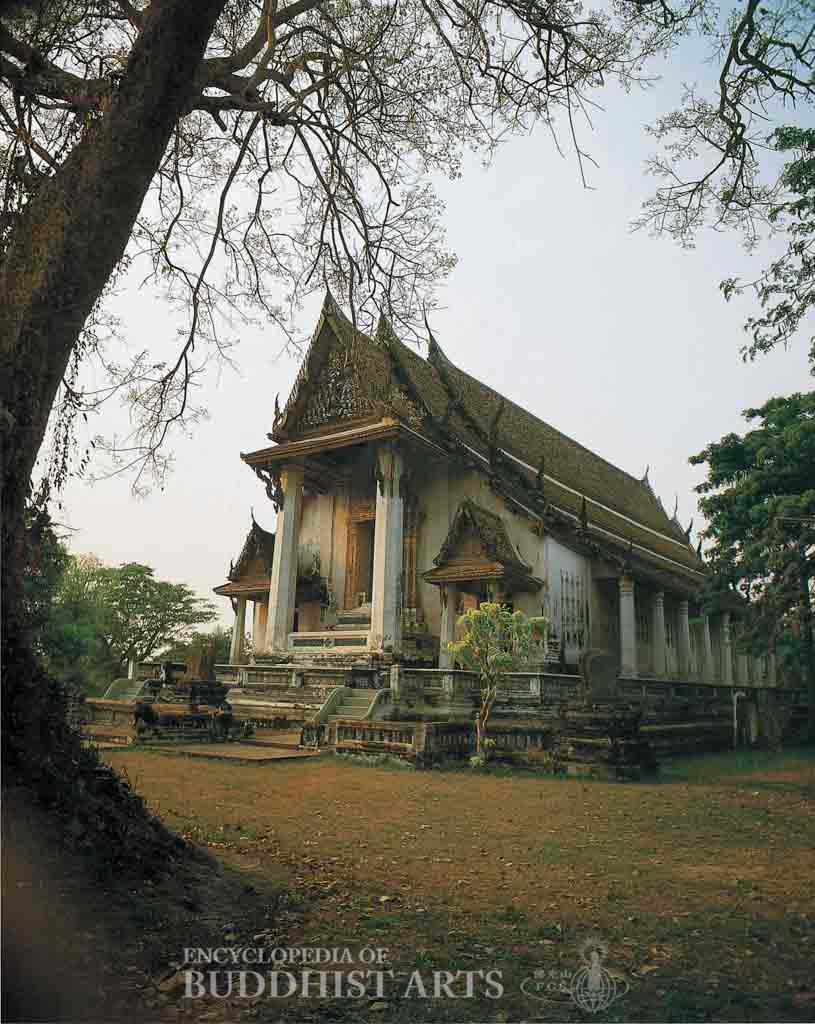
Wat Na Phra Men: Ordination Hall

Wat Na Phra Men: Ordination Hall - Ceiling
Wat Na Phra Men
THAILAND, Ayutthaya
Wat Na Phra Men means Temple in Front of the Crematorium. The temple is located north of the Lopburi River in the ancient city of Ayutthaya. It is believed that the temple was built in 1504 during the time of King Ramathibodi II (reigned 1491–1529) and was originally named Wat Pramerurachikaram. In the 18th century it was renovated during the rule of King Boromakot (reigned 1733–1758), and it was restored twice during the reigns of King Rama III (reigned 1824–1851) and King Rama IV (reigned 1851–1868). As part of the Historic City of Ayutthaya, it was listed as a UNESCO World Heritage Site in 1991.
The temple consists of the ordination hall, subsidiary hall, and pavilion. The most important building is the ordination hall, which faces south. It stands on a rectangular platform and measures 41.4 m by 17.5 m. The roof is divided into sections and the main roof has four tiers. The eaves are supported by hexagonal columns with capitals in the shape of lotus buds. At the ends of the ridges there are garudas, and the bargeboards are decorated with nagas. The gilded wood carvings on the pediment depict Vishnu riding a garuda as well as heavenly beings with joined palms. There are also hexagonal columns supporting the ceiling inside the ordination hall and they are similar in design to those outside. The wooden ceiling is adorned with gilded stars inlaid with pieces of mirror, giving a colorful finish. The ordination hall contains a 6 m high Buddha statue with hands in the bhumisparsa (earth-touching) mudra. This statue is one of the largest of its kind from the Ayutthaya period (circa 1350–1767).
Next to the ordination hall there is the subsidiary hall, which also faces south. It has a rectangular plan with multiple corners and measures 25 m by 11.5 m. Its entrance contains decorations of vines and flowers. A 5.2 m high stone seated Buddha statue in Dvaravati style is enshrined within the hall. There are also murals depicting scenes from the Jataka tales, but most of them have faded.
For more details, go to the Encyclopedia of Buddhist Arts: Architecture T-Z, page 1209.
Cite this article:
author = Hsingyun and Youheng and Johnson, Peter and Mankuang and Lancaster, Lewis,
booktitle = {Encyclopedia of Buddhist Arts: Architecture T-Z},
pages = 1209,
title = {{Wat Na Phra Men}},
volume = 4,
year = {2016}}