
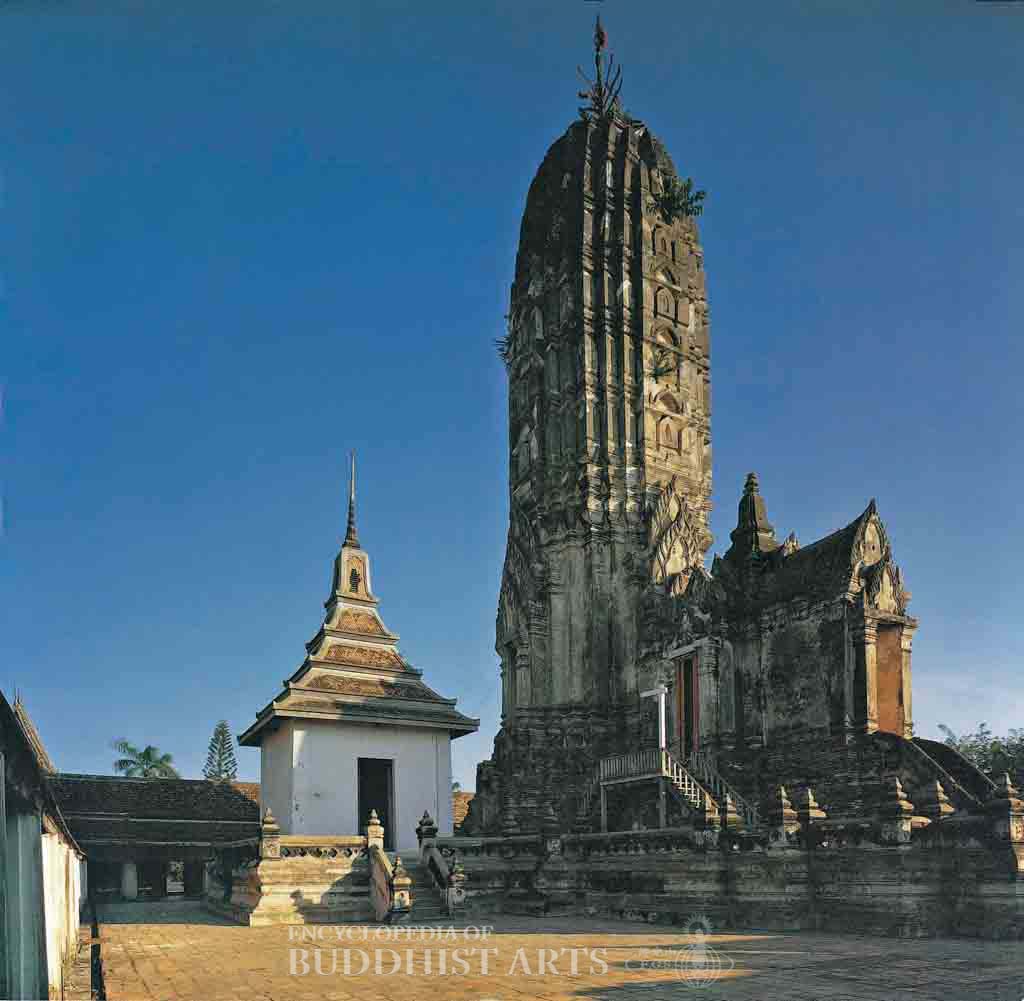
Wat Phutthaisawan
Wat Phutthaisawan
THAILAND, Ayutthaya
Phutthaisawan means Buddha of the Heavens. It is located on the south bank of the Chao Phraya River, to the south of the ancient city of Ayutthaya. It was built in 1353 by King Ramathibodi I (reigned 1351–1369), the founder of the Ayutthaya Kingdom (circa 1350–1767). It was built on the site where the king first settled before establishing Ayutthaya as the capital city. The temple has undergone a few major renovations over time, including one in 1868 during the time of King Rama V (reigned 1868–1910). As part of the Historic City of Ayutthaya, it was listed as a UNESCO World Heritage Site in 1991.
The temple consists of the Khmer-style main stupa, the ordination hall, the main hall, two pavilions, Reclining Buddha Hall, and several Thai-style stupas. The temple complex was enclosed by a 192 m by 92 m boundary wall. The Khmer-style stupa is located in the center of the temple, surrounded by a colonnaded walkway lined with seated Buddha images. The stupa stands on a tall base platform on a square layout with multiple corners. The body and spire have a tapered curved shape. There are staircases on the east and the west side of the stupa, but the inner chamber can only be accessed through the east portico. A Buddha image named Phra Chao U-Thong is enshrined within the stupa. There are pavilions located on both sides of the stupa within the walkway, and the ordination hall is situated to the west of the walkway. The form and layout of this temple are in the early Ayutthaya architectural style.
For more details, go to the Encyclopedia of Buddhist Arts: Architecture T-Z, page 1246.
Cite this article:
author = Hsingyun and Youheng and Johnson, Peter and Mankuang and Lancaster, Lewis,
booktitle = {Encyclopedia of Buddhist Arts: Architecture T-Z},
pages = 1246,
title = {{Wat Phutthaisawan}},
volume = 4,
year = {2016}}