
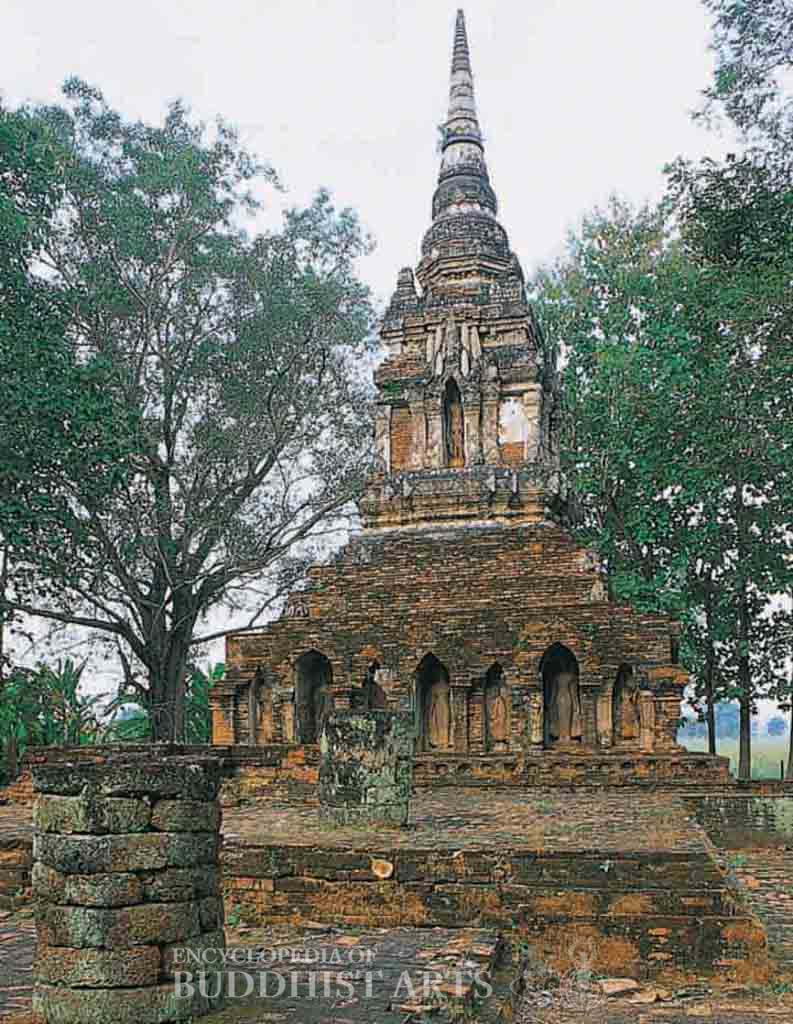
Wat Pa Sak
Wat Pa Sak
THAILAND, Chiang Saen
Pa Sak means Teak Forest and the temple was so named because it is surrounded by teak trees. It is an important monument in Chiang Saen, which was the cradle of the Lanna Thai Kingdom (circa 1259–1558) of northern Thailand. It was probably founded in the early 14th century. It was later renovated and the Thai-style stupa was restored.
The remains of Wat Pa Sak include the main stupa and the foundation and bases of columns belonging to the ordination hall. The stuccoed brick main stupa was constructed to enshrine a relic obtained from Pataliputra in India. The stupa was partly influenced by Mon style architecture, as well as by Sukhothai and Bagan styles. The lower part of the base of the stupa is square with a total of seven niches on each side: three large niches contain stucco standing Buddha images, alternating with four smaller niches with heavenly beings. The upper part of the base looks like a truncated pyramid with a series of tiers. The square stupa body has a niche on each side, framed with delicately carved double pilasters. The double arches above the niches are ornately carved and have vertical projections. The carvings around and above the niches feature makara, garuda, kala, and squatting demonic figures. A standing Buddha statue with large hands is installed in each of these niches. Above the niches there are two square sections followed by an octagonal section. The spire consists of a series of round convex sections followed by the stacked rings of the finial.
For more details, go to the Encyclopedia of Buddhist Arts: Architecture T-Z, page 1212.
Cite this article:
author = Hsingyun and Youheng and Johnson, Peter and Mankuang and Lancaster, Lewis,
booktitle = {Encyclopedia of Buddhist Arts: Architecture T-Z},
pages = 1212,
title = {{Wat Pa Sak}},
volume = 4,
year = {2016}}