
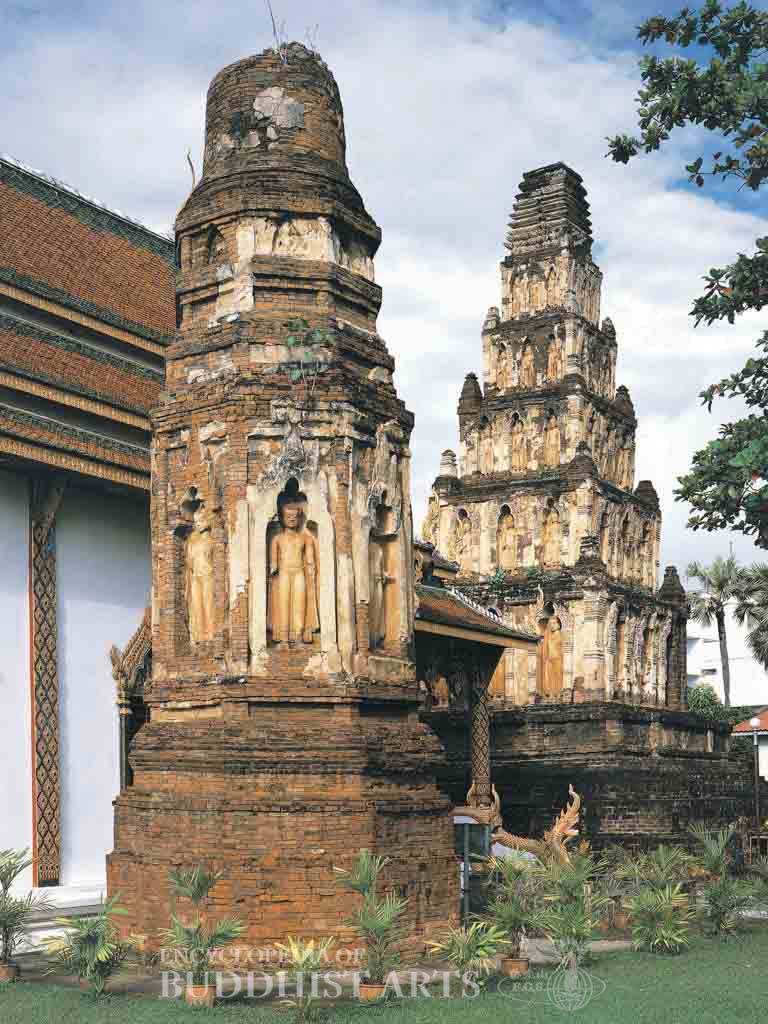
Wat Ku Kut: Ratana Stupa and Mahapol Stupa

Wat Ku Kut: Ordination Hall - Pediment (detail)
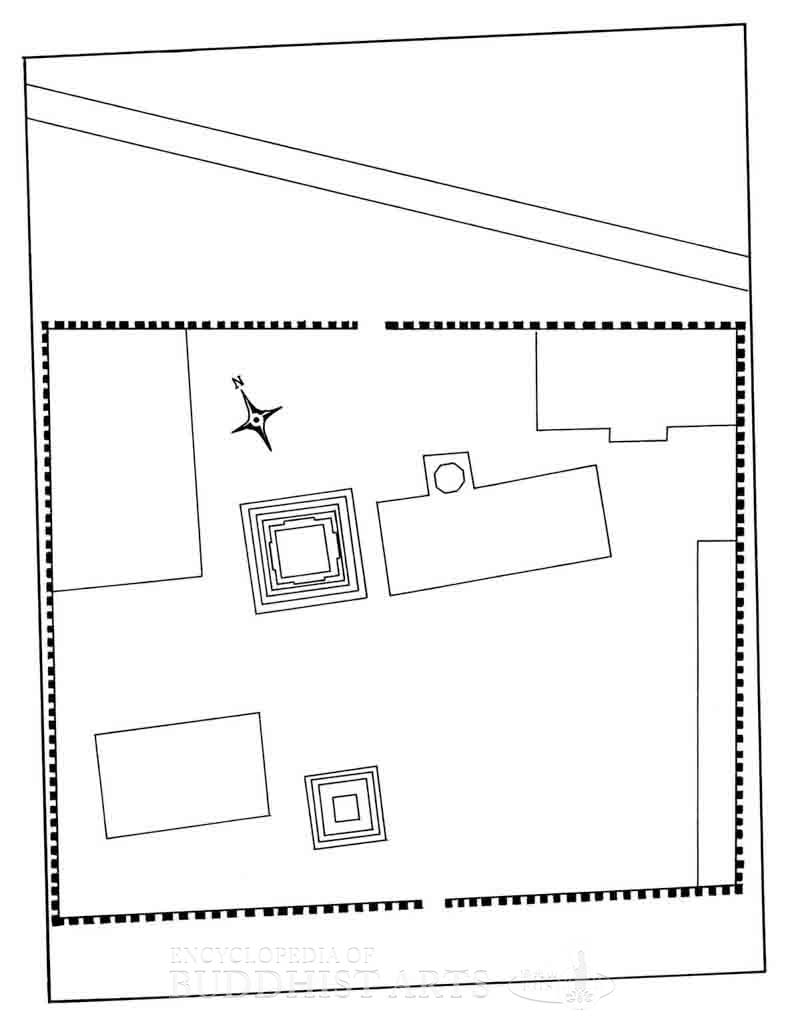
Wat Ku Kut (site layout)
Wat Ku Kut
THAILAND, Lamphun
Ku Kut means Stupa without a Top. It is one of the most important temples in Lamphun province. The temple is also known as Wat Chamathewi, named after the first queen of Lamphun. According to legend, it was built by Queen Chamathewi or in memory of the queen in the 7th century. It underwent several reconstructions and in 1218 the Mahapol Stupa was rebuilt in its present form.
The major structures in the temple include the Mahapol Stupa, Ratana (Gem) Stupa, ordination hall, Buddha hall, and pavilion. The Mahapol Stupa is one of the best known stupas in Northern Thailand and is one of the few remaining structures from the Dvaravati period (circa 6th–13th century). The stupa is 21 m high and stands on a three-layer square base platform which is 15.3 m wide. The body of the stupa consists of five diminishing tiers. There are three niches on each side of each tier containing standing Buddha statues in stucco. The statues are in Mon style with broad faces and eyebrows which are curved and connected. They also wear robes which are light and transparent. Most of the Buddha statues are damaged, but all of them form the same hand gesture: the left hand hangs down while the right hand is raised in abhaya (fearlessness) mudra. At the top of the stupa there is the spire in the form of square stacked rings, but the finial is missing.
The Ratana Stupa is an octagonal brick stupa in Mon style. The stupa is 11.5 m high in its present, damaged form. Standing on the base are the four tiers of the body. The first tier is comparatively high and there are niches containing a terracotta standing Buddha statue on all eight sides.The second and third tiers are undecorated, while the forth tier has niches containing seated Buddha statues. The upper part of the body of the stupa is in the shape of a bell, but the spire has collapsed. The ordination hall is located at the southwest corner of the temple. A stone stele with inscriptions stands at its entrance. The pediment is decorated with animals set among filigree vines, all gilded, which is a special feature of the ordination hall.
For more details, go to the Encyclopedia of Buddhist Arts: Architecture T-Z, page 1199.
Cite this article:
author = Hsingyun and Youheng and Johnson, Peter and Mankuang and Lancaster, Lewis,
booktitle = {Encyclopedia of Buddhist Arts: Architecture T-Z},
pages = 1199,
title = {{Wat Ku Kut}},
volume = 4,
year = {2016}}