

Prasat Hin Phimai
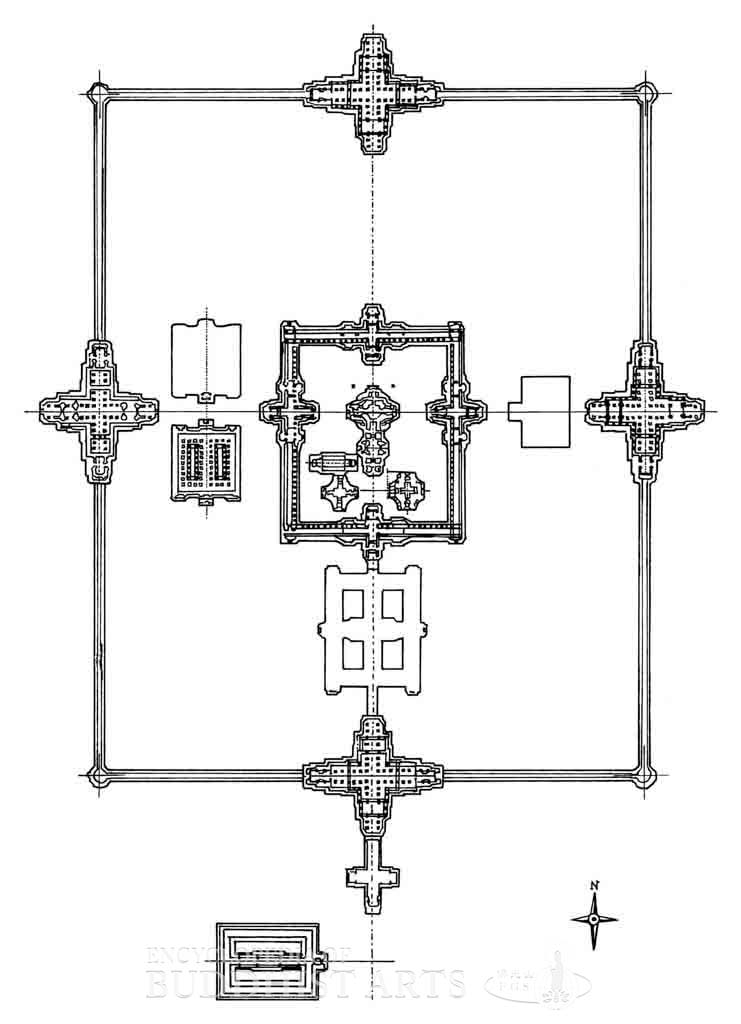
Prasat Hin Phimai (site layout)
Prasat Hin Phimai
THAILAND, Nakhon Ratchasima
The temple is situated at the center of the town of Phimai. It was one of the most important Buddhist temples in Thailand during the Khmer Empire (circa 9th–15th century). Many of its iconographic and stylistic features are similar to those of Angkor Wat, which it predates. From the inscription found inside the main Khmer-style stupa stating that King Suryavarman I (reigned circa 1010–1050) was a Mahayana Buddhist, it is believed that the temple was built by that king in the 11th century. The temple was renovated by subsequent Khmer kings, including King Jayavarman VII (reigned circa 1181–1200) in the 12th century. It underwent major restoration between 1964 and 1969. The entire complex was listed as Prasat Hin Phimai National Historical Park in 1989.
The temple complex faces south and covers an area of nearly 6 ha. The temple was built according to Buddhist cosmology, with the main Khmer-style stupa at the center representing Mount Sumeru. The entire temple is built of brick, sandstone, and laterite. The temple complex includes three Khmer-style stupas, two pavilions, eight gateways, a hall, and two sets of enclosures. The outer enclosure is marked by a boundary wall, while the inner one is surrounded by galleries. In front of the main entrance there is a walkway with balustrades surmounted by nagas.
The three Khmer-style stupas are the main stupa, Bhramadhat Stupa, and Hin Daeng Stupa. The stupas are built with stone blocks of different sizes, without using any timber or mortar. The main stupa is built on a terraced platform, with a portico on each of the four sides and a shrine on the south side. The tympana above the porticos are delicately carved with Buddhist subjects, including one with a standing Buddha in vitarka (teaching) mudra. The stupa body has a tapered curved form, which is a typical Khmer architectural feature. At the very top there is a finial in the shape of a lotus bud. Engravings and inscriptions in the Khmer language are found both on the interior and exterior stone walls of the stupa, providing records of the history of Phimai town as well as the temple. The two stupas flanking the main stupa are smaller. There is a gateway on each of the four sides of the outer boundary wall and the galleries. Each gateway is flanked by lateral porticos resulting in a cruciform plan.
For more details, go to the Encyclopedia of Buddhist Arts: Architecture M-S, page 838.
Cite this article:
author = Hsingyun and Youheng and Johnson, Peter and Mankuang and Lancaster, Lewis,
booktitle = {Encyclopedia of Buddhist Arts: Architecture M-S},
pages = 838,
title = {{Prasat Hin Phimai}},
volume = 3,
year = {2016}}