
Yumbu Lakhang Palace
Yumbu Lakhang Palace
CHINA, Tibet, Lhoka
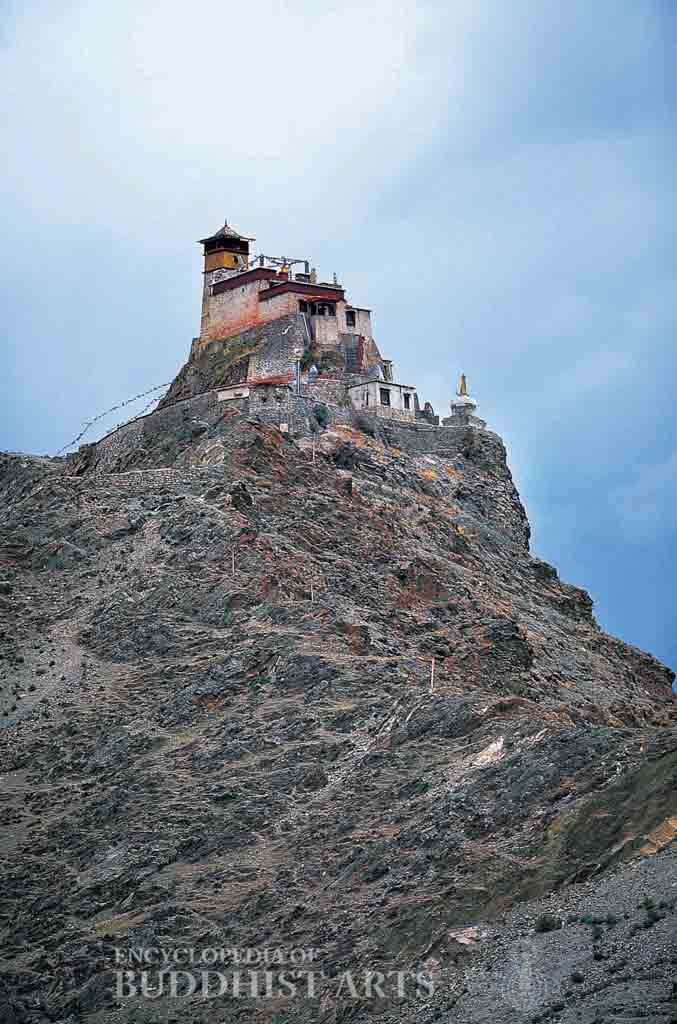
The palace is located on a hill on the eastern bank of the Yarlung Tsangpo River, in the southeast of Nedong county. It is said to be the first building in Tibet and was built by the first king of Tibet, Nyatri Tsenpo, during the 2nd century BCE. It was later converted to a Buddhist temple. The records state that the gilded roof was renovated in the early 14th century. The temple was severely damaged between 1966 and1976, and was restored in 1982. It was listed as a Provincial Cultural Heritage Site in 1962.
Yumbu Lakhang Palace faces west and is modest in scale. The existing building is rectangular and is divided into front and rear structures. The front structure was originally three stories high, but it was modified into two stories. The first story consists of three parts: the portico, shrine, and main hall. Outside the portico there is a small covered platform with eaves. The main hall houses statues of the Three Buddhas, as well as Nyatri Tsenpo and his successive Tsenpos, Princess Wencheng and Princess Bhrkuti. The second story was divided into front and rear sections: the front section is built as a platform surrounded by low walls on three sides, while the rear section consists of an open area surrounded by corridors. The rear structure consists of a square tower with a gilded pyramidal roof. On the inside it is three stories high.
Traces of the temple’s original structure can be found in the stone masonry at the base of the building, which is very different to the modern masonry of the structure above. The decorative features include pembe friezes, horizontal bands of dark red thatch, victory banners, and canopies.
The tower-like form, delicate statues, and long history of the Yumbu Lakhang Palace are important in the study of Tibet, its architecture and religion.
For more details, go to the Encyclopedia of Buddhist Arts: Architecture T-Z, page 1378.
Cite this article:
author = Hsingyun and Youheng and Johnson, Peter and Mankuang and Lancaster, Lewis,
booktitle = {Encyclopedia of Buddhist Arts: Architecture T-Z},
pages = 1378,
title = {{Yumbu Lakhang Palace}},
volume = 4,
year = {2016}}