
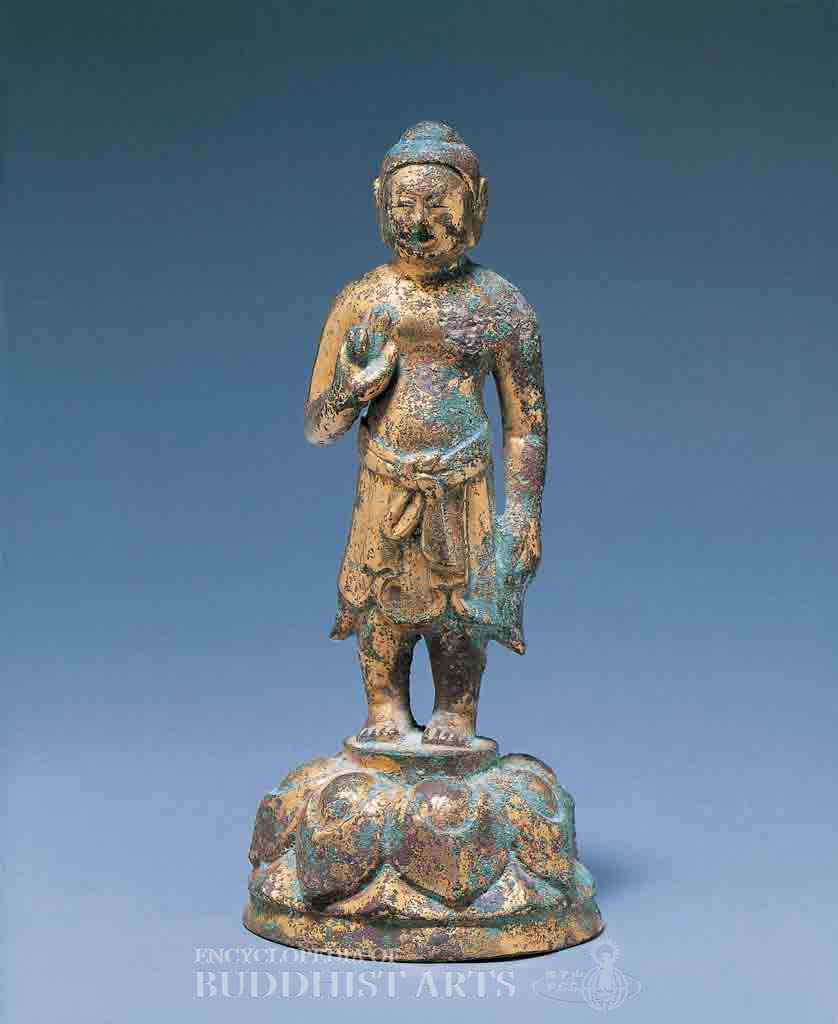
Prince Siddhartha at Birth
Bronze
Prince Siddhartha at Birth
KOREA; Three Kingdoms period
Statues of the infant Buddha-to-be were popular from the 6th until the first half of the 7th century in Korea and developed two styles of representation. The right hand, in one, points to the sky and the left to the earth. In the other, as illustrated here, the right is raised in a mudra in which the two outer fingers are turned down to the palm. The infant stands upon an inverted lotus pedestal wearing a short skirt tied with a bow. This interpretation also influenced contemporary Japanese portrayals of the scene.
For more details, go to the Encyclopedia of Buddhist Arts: Sculpture N-Sr, page 842.
Cite this article:
Hsingyun, et al. "Prince Siddhartha at Birth." Encyclopedia of Buddhist Arts: Sculpture N-Sr, vol. 12, 2016, pp. 842.
Hsingyun, Youheng, Yann Lovelock, Yuan Chou, Susan Huntington, Gary Edson, and Robert Neather. 2016. "Prince Siddhartha at Birth" In Encyclopedia of Buddhist Arts: Sculpture N-Sr, 12:842.
Hsingyun, Youheng, Lovelock, Y., Chou, Y., Huntington, S., Edson, G., & Neather, R.. (2016). Prince Siddhartha at Birth. In Encyclopedia of Buddhist Arts: Sculpture N-Sr (Vol. 12, pp. 842).
@misc{Hsingyun2016,
author = Hsingyun and Youheng and Lovelock, Yann and Chou, Yuan and Huntington, Susan and Edson, Gary and Neather, Robert,
booktitle = {Encyclopedia of Buddhist Arts: Sculpture N-Sr},
pages = 842,
title = {{Prince Siddhartha at Birth}},
volume = 12,
year = {2016}}
author = Hsingyun and Youheng and Lovelock, Yann and Chou, Yuan and Huntington, Susan and Edson, Gary and Neather, Robert,
booktitle = {Encyclopedia of Buddhist Arts: Sculpture N-Sr},
pages = 842,
title = {{Prince Siddhartha at Birth}},
volume = 12,
year = {2016}}