
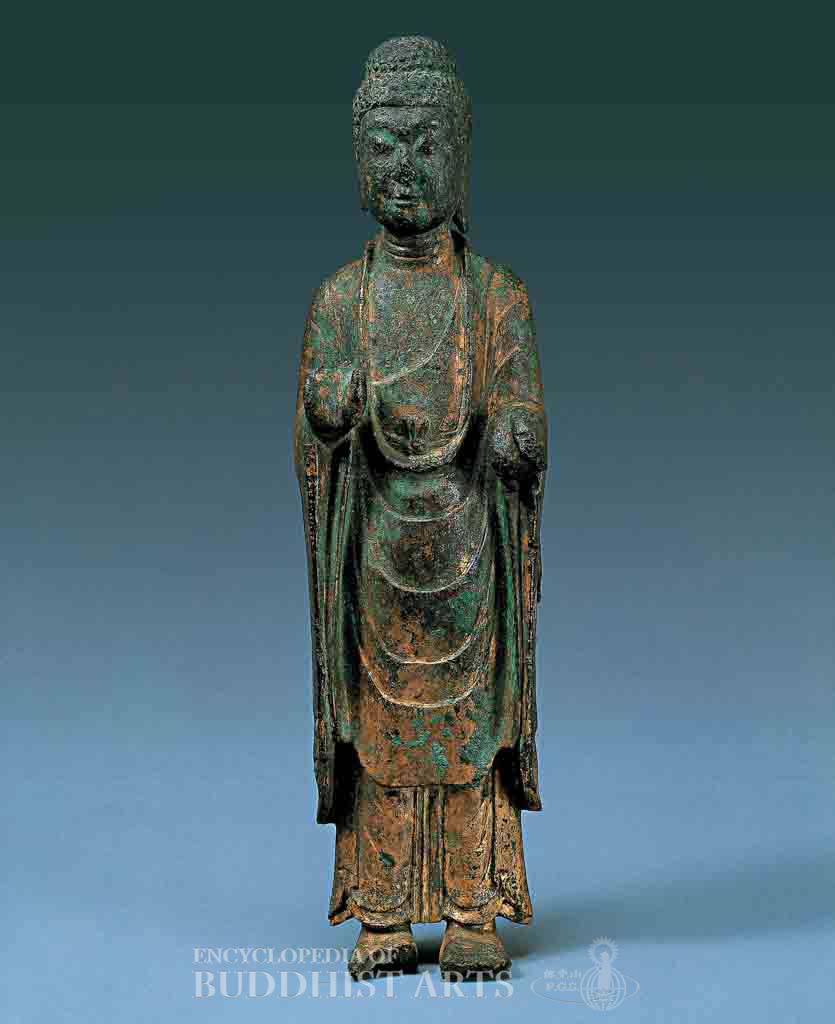
Gangwon: Standing Buddha
Gilt bronze
Gangwon: Standing Buddha
SOUTH KOREA, Gangwon; Three Kingdoms Period
The slim bronze figure was so expertly cast that a copper coin could be used to close the square hole at the back. The hollow statue with the empty hole was a technique typically seen at the end of the Three Kingdoms period (57 BCE–668 CE) and continued through to the Unified Silla dynasty (668–935). The oval head with its large usnisa is supported by a long neck with the three lines that signify a great person. The Buddha’s monastic robes cover both shoulders and fall in curves to the skirt beneath, which divides over the legs. The hands are damaged but the right hand is probably raised in abhaya (fearlessness) mudra.
For more details, go to the Encyclopedia of Buddhist Arts: Sculpture G-M, page 368.
Cite this article:
Hsingyun, et al. "Gangwon: Standing Buddha." Encyclopedia of Buddhist Arts: Sculpture G-M, vol. 11, 2016, pp. 368.
Hsingyun, Youheng, Yann Lovelock, Yuan Chou, Susan Huntington, Gary Edson, and Robert Neather. 2016. "Gangwon: Standing Buddha" In Encyclopedia of Buddhist Arts: Sculpture G-M, 11:368.
Hsingyun, Youheng, Lovelock, Y., Chou, Y., Huntington, S., Edson, G., & Neather, R.. (2016). Gangwon: Standing Buddha. In Encyclopedia of Buddhist Arts: Sculpture G-M (Vol. 11, pp. 368).
@misc{Hsingyun2016,
author = Hsingyun and Youheng and Lovelock, Yann and Chou, Yuan and Huntington, Susan and Edson, Gary and Neather, Robert,
booktitle = {Encyclopedia of Buddhist Arts: Sculpture G-M},
pages = 368,
title = {{Gangwon: Standing Buddha}},
volume = 11,
year = {2016}}
author = Hsingyun and Youheng and Lovelock, Yann and Chou, Yuan and Huntington, Susan and Edson, Gary and Neather, Robert,
booktitle = {Encyclopedia of Buddhist Arts: Sculpture G-M},
pages = 368,
title = {{Gangwon: Standing Buddha}},
volume = 11,
year = {2016}}