
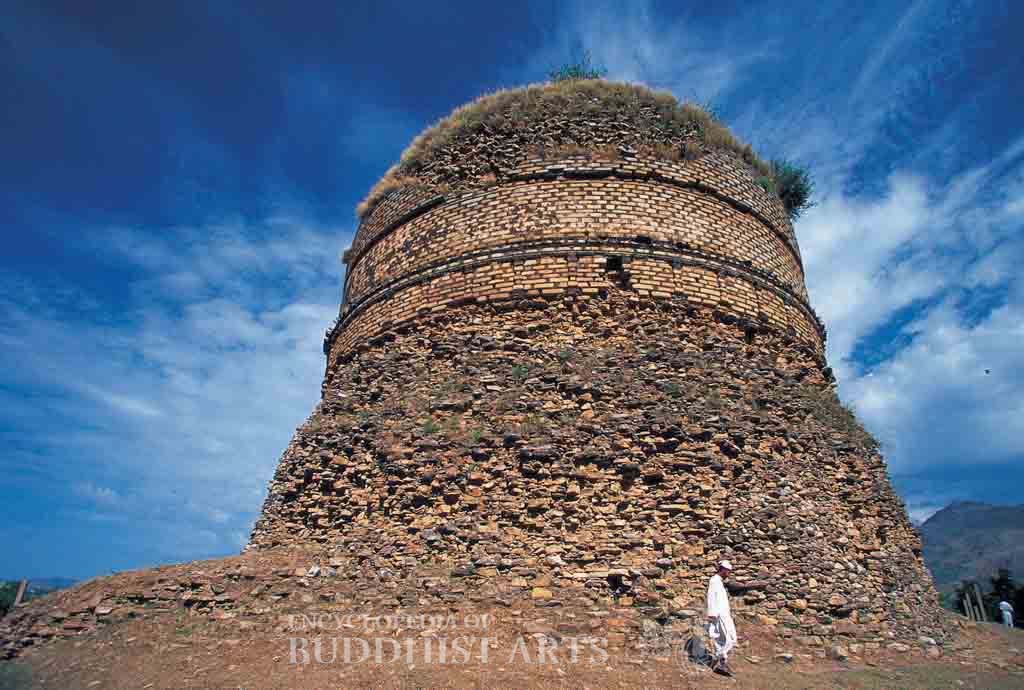
Shingerdar Stupa (detail)
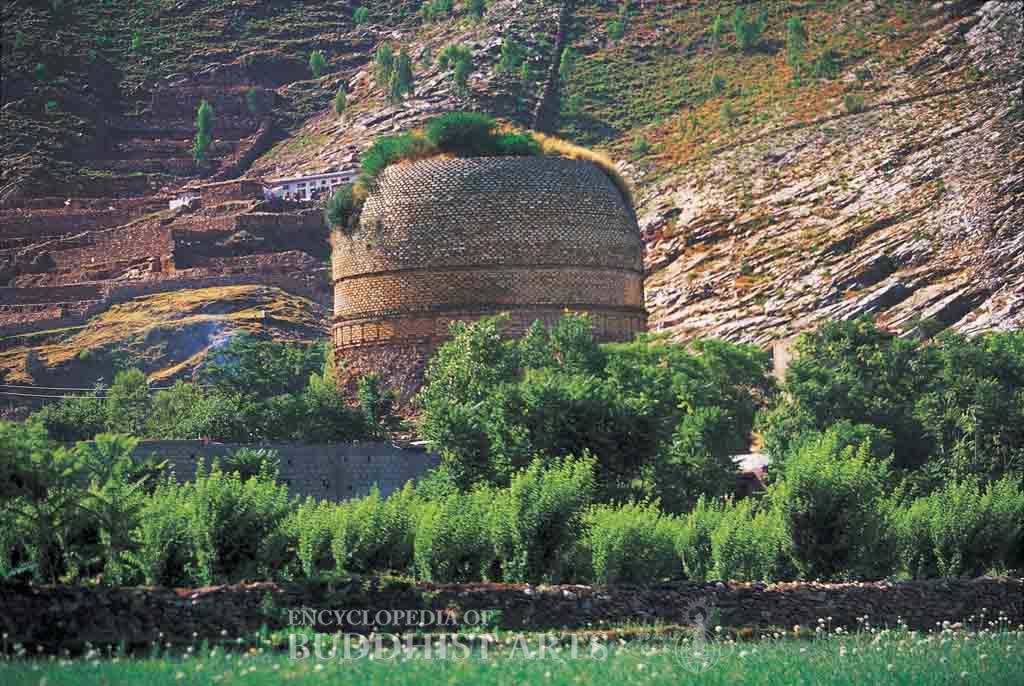
Shingerdar Stupa
Shingerdar Stupa
PAKISTAN, Khyber Pakhtunkhwa, Swabi
This is the largest surviving stupa in the lower valley of the Swat River. This place is referred to as Udyana with its capital Mangalapura (present day Mingora) in the Great Tang Records on the Western Regions by Master Xuanzang, a Chinese pilgrim from the Tang dynasty (618–907). He writes that before Sakyamuni Buddha entered parinirvana he instructed that some of his relics be distributed to Uttarasena, the king of Swat. The white elephant transporting the relics died upon arrival and transformed into a huge boulder. It is said that Uttarasena built a stupa beside the boulder. Some scholars believe that the stupa was built during the 2nd century BCE, while others date it to the 6th century.
The stupa is made entirely of brick and is 27.4 m high. The high cylindrical base with a diameter of approximately 13 m is surmounted by the body, which is also cylindrical, followed by the dome. There are Greek pilasters, which are rectangular columns with a capital and base, projecting slightly from the wall of the body as an ornamental motif. The base used to be covered in panels, which are either missing or have weathered away, exposing the brick walls underneath.
For more details, go to the Encyclopedia of Buddhist Arts: Architecture M-S, page 996.
Cite this article:
author = Hsingyun and Youheng and Johnson, Peter and Mankuang and Lancaster, Lewis,
booktitle = {Encyclopedia of Buddhist Arts: Architecture M-S},
pages = 996,
title = {{Shingerdar Stupa}},
volume = 3,
year = {2016}}