
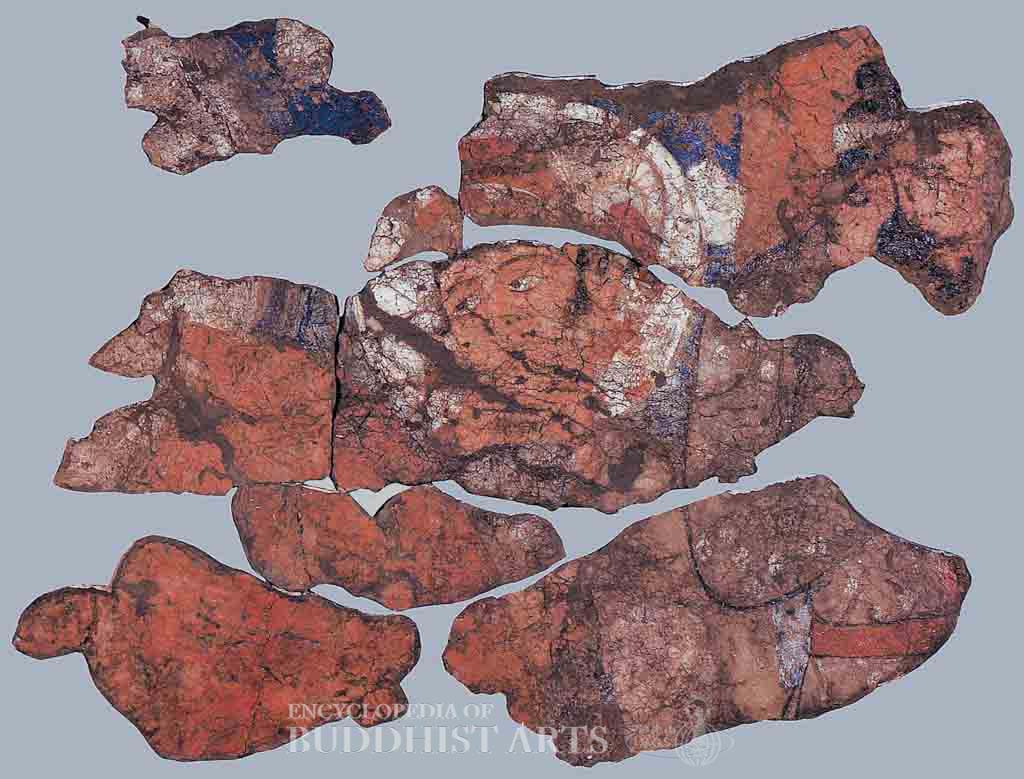
Fayaz Tepe: Figures Making Offerings

Fayaz Tepe: Figures Making Offerings (detail)
Fayaz Tepe: Figures Making Offerings
UZBEKISTAN, Surkhandarya, Termez
These fragments were originally part of the east wall mural in the temple hall at Fayaz Tepe. It is one of the oldest Buddhist murals in Central Asia, dated from the time of the Kushan period (circa 1st–3rd century). Parts of three figures can be seen in the fragments. The figure in the center wears a helmet, and has a high-bridged nose, slanted eyes, and long, narrow eyebrows. There is a ram’s horn drawn on the right side of the helmet. On existing historical relics and coins from the Persian Sassanid Empire (224–651), the image of Bahram II (reigned 276–293) is adorned with a similar ram’s horn. The figure is thus thought to be a monarch who is paying respect to the Buddha. On the right, part of the white robe and the face of another figure is visible. On the left, there is only part of a nimbus and a robe to suggest the presence of the third figure.
For more details, go to the Encyclopedia of Buddhist Arts: Painting A-H, page 238.
Cite this article:
author = Hsingyun and Youheng and Youlu and Wilson, Graham and Manho and Mankuang and Huntington, Susan,
booktitle = {Encyclopedia of Buddhist Arts: Painting A-H},
pages = 238,
title = {{Fayaz Tepe: Figures Making Offerings}},
volume = 14,
year = {2016}}