
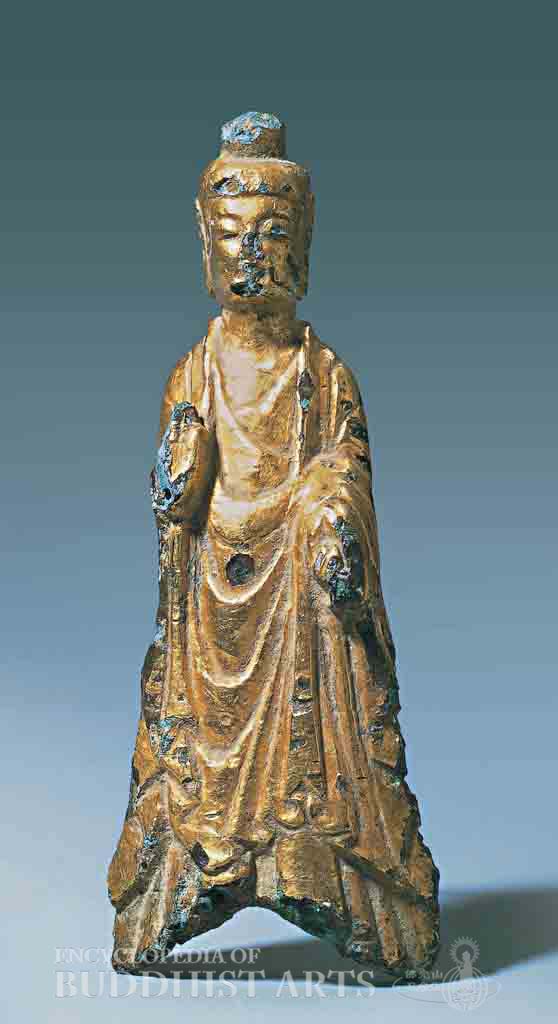
Bowonsa Temple: Amitabha Buddha
Gilt bronze
Bowonsa Temple: Amitabha Buddha
SOUTH KOREA, South Chungcheong, Seosan; Baekje period
This damaged statue was excavated from ruins of Bowonsa Temple. The characteristics of Baekje (18 BCE–663) sculptures are their intricate carving and smooth textures. Figures are generally considered to show Chinese influence, especially that of the Southern Dynasties (420–589), but this particular statue with its slender build is more similar to the Northern Wei (386–534) style. The right hand most likely forms the abhaya (fearlessness) mudra while the left hand points downward. The back of the sculpture is flat and there are tenons where a mandorla was originally attached.
For more details, go to the Encyclopedia of Buddhist Arts: Sculpture A-F, page 188.
Cite this article:
Hsingyun, et al. "Bowonsa Temple: Amitabha Buddha." Encyclopedia of Buddhist Arts: Sculpture A-F, vol. 10, 2016, pp. 188.
Hsingyun, Youheng, Yann Lovelock, Yuan Chou, Susan Huntington, Gary Edson, and Robert Neather. 2016. "Bowonsa Temple: Amitabha Buddha" In Encyclopedia of Buddhist Arts: Sculpture A-F, 10:188.
Hsingyun, Youheng, Lovelock, Y., Chou, Y., Huntington, S., Edson, G., & Neather, R.. (2016). Bowonsa Temple: Amitabha Buddha. In Encyclopedia of Buddhist Arts: Sculpture A-F (Vol. 10, pp. 188).
@misc{Hsingyun2016,
author = Hsingyun and Youheng and Lovelock, Yann and Chou, Yuan and Huntington, Susan and Edson, Gary and Neather, Robert,
booktitle = {Encyclopedia of Buddhist Arts: Sculpture A-F},
pages = 188,
title = {{Bowonsa Temple: Amitabha Buddha}},
volume = 10,
year = {2016}}
author = Hsingyun and Youheng and Lovelock, Yann and Chou, Yuan and Huntington, Susan and Edson, Gary and Neather, Robert,
booktitle = {Encyclopedia of Buddhist Arts: Sculpture A-F},
pages = 188,
title = {{Bowonsa Temple: Amitabha Buddha}},
volume = 10,
year = {2016}}