
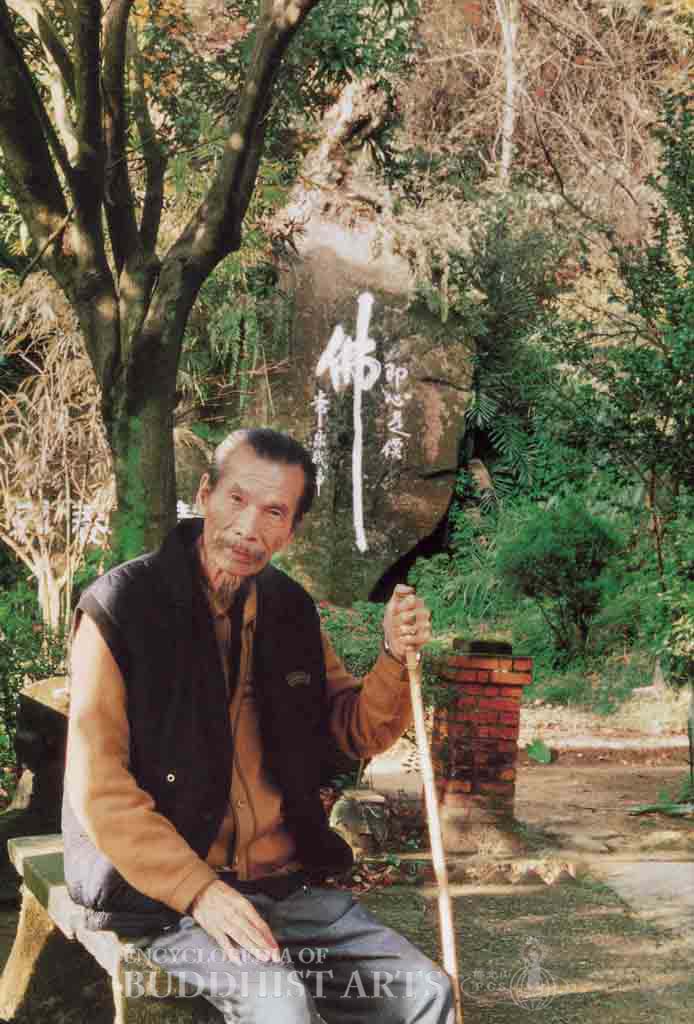
Li Ying-Bin
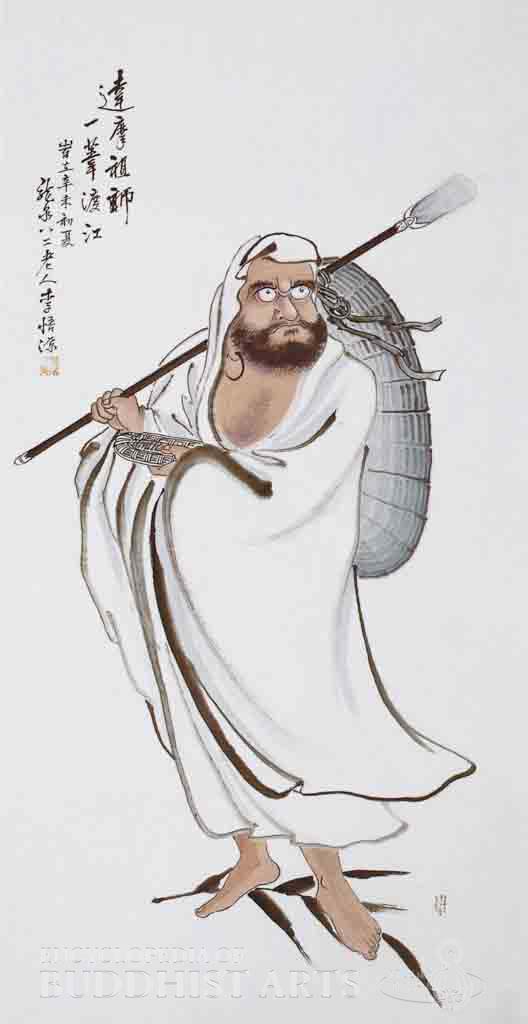
Bodhidharma by Li Ying-Bin; Dated 1991
Ink and color on paper
Li Ying-Bin
TAIWAN, New Taipei City
Li Ying-Bin, also known as Laoren Longquan, was a sculptor and painter born in Fangliao (present day Zhonghe, New Taipei City). He assisted Lin Te-Wang in the creation of temple murals in Mengjia (present day Wanhua, Taipei) in 1927, and his ability to surpass the senior artist in his work earned him the nickname of the Eighteen-Year-Old Master. In particular, his skills were evident from the six panels of door guardians he painted at Longshan Temple in Taipei. Several of Li’s works were selected to be displayed in the Taiwan Provincial Fine Arts Exhibition starting in 1942, and from thereafter his paintings won various awards at different exhibitions.
Li became a Buddhist mid-life and managed Pu’an Hall of Tucheng in New Taipei, later developing it into a cultural park that integrated nature, religion, and art. In 1969, he sculpted a 4 m high statue of Ksitigarbha Bodhisattva, and in 1972, a new hall was constructed to house the statue. Statues of Dharma Protecting Bodhisattvas and Donors were subsequently erected on both sides of the Ksitigarbha statue.
In his later years, Li concentrated on painting, creating ink renderings of Bodhisattvas and noble beings. In addition, he sculpted a 4 m high statue of Chan Master Daoji in 1984, which is considered to be a work of high cultural, artistic, and religious value. Furthermore, the Bodhidharma in Pu’an Hall in New Taipei City was also created by Li.
For more details, go to the Encyclopedia of Buddhist Arts: People, page 166.
Cite this article:
author = Hsingyun and Youheng and Youlu and Pokorski, Stefanie and Yichao and Mankuang and Miaohsi,
booktitle = {Encyclopedia of Buddhist Arts: People },
pages = 166,
title = {{Li Ying-Bin}},
volume = 19,
year = {2016}}