
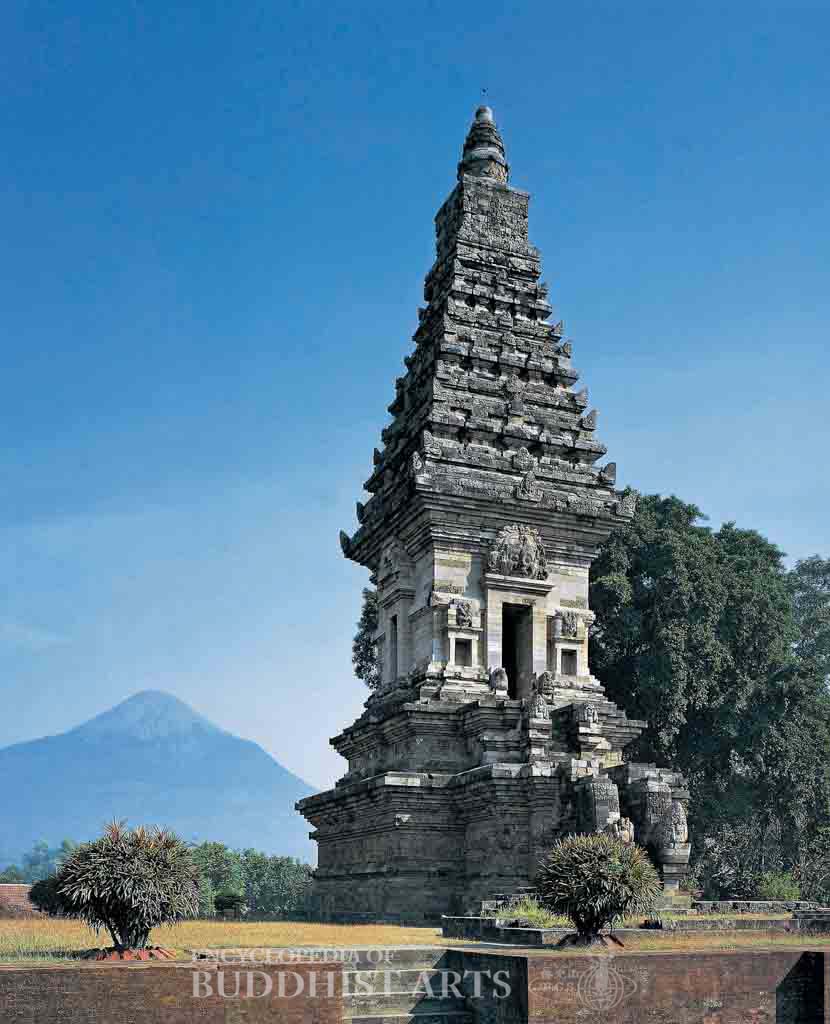
Jawi Temple
Jawi Temple
INDONESIA, East Java, Surabaya
Constructed around 1300, this shrine was built in memory of King Kertanegara (reigned 1268–1292), the last monarch of the Singhasari Kingdom (1222–1292). Restoration took place between 1930 and 1941, followed by regular maintenance. According to the record of the Javanese epic poem Nagarakrtagama, the shrine characterizes the religious harmony between Buddhism and Hinduism. The shrine contained a statue of Shiva, which had the image of Aksobhya Buddha on its head. However, this image is now missing and therefore cannot be accurately described.
The shrine sits on a plateau surrounded by canals. It is 24.2 m high with a 14.2-by-14.2 m square base, and is made of andesite, tufa stone, and brick. Its layout symbolizes Mount Sumeru. The shrine is constructed in three sections with a large base platform, body and roof. The base platform is in the form of a Sumeru throne with graceful brick corbeling, and the reliefs running in a clockwise direction along the sides illustrate the path of practice. A door is located on the west side of the body, while there are niches on the other three sides. The roof consists of a series of tiers narrowing at the top to form the square base of the spire. At the very top of the spire there is a small inverted bowl. This example of Javanese architecture contains both Buddhist and Hindu elements.
For more details, go to the Encyclopedia of Buddhist Arts: Architecture G-L, page 500.
Cite this article:
author = Hsingyun and Youheng and Johnson, Peter and Mankuang and Lancaster, Lewis,
booktitle = {Encyclopedia of Buddhist Arts: Architecture G-L},
pages = 500,
title = {{Jawi Temple}},
volume = 2,
year = {2016}}