
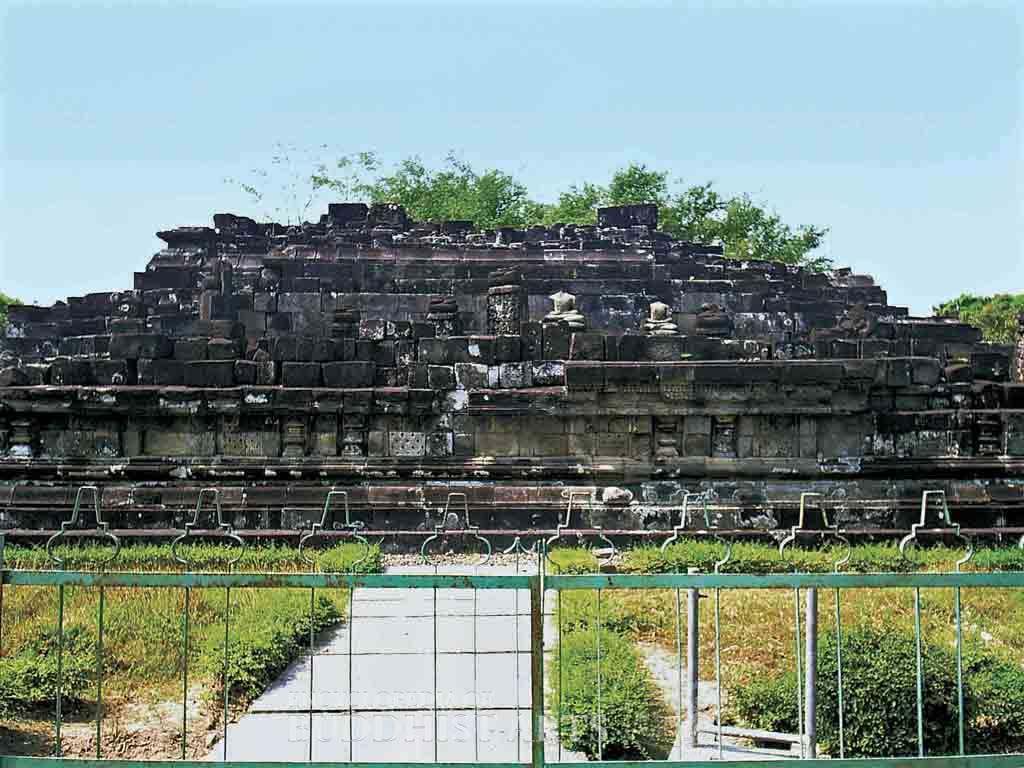
Bubrah Temple
Bubrah Temple
INDONESIA, Yogyakarta, Sleman
Bubrah means Fallen Apart or Scattered All Over. The temple was constructed during the late 8th century, possibly as a subsidiary temple to the Sewu Temple. It has undergone several restorations, but, at present, there is only the base of the structure remaining.
This temple faces east and was built with andesite stone in a rectangular plan with multiple corners. Only the Sumeru throne is left, together with some remaining parts of the chamber. The flat surface of the Sumeru throne is carved with diamond-shaped patterns. Along the side of the throne there are many damaged Buddha statues but it is possible to see that they are sitting with hands in dhyana (meditation) mudras. The missing ends of the entrance stairway handrails used to consist of exquisitely carved makaras, which are currently kept in the Netherlands. There is a large well inside the chamber, which is a special feature of this temple.
For more details, go to the Encyclopedia of Buddhist Arts: Architecture A-F, page 99.
Cite this article:
author = Hsingyun and Youheng and Johnson, Peter and Mankuang and Lancaster, Lewis,
booktitle = {Encyclopedia of Buddhist Arts: Architecture A-F},
pages = 99,
title = {{Bubrah Temple}},
volume = 1,
year = {2016}}