
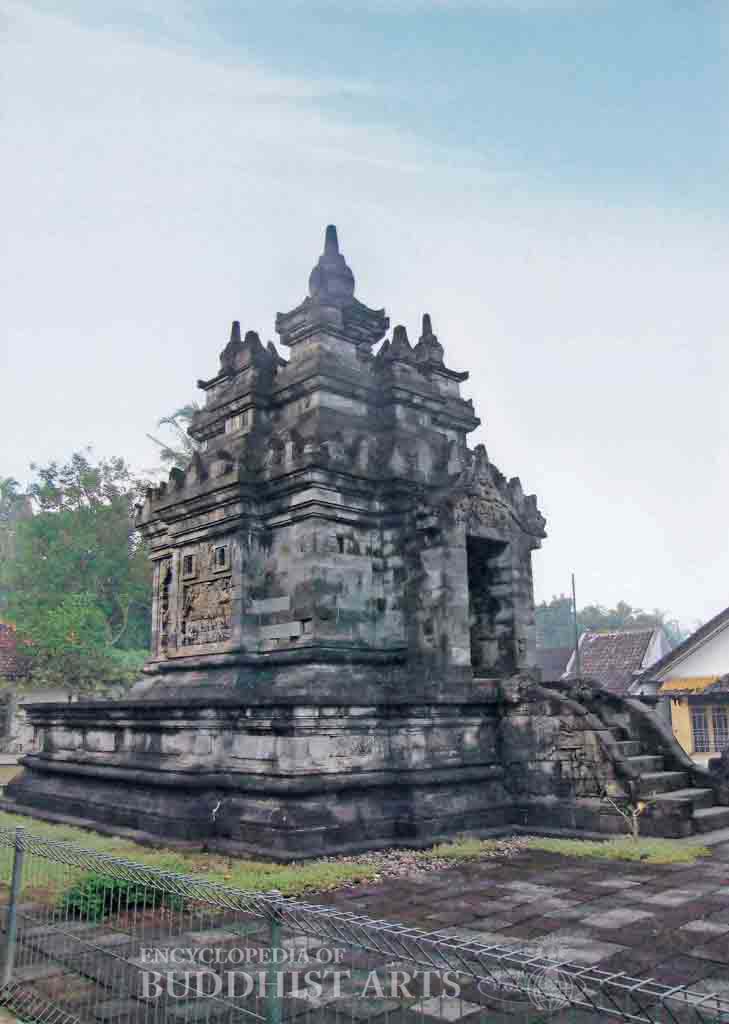
Pawon Temple
Pawon Temple
INDONESIA, Central Java, Magelang
Pawon means Fireplace, and derives from a root word meaning Dust. The temple is also known as Brajanalan (Thunder Fire) Temple. It is about 1.7 km east of Borobudur and 1.2 km west of Mendut Temple. It was probably built between the late 8th and early 9th centuries during the Sailendra dynasty (circa 750–850). The temple was restored to its present form in 1903.
The temple faces northwest and is built of andesite stone and basalt. Measuring 12 m high and 10 m along each side, it has a square plan with multiple corners. The two-layer base platform is in the shape of a Sumeru throne and is decorated with reliefs along its flat surface. A portico projects from the entrance to the temple, with a relief of kirtimukha above the doorway. The walls flanking the entrance have niches containing reliefs of Bodhisattvas, but only one of the two reliefs remains. The wall facing southeast has a relief of wish-fulfilling tree. Niches with more reliefs of Bodhisattvas are found on the walls on both sides. The roof consists of a terraced platform culminating in nine stupas. The central stupa stands out above the eight surrounding smaller stupas. The statues originally enshrined in the temple are missing.
For more details, go to the Encyclopedia of Buddhist Arts: Architecture M-S, page 810.
Cite this article:
author = Hsingyun and Youheng and Johnson, Peter and Mankuang and Lancaster, Lewis,
booktitle = {Encyclopedia of Buddhist Arts: Architecture M-S},
pages = 810,
title = {{Pawon Temple}},
volume = 3,
year = {2016}}