
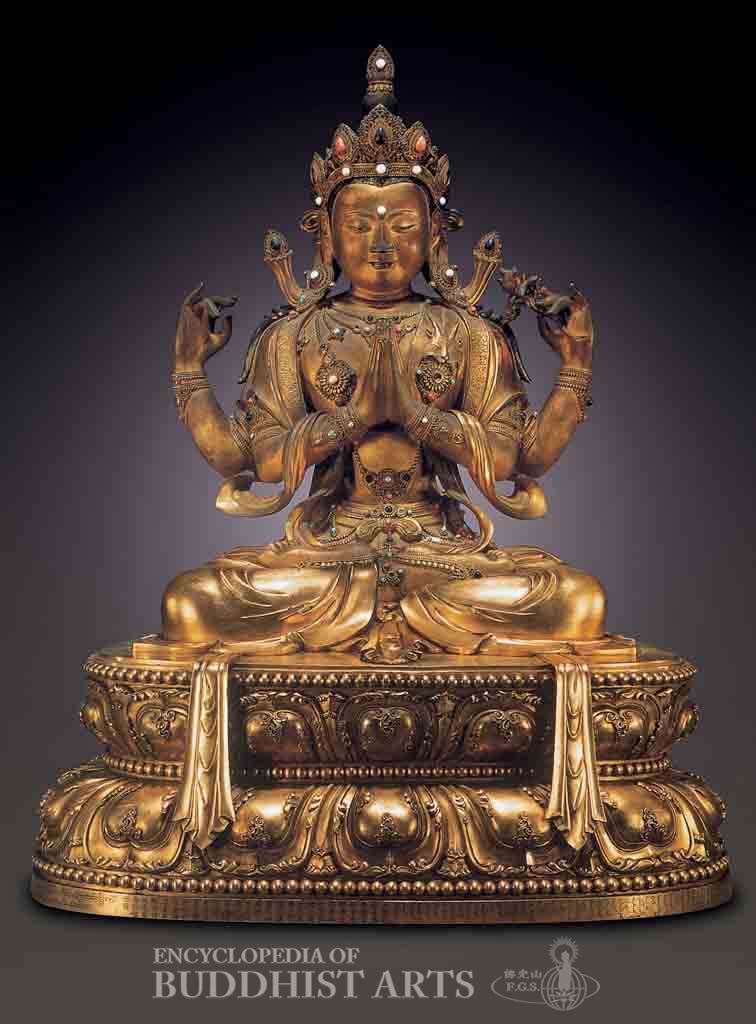
Four-Armed Avalokitesvara
Gilt copper alloy
Four-Armed Avalokitesvara
CHINA; Qing dynasty
This sculpture of Avalokitesvara is a richly detailed court treasure of the early Qing dynasty (1644–1911). The figure has a rounded, smiling face and wears a five-leaf crown decorated with gems. The chest is adorned with a necklace, a string bead ornament, and inlaid pearls and gems. The Bodhisattva’s main hands are held in the anjali (reverence) mudra while the left hand raised behind holds a lotus bud. What was most likely some prayer beads held in the right hand appears to be missing. The figure sits cross-legged and the material of the skirt has the natural folds seen on sculptures cast during the reign of Emperor Yongle (reigned 1402–1424) and Emperor Xuande (reigned 1425–1435) of the Ming dynasty (1368–1644). The lotus pedestal is rimmed with string beads and the rounded petals are decorated with cloud patterns. The silk stoles overhanging the pedestal are an element adopted on Tibetan Buddhist sculptures in China.
The lower rim of the pedestal is engraved with inscriptions in Chinese, Manchu, Mongolian, and Tibetan. The Chinese states that the sculpture was commissioned by Emperor Kangxi (reigned 1661–1722) of the Qing dynasty in 1686 for his grandmother, Grand Empress Dowager Xiaozhuang.
For more details, go to the Encyclopedia of Buddhist Arts: Sculpture A-F, page 350.
Cite this article:
author = Hsingyun and Youheng and Lovelock, Yann and Chou, Yuan and Huntington, Susan and Edson, Gary and Neather, Robert,
booktitle = {Encyclopedia of Buddhist Arts: Sculpture A-F},
pages = 350,
title = {{Four-Armed Avalokitesvara}},
volume = 10,
year = {2016}}