
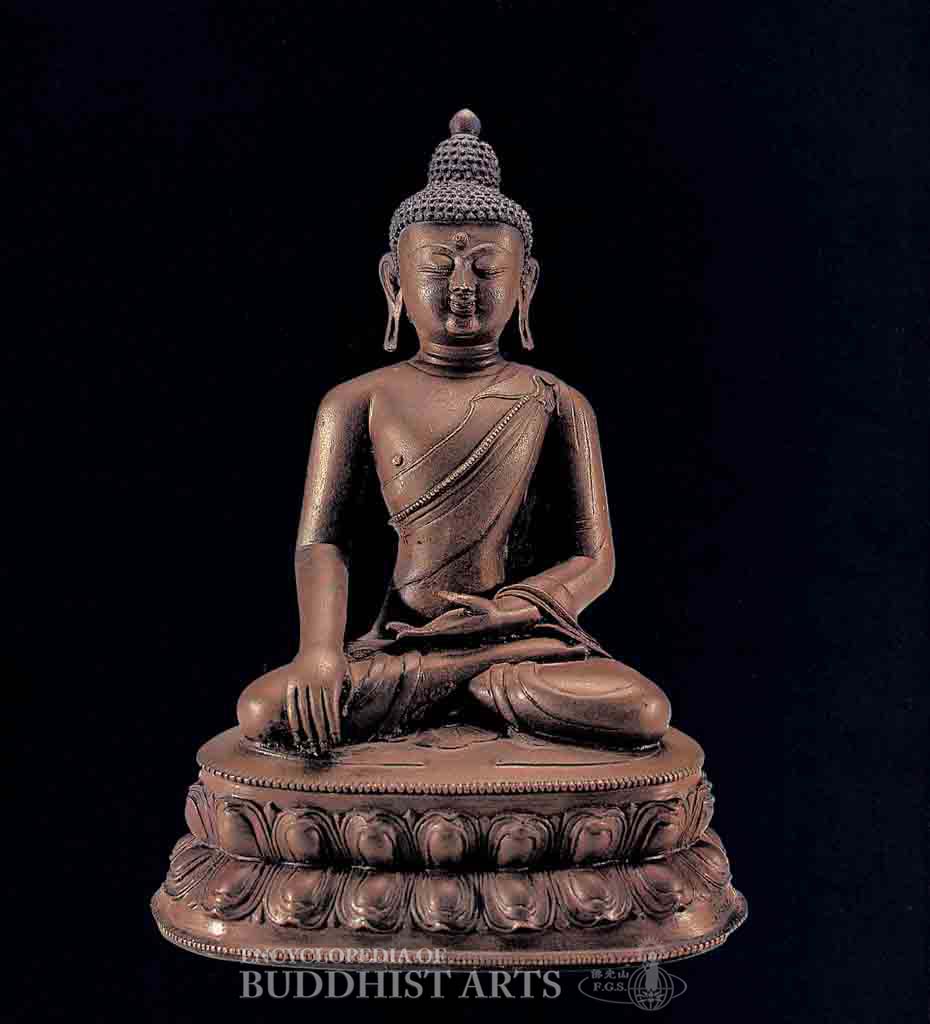
Sakyamuni Buddha
Brass
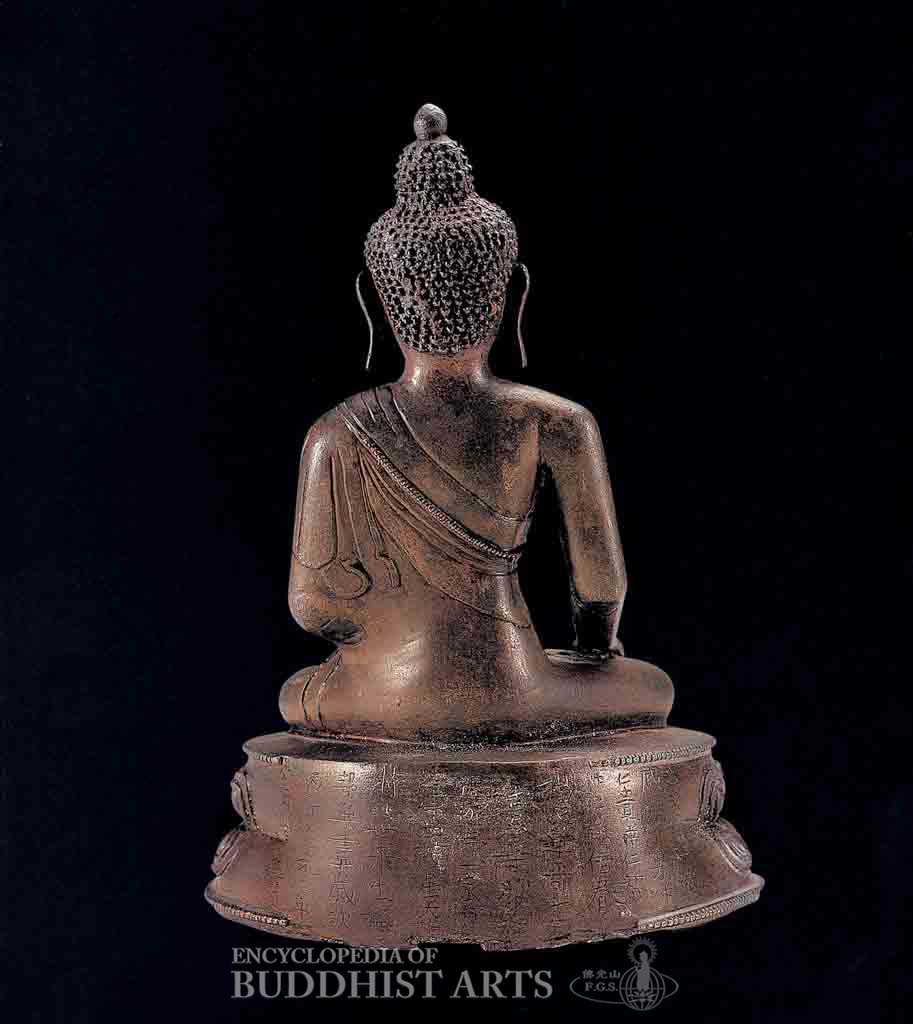
Sakyamuni Buddha (back)
Sakyamuni Buddha
CHINA; Yuan dynasty
This statue is an example of Chinese sculptures created during the 14th century that were influenced by the Tibetan style. An inscription on the back of the throne dates the statue to 1336, and explains it was commissioned by the monk Zhiwei and his family for protection and prosperity.
The Buddha sits in full lotus position with the right hand in the bhumisparsa (earth-touching) mudra and the left hand lying upwards on the lap. The statue’s facial features are youthful and closely grouped. The hair is tightly curled with a high, gem-crowned usnisa. The Buddha’s neck shows the three lines of a great person. Other physical characteristics of a Buddha include rounded shoulders and a broad chest emphasized by the slim waist. The monastic robe is worn over the left shoulder and adapts the Chinese style of smooth draping folds. The lotus pedestal has two reflective rows of overlapping petals and a beaded pattern lining the upper and lower rims.
For more details, go to the Encyclopedia of Buddhist Arts: Sculpture N-Sr, page 916.
Cite this article:
author = Hsingyun and Youheng and Lovelock, Yann and Chou, Yuan and Huntington, Susan and Edson, Gary and Neather, Robert,
booktitle = {Encyclopedia of Buddhist Arts: Sculpture N-Sr},
pages = 916,
title = {{Sakyamuni Buddha}},
volume = 12,
year = {2016}}