
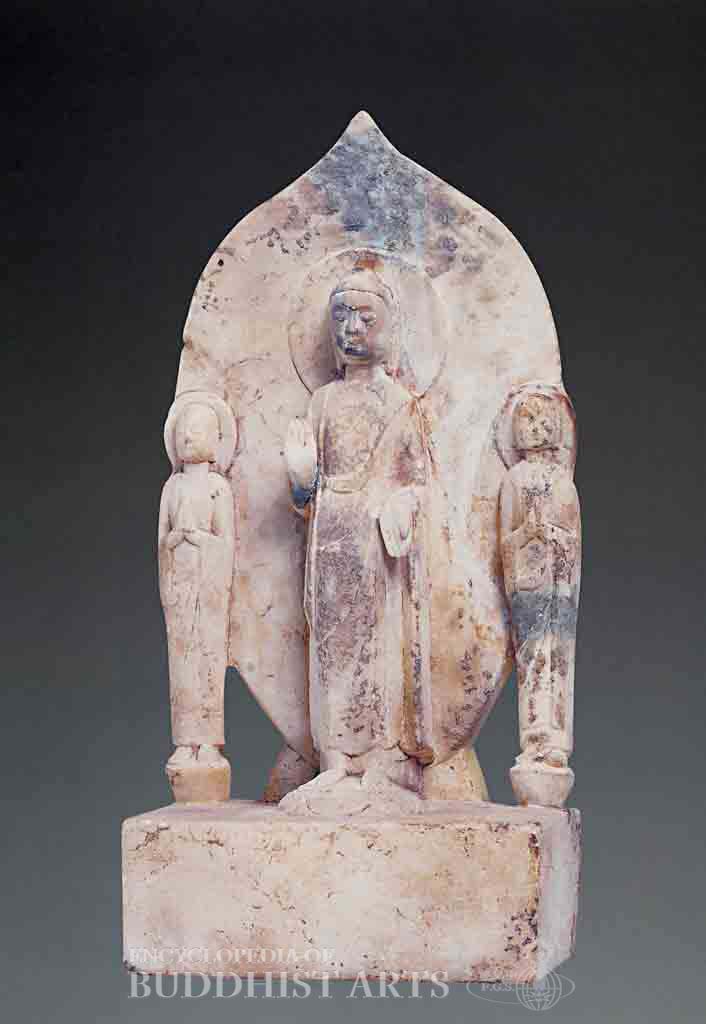
Xiude Temple: Amitabha Buddha Triad
Marble
Xiude Temple: Amitabha Buddha Triad
CHINA, Hebei, Baoding; Sui dynasty
The triad was unearthed from the site of Xiude Temple. The inscription on the back dates the statue to 591 and indicates Zhang Maoren as the donor who dedicated the merit of the sculpture’s making to his family members, whether they are living or deceased.
Amitabha Buddha and the two flanking Bodhisattvas stand on lotus pedestals that are supported on a plain rectangular base. Amitabha’s hands are in abhaya (fearlessness) and varada (wish-granting) mudras while the smaller figures on either side have their hands in anjali (reverence) mudra. A large plain mandorla rises behind the Buddha on which the plain unadorned nimbuses are carved in relief.
For more details, go to the Encyclopedia of Buddhist Arts: Sculpture St-Z, page 1384.
Cite this article:
Hsingyun, et al. "Xiude Temple: Amitabha Buddha Triad." Encyclopedia of Buddhist Arts: Sculpture St-Z, vol. 13, 2016, pp. 1384.
Hsingyun, Youheng, Yann Lovelock, Yuan Chou, Susan Huntington, Gary Edson, and Robert Neather. 2016. "Xiude Temple: Amitabha Buddha Triad" In Encyclopedia of Buddhist Arts: Sculpture St-Z, 13:1384.
Hsingyun, Youheng, Lovelock, Y., Chou, Y., Huntington, S., Edson, G., & Neather, R.. (2016). Xiude Temple: Amitabha Buddha Triad. In Encyclopedia of Buddhist Arts: Sculpture St-Z (Vol. 13, pp. 1384).
@misc{Hsingyun2016,
author = Hsingyun and Youheng and Lovelock, Yann and Chou, Yuan and Huntington, Susan and Edson, Gary and Neather, Robert,
booktitle = {Encyclopedia of Buddhist Arts: Sculpture St-Z},
pages = 1384,
title = {{Xiude Temple: Amitabha Buddha Triad}},
volume = 13,
year = {2016}}
author = Hsingyun and Youheng and Lovelock, Yann and Chou, Yuan and Huntington, Susan and Edson, Gary and Neather, Robert,
booktitle = {Encyclopedia of Buddhist Arts: Sculpture St-Z},
pages = 1384,
title = {{Xiude Temple: Amitabha Buddha Triad}},
volume = 13,
year = {2016}}