
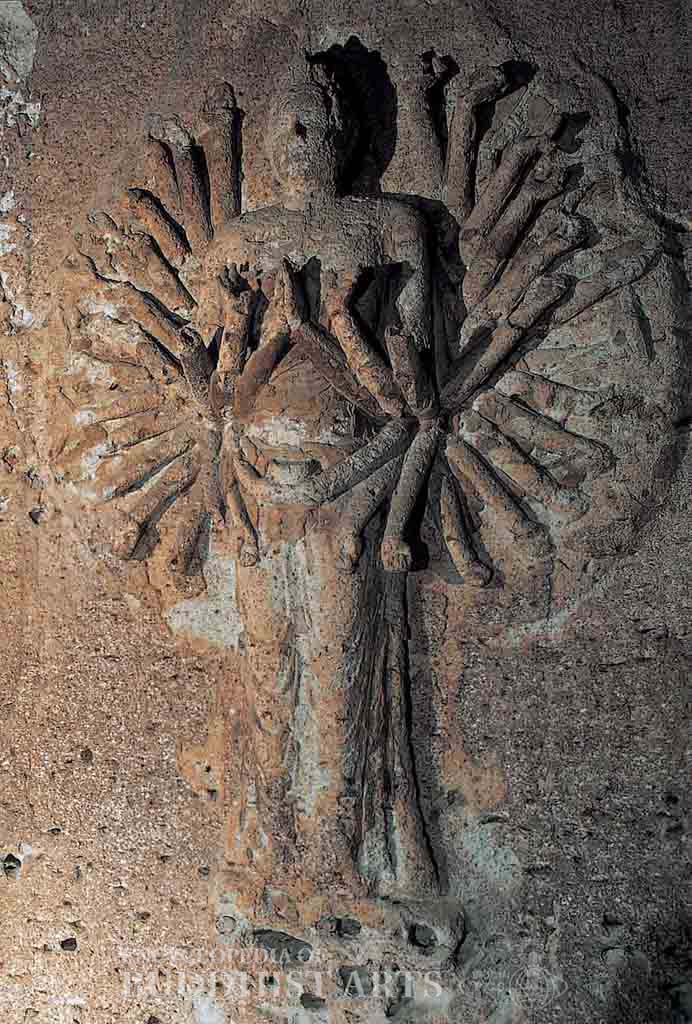
Oyaji Temple Cave: Niche 1 - Thousand-Armed Avalokitesvara
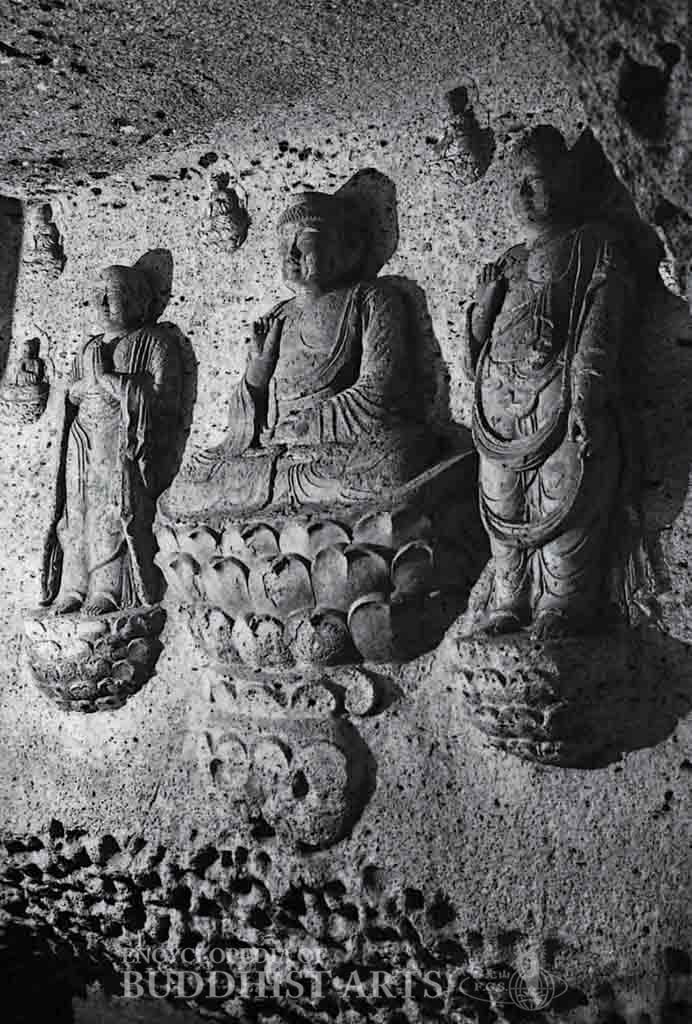
Oyaji Temple Cave: Niche 4 - Amitabha Buddha Triad
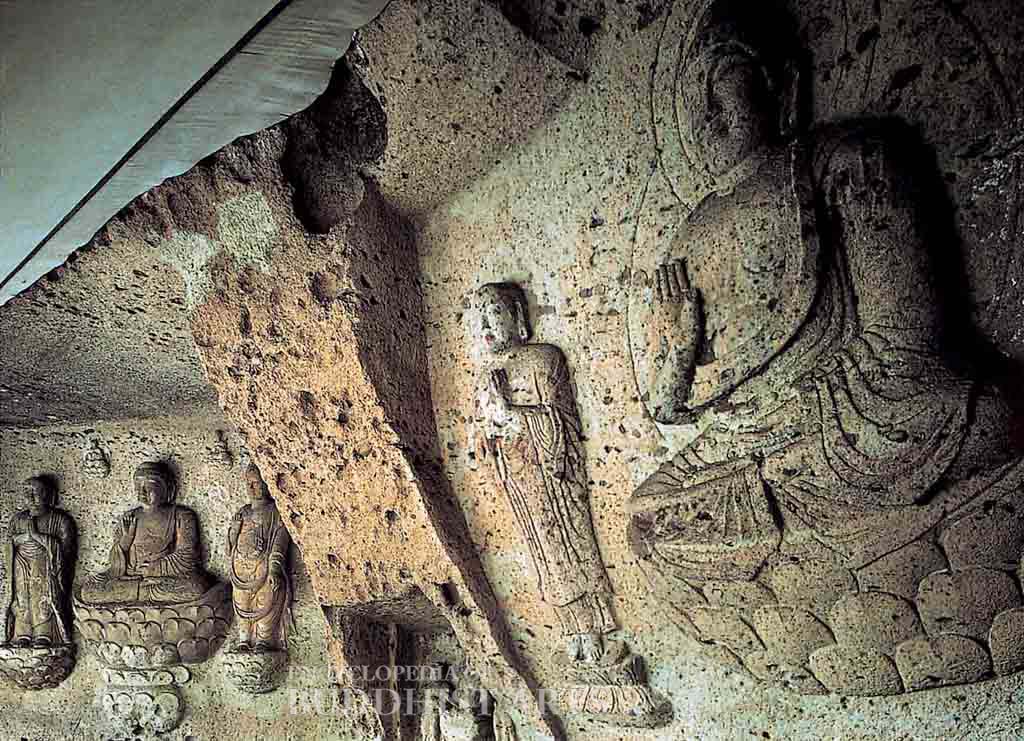
Oyaji Temple Cave: Niches 2, 3, and 4
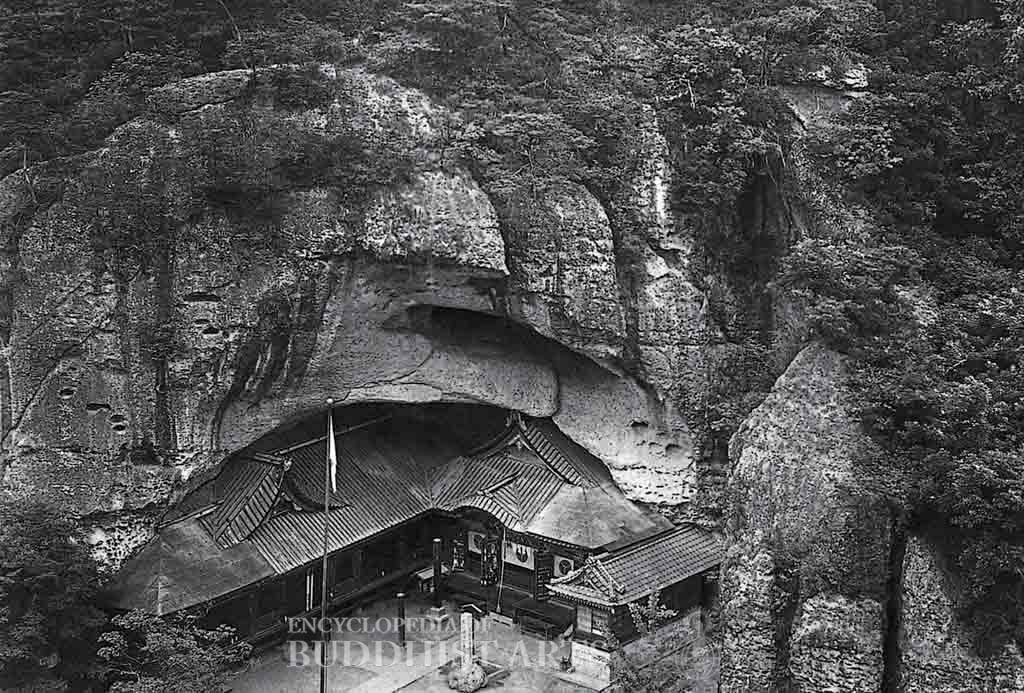
Oyaji Temple Cave
Oyaji Temple Cave
JAPAN, Tochigi, Utsunomiya
The temple cave is located in the southwest of Mount Otome near the town of Utsunomiya, Tochigi. Construction began in the Heian period (794–1185). The natural rock was used to carve high relief figures within four separate niches. There is a standing Thousand-Armed Avalokitesvara Bodhisattva, a Sakyamuni Buddha Triad, a Medicine Buddha Triad, and an Amitabha Buddha Triad. The temple is listed as an Important Cultural Property and a National Buddhist Treasure.
The Thousand-Armed Avalokitesvara in Niche 1 is the work of Master Kukai from 810 of the early Heian period. It has long been referred to as the Avalokitesvara of Oya. The statue is located in the center of the west cliff. The Bodhisattva has a mandorla behind the body and the hands extend outwards on both sides. The figure was originally painted in gold; however, a fire during the Edo period (1615–1868) caused the outer layers of clay to peel from the statue, exposing the stone beneath. The face is narrow and long, and the body is rich in detail, with the folds of the clothing still distinct. The figure is well proportioned and elegant.
A seated Sakyamuni Buddha with a double-tier nimbus and an aureole is located within Niche 2. The Buddha forms a mudra with the right hand and is seated in full lotus position on a multi-tier lotus throne. A standing Bodhisattva is on the right, and on the left is a monk. The facial features, folds of the clothing, and chest ornaments are carved in bas-relief.
Niche 3 is much smaller and carved in the lower section between Niches 2 and 4. The sculptures are thought to be among the earliest artworks within the Oyaji Temple Cave. The stone has been severely weathered and the clay that once covered the sculptures has peeled away, rendering the details almost indecipherable. The central figure is believed to be the Medicine Buddha.
Niche 4 contains Amitabha Buddha flanked by Avalokitesvara and Ksitigarbha Bodhisattvas. Amitabha Buddha, 2.66 m in height, is seated in full lotus position on a lotus throne. The right hand is raised and the left hand is placed in front of the abdomen. Ksitigarbha, measuring 3.91 m, stands to the left of the Buddha, and Avalokitesvara, measuring 3.36 m, stands to right. Images of six Buddhas, three of which are in high relief, are depicted on the upper section of the wall.
For more details, go to the Encyclopedia of Buddhist Arts: Caves Mo-S, page 1294.
Cite this article:
author = Hsingyun and Youheng and Johnson, Peter and Mankuang and Huntington, Susan and Edson, Gary and Neather, Robert,
booktitle = {Encyclopedia of Buddhist Arts: Caves Mo-S},
pages = 1294,
title = {{Oyaji Temple Cave}},
volume = 8,
year = {2016}}