
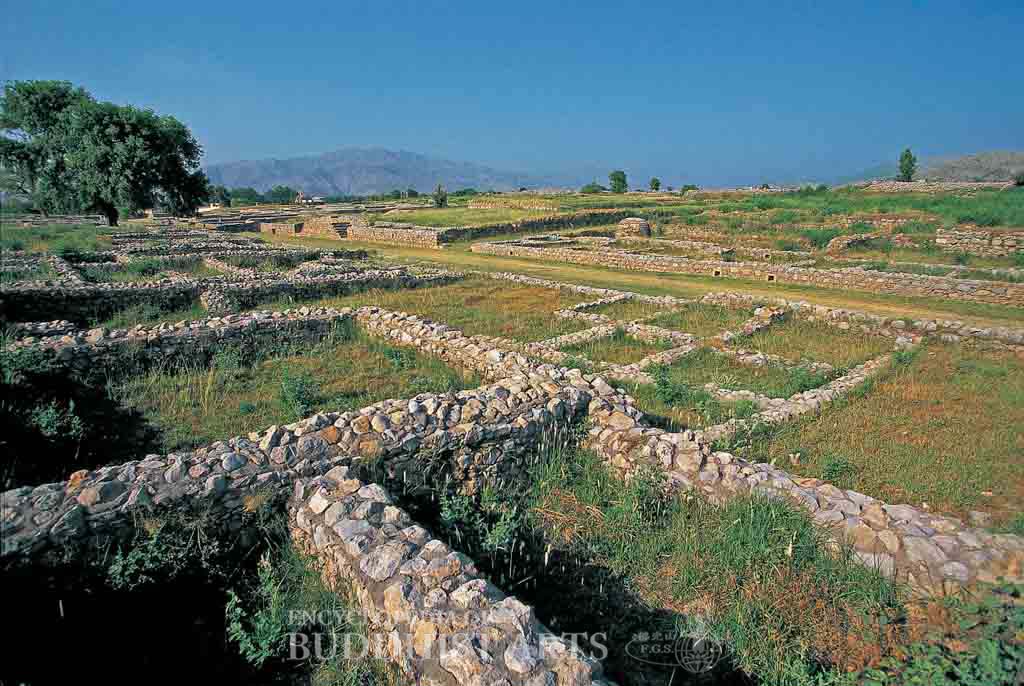
Taxila Sirkap

Taxila Sirkap: Block F - Two-Headed Eagle Stupa

Taxila Sirkap: Block F - Two-Headed Eagle Stupa (detail)
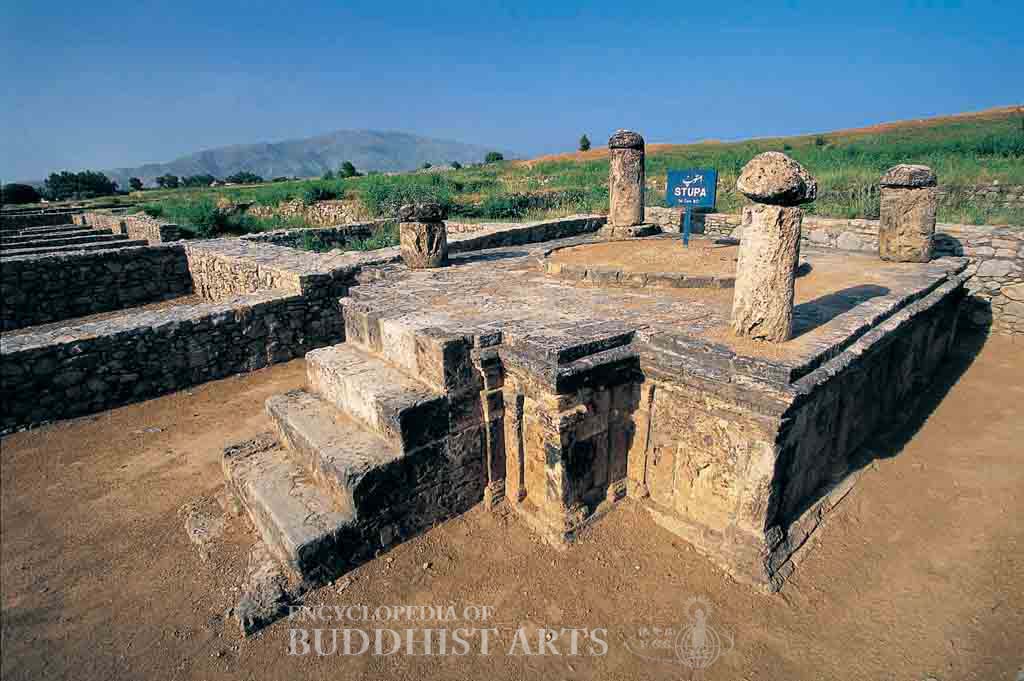
Taxila Sirkap: Block G - Square Base
Taxila Sirkap
PAKISTAN, Punjab, Taxila
Sirkap was founded by Greco-Bactrians in the 2nd century BCE and rebuilt by the Scythians and Parthians in the period 20 to 30 CE. As part of Taxila, it was listed as a UNESCO World Heritage Site in 1980.
The north-facing site has a city wall approximately 5.4 km long. The flat area to the north was the lower city district and has been the main site of excavations. The district is laid out in a grid pattern with a main avenue running north-south and 13 intersecting streets running east-west. There are many buildings on both sides of the main avenue organized neatly in street blocks. The blocks are designated A to L from north to south except for those immediately adjacent to the north wall. The extant buildings include a number of temples, several stupas, Surya Temple, many residences, and a royal palace.
The Two-Headed Eagle Stupa on the east side of Block F now only consists of a square base platform and stairs. The walls of the base platform are intricately carved with Corinthian pilasters placed between niches. Each niche contains a miniature gateway in a different design. The gateway in one of the niches resembles that of the Sanchi Stupa in India and is sculpted with two columns and two arched lintels, surmounted by an eagle. Another niche has the arched doorway of an Indian caitya, with a horseshoe-shape lintel and a double-headed eagle standing on top. Another has a Greek temple doorway with a triangular pediment.
The stupa on the east side of Block G has only a square base with steps and a damaged compound wall. The base has a T-shape plan with steps projecting from the front. The side walls are divided into several niches by pilasters. The pilasters are finely sculpted in relief with column bases, bodies, and capitals together with corbeling and bracket sets, all in imitation of a carved wooden structure. There are architraves that span the columns, while bas-reliefs fill the niches. Remnants of stone columns are found on the four corners of the stupa base. The stupa is surrounded by a rectangular wall with steps, but there is no trace of another stupa compound or monastery. Since it is located by the main road, it is possible that the stupa may just have been a place for travelers to venerate the Buddha, but was not part of a temple or monastery.
The appearance of both Indian and Greek styles in a standalone Buddhist stupa exemplifies the syncretic quality of Gandharan architecture.
For more details, go to the Encyclopedia of Buddhist Arts: Architecture T-Z, page 1099.
Cite this article:
author = Hsingyun and Youheng and Johnson, Peter and Mankuang and Lancaster, Lewis,
booktitle = {Encyclopedia of Buddhist Arts: Architecture T-Z},
pages = 1099,
title = {{Taxila Sirkap}},
volume = 4,
year = {2016}}