
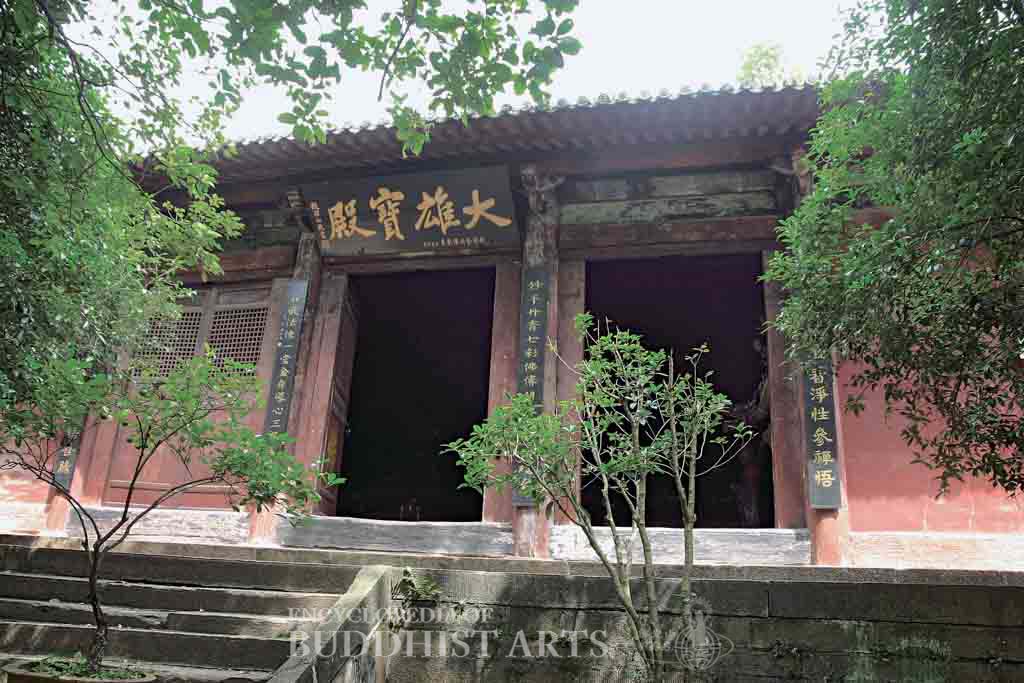
Jueyuan Temple: Great Hero Hall
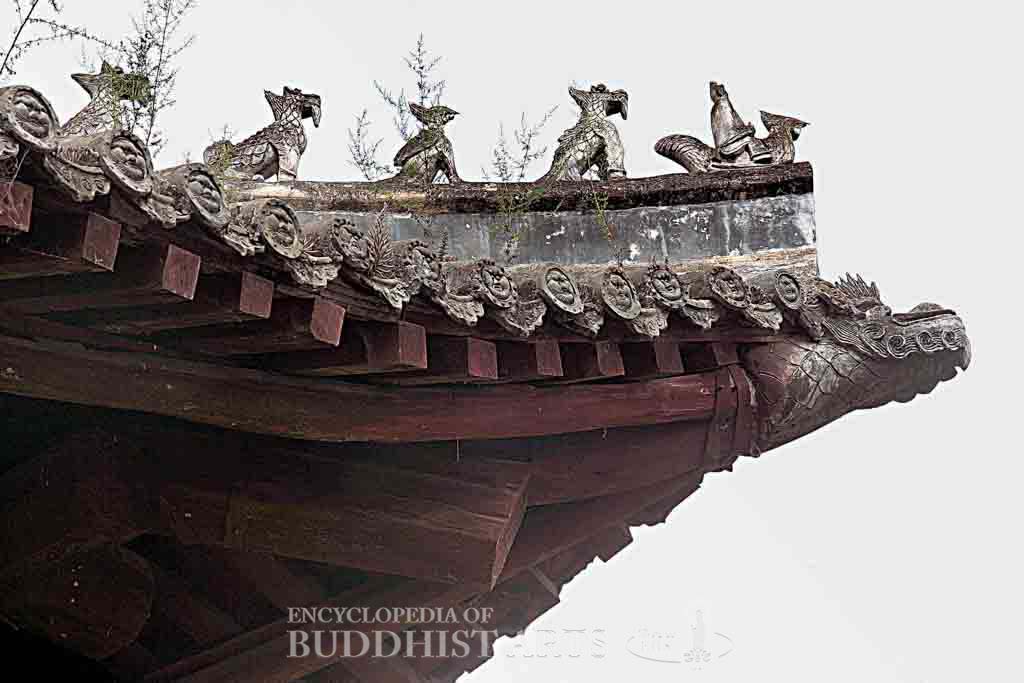
Jueyuan Temple: Great Hero Hall - Corner of Roof
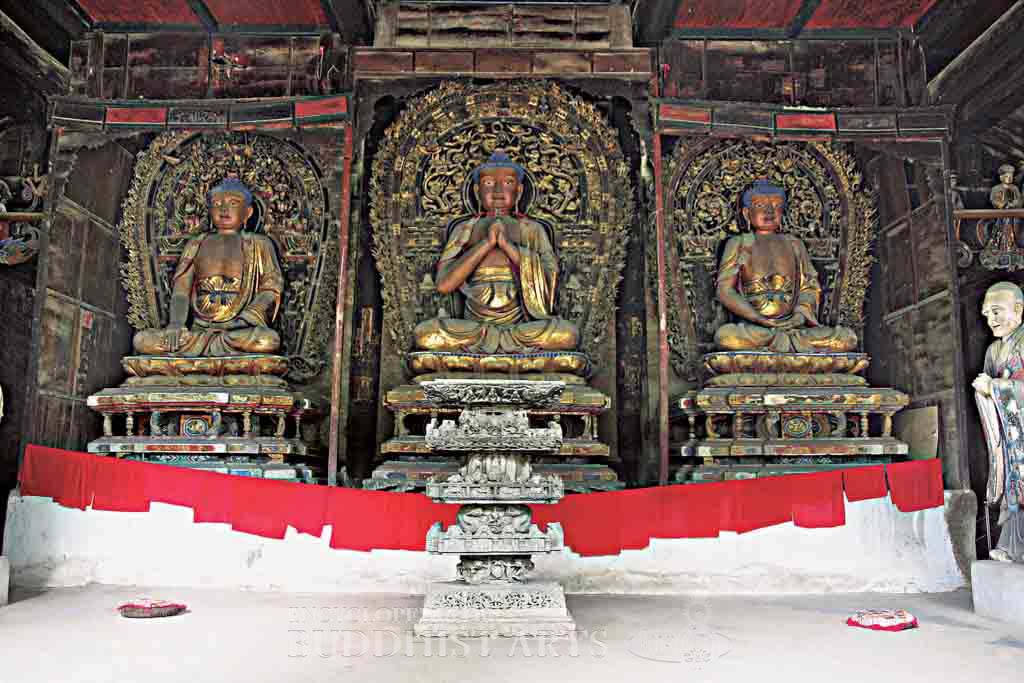
Jueyuan Temple: Great Hero Hall (interior)
Jueyuan Temple
CHINA, Sichuan, Guangyuan
Jueyuan means Awakening Garden. The temple was constructed during the rule of Emperor Xianzong (reigned 806–820) of the Tang dynasty. The sutra repository was constructed during the Southern Song dynasty (1127–1279). The temple was destroyed at the end of the Yuan dynasty (1271–1368) and it was not rebuilt until the middle of the Ming dynasty (1368–1644), when it acquired its present layout. It was listed as a National Cultural Heritage Site in 2001.
The temple faces south, occupies 3,200 sq m, and has multiple courtyards. The sutra repository is located at the front, the Great Hero Hall is in the center, and the Avalokitesvara Hall is at the back. There are perfectly preserved subsidiary buildings on either side. The five-bay wide Great Hero Hall has a single-eave hip-and-gable roof. Inside the building, there are the Sakyamuni, Amitabha, and Medicine Buddhas, Twenty-Four Heavenly Beings carved in wood, and sculptures of Mahakasyapa and Ananda, all created during the Ming dynasty. In the center, there is a square, stone incense burner created in 1492. Apart from the three central bays on the south wall and the central bay on the north wall, which are filled with lattice doors, the remaining walls contain 14 murals occupying 139.8 sq m. There are 209 separate scenes all depicting in detail the Buddha’s life from his birth to his parinirvana, as well as important events such as the distribution of relics among the eight kings, the First Buddhist Council, the construction of stupas by King Asoka (reigned circa 269–232 BCE) of Maurya, and the spread of Buddhism to the east. These are the most complete and extensive Ming dynasty murals detailing the Life of the Buddha.
The five-by-three bay sutra repository has a double-eave hip-and-gable roof. There are no bracket sets supporting the roof, which is an unusual feature. There were originally statues of the Four Heavenly Kings enshrined in the hall, so it is also called the Heavenly King Hall. However, these statues no longer exist.
For more details, go to the Encyclopedia of Buddhist Arts: Architecture G-L, page 558.
Cite this article:
author = Hsingyun and Youheng and Johnson, Peter and Mankuang and Lancaster, Lewis,
booktitle = {Encyclopedia of Buddhist Arts: Architecture G-L},
pages = 558,
title = {{Jueyuan Temple}},
volume = 2,
year = {2016}}