
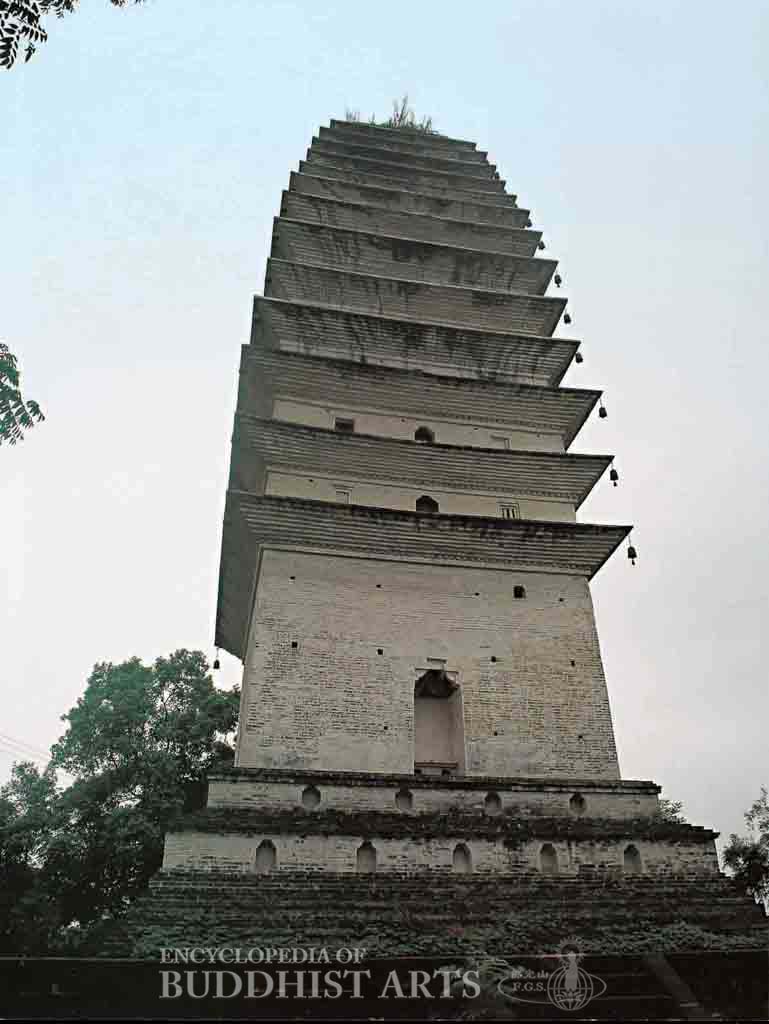
Lingyun Temple Lingbao Pagoda
Lingyun Temple Lingbao Pagoda
CHINA, Sichuan, Leshan
Lingbao means Spiritual Treasure. The pagoda is named after the nearby mountain peak. It stands behind the Leshan Giant Buddha. Judging from the structure of the pagoda, it was constructed during the Song dynasty (960–1279). It was repaired during the Ming (1368–1644) and Qing (1644–1911) dynasties, and subsequently listed as a Provincial Cultural Heritage Site in 1980.
The 13-tier, square, hollow, brick pagoda is 40 m high. The base has two layers which have empty trapezoidal arch niches. The entrance is on the west side of the first tier. The remaining three sides have false doors. The eaves are in the form of corbeling, which is followed by a course of dogtooth bricks. Wind chimes hang from every corner of the eaves. On each side of every tier there is a trapezoidal arch niche and two vertical bar windows. The roof of the pagoda is pyramidal and the spire no longer exists.
For more details, go to the Encyclopedia of Buddhist Arts: Architecture G-L, page 677.
Cite this article:
author = Hsingyun and Youheng and Johnson, Peter and Mankuang and Lancaster, Lewis,
booktitle = {Encyclopedia of Buddhist Arts: Architecture G-L},
pages = 677,
title = {{Lingyun Temple Lingbao Pagoda}},
volume = 2,
year = {2016}}