
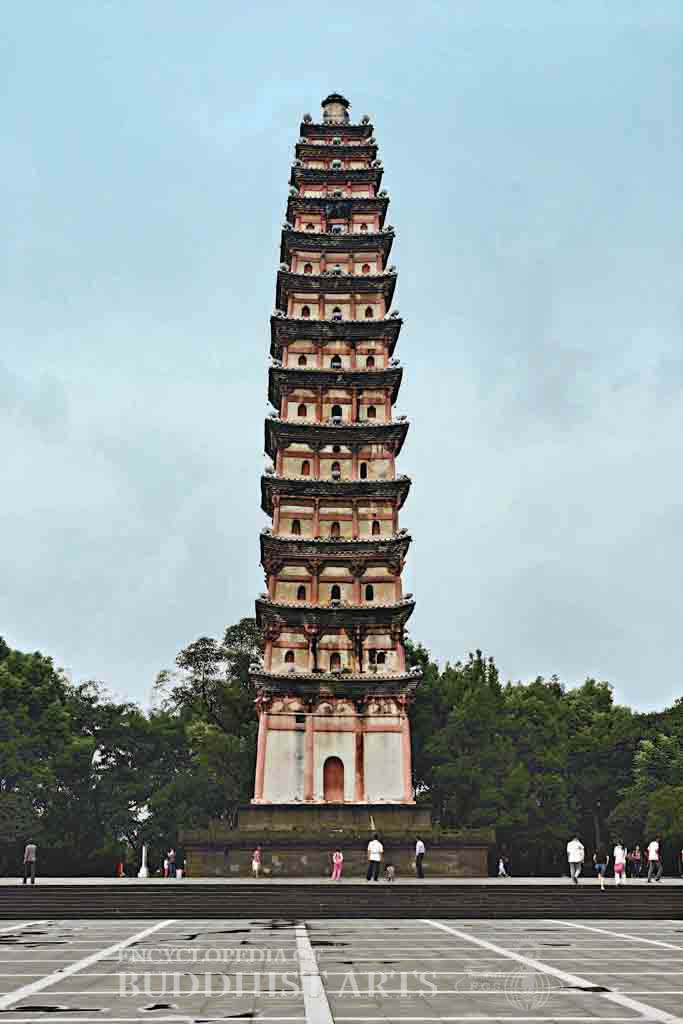
Nanchong White Pagoda
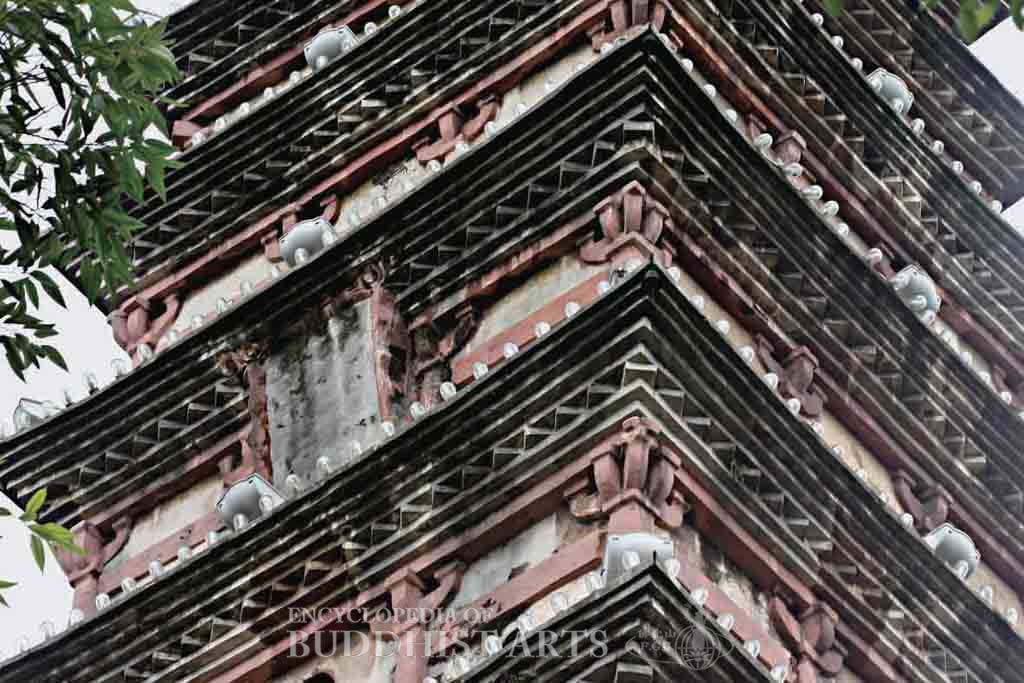
Nanchong White Pagoda (detail)
Nanchong White Pagoda
CHINA, Sichuan, Nanchong
The pagoda is situated on Hemingshan (Crane Cry Mountain). It was constructed during the rule of Emperor Taizu (reigned 960–976) of the Northern Song dynasty and is one of Sichuan’s rare Song dynasty (960–1279) pagodas. It was listed as a National Cultural Heritage Site in 2006.
The 13-story, square, brick pagoda is 37.1 m high. The base consists of stone slabs. The architectural elements, such as the architraves and bracket sets, are constructed from gray brick. Each wall is separated into three bays by pilasters. The eaves consist of corbeling with a course of dogtooth bricks below. From the second to tenth stories, the walls contain 108 niches that once housed Buddha statues. The pagoda is hollow and access can be gained from the first story. From the first to fourth stories there is a spiral staircase. The spire is incomplete and consists of an inverted bowl with a cast-iron canopy.
For more details, go to the Encyclopedia of Buddhist Arts: Architecture M-S, page 780.
Cite this article:
author = Hsingyun and Youheng and Johnson, Peter and Mankuang and Lancaster, Lewis,
booktitle = {Encyclopedia of Buddhist Arts: Architecture M-S},
pages = 780,
title = {{Nanchong White Pagoda}},
volume = 3,
year = {2016}}