
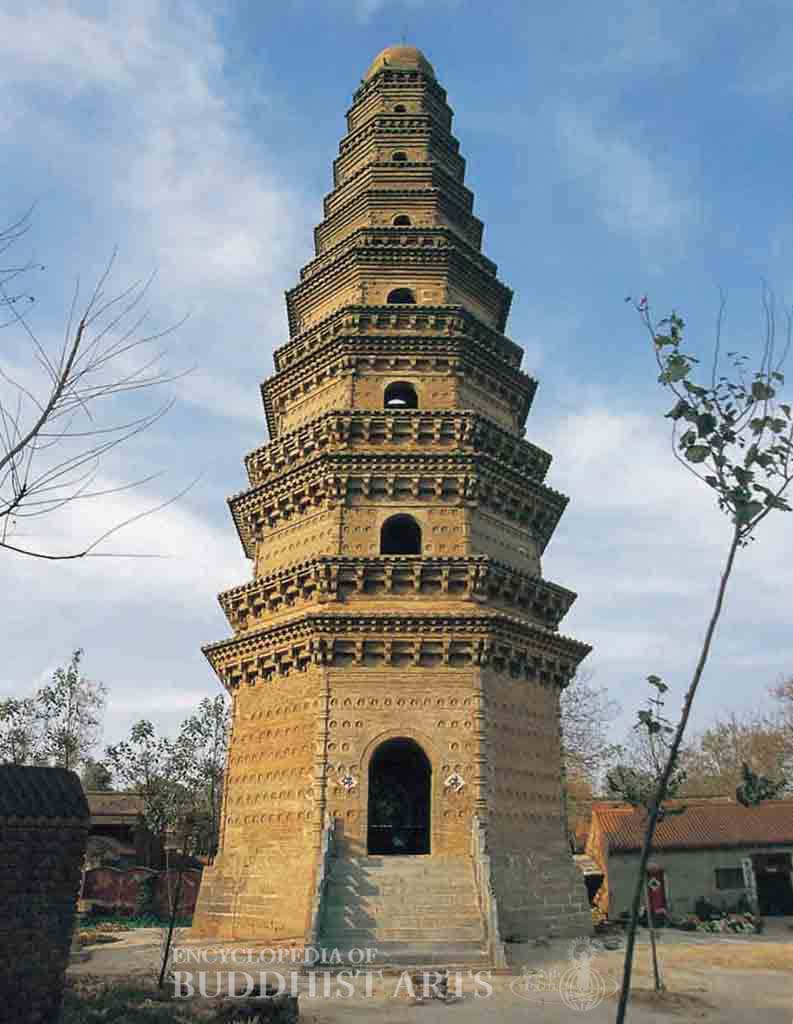
Mingfu Temple Pagoda
Mingfu Temple Pagoda
CHINA, Henan, Anyang
The pagoda was built on the grounds of Mingfu Temple, which no longer exists. Judging from its design and the artifacts found within, it is believed to have been constructed during the early Northern Song dynasty (960–1127). The pagoda was once nine stories high but a lightning strike reduced it to five stories. Repairs were carried out in 1929 and two extra stories were added. It was listed as a National Cultural Heritage Site in 2001.
The seven-story, octagonal brick pagoda is 43 m high. The diameter of the building decreases with height producing a tapered curved effect. The base is 2.4 m high and constructed from blue limestone. On the south side there are steps leading up to the entrance of the pagoda. Altogether the pagoda body and the spire are constructed from more than 70 different types of gray bricks. There used to be stairs leading to the fifth story. There is a single arched doorway on the south side of the first story, while on the remaining stories there is an arched doorway on each side facing the four cardinal directions. False lattice windows are found on the remaining sides from the fifth to seventh story. Small, round, shallow niches with seated Buddhas cover the exterior walls, so it is also known as the Thousand Buddha Pagoda. At the corners on every story there are bamboo-like pilasters interspersed with lotuses. This type of design is rarely seen on other pagodas. The eaves are supported by bracket sets. The spire is in the form of an inverted bowl.
For more details, go to the Encyclopedia of Buddhist Arts: Architecture M-S, page 739.
Cite this article:
author = Hsingyun and Youheng and Johnson, Peter and Mankuang and Lancaster, Lewis,
booktitle = {Encyclopedia of Buddhist Arts: Architecture M-S},
pages = 739,
title = {{Mingfu Temple Pagoda}},
volume = 3,
year = {2016}}