
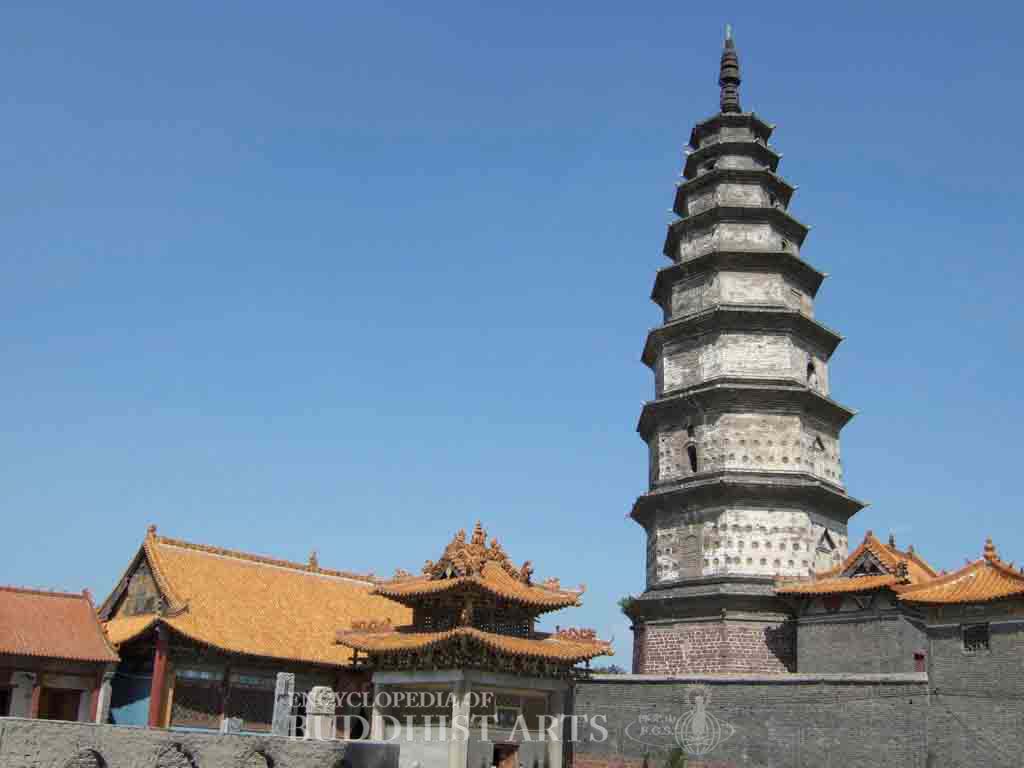
Xiangshan Temple Avalokitesvara Pagoda
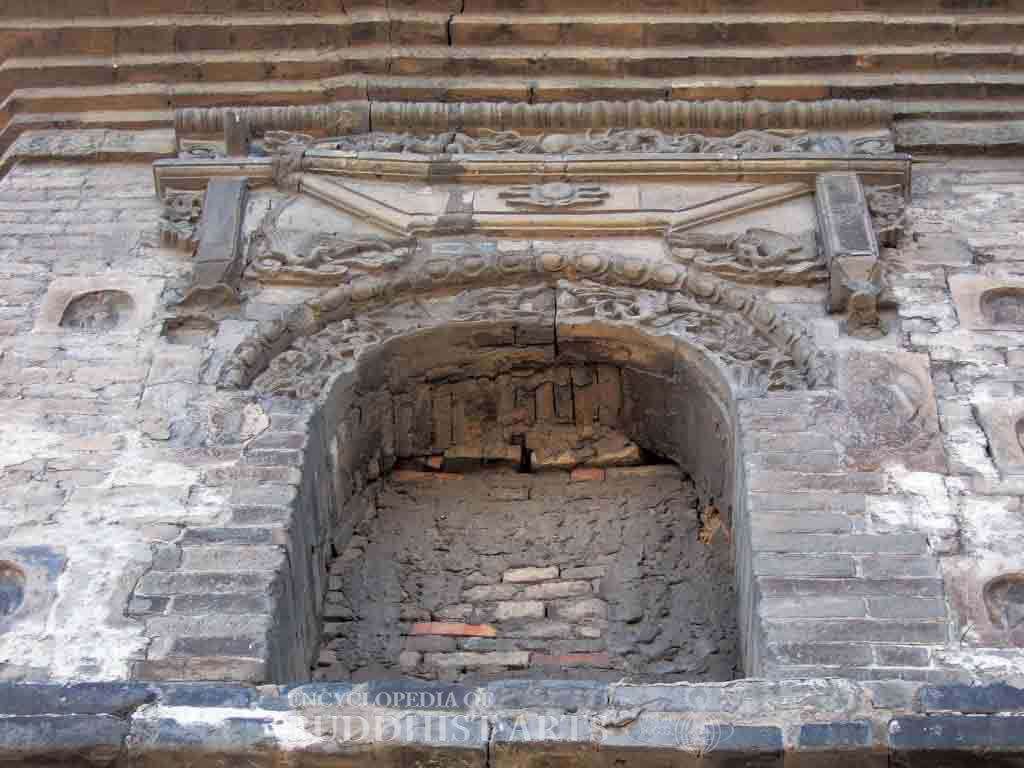
Xiangshan Temple Avalokitesvara Pagoda (detail)
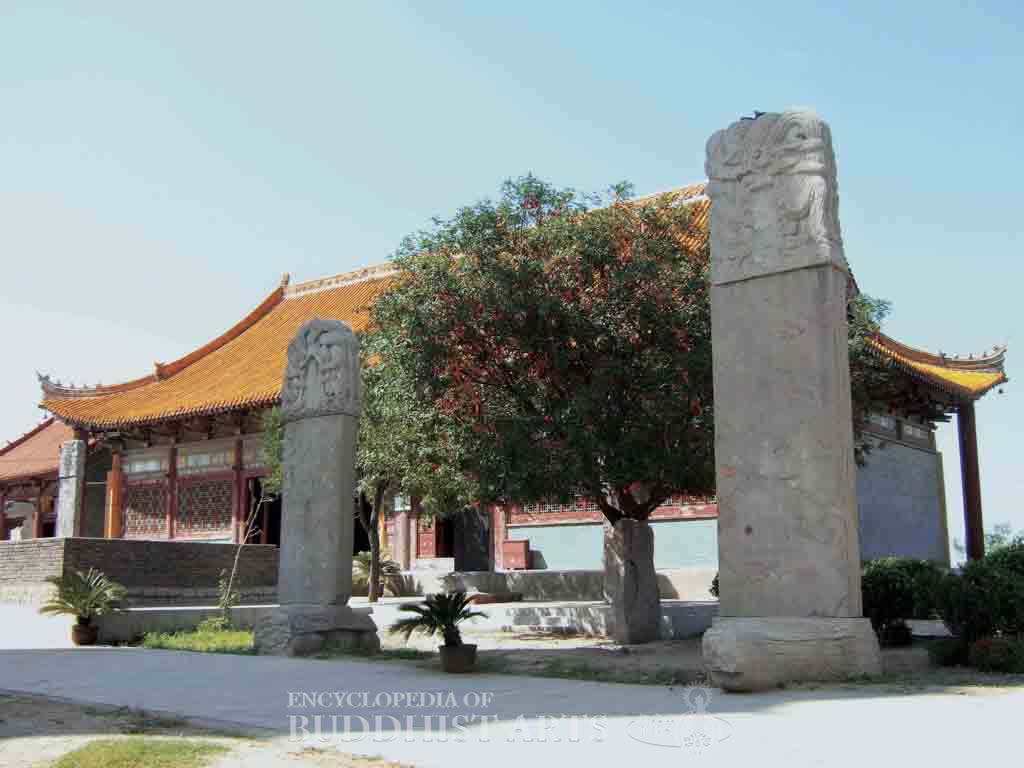
Xiangshan Temple Avalokitesvara Pagoda: Steles
Xiangshan Temple Avalokitesvara Pagoda
CHINA, Henan, Pingdingshan
The pagoda is located on the grounds of Xiangshan (Fragrant Mountain) Temple. It was originally built in 181 during the Eastern Han dynasty, but the existing building was reconstructed in 1068 during the Northern Song dynasty. The pagoda is listed as a Provincial Cultural Heritage Site.
The nine-story, octagonal, brick pagoda is built on a 3 m high square base. In the first story, there is a shrine housing a standing statue of the Thousand-Armed, Thousand-Eyed Avalokitesvara Bodhisattva. The walls on the second and third stories of the pagoda have numerous niches containing Buddhas, Bodhisattvas, and Arhats. The remaining stories are unadorned and constructed with brick. The pyramidal roof is surmounted by an iron spire consisting of an inverted bowl, stacked rings, a canopy, and jewel.
Behind the pagoda there is a large limestone stele erected in 1100 during the Northern Song dynasty. It was inscribed by the famous calligrapher Cai Jing and states that Miaoshan, the third daughter of King Zhuang (reigned 613–591 BCE) of Chu, was a manifestation of Avalokitesvara Bodhisattva. She attained enlightenment on Xiangshan and her relics are buried beneath the pagoda.
For more details, go to the Encyclopedia of Buddhist Arts: Architecture T-Z, page 1313.
Cite this article:
author = Hsingyun and Youheng and Johnson, Peter and Mankuang and Lancaster, Lewis,
booktitle = {Encyclopedia of Buddhist Arts: Architecture T-Z},
pages = 1313,
title = {{Xiangshan Temple Avalokitesvara Pagoda}},
volume = 4,
year = {2016}}