
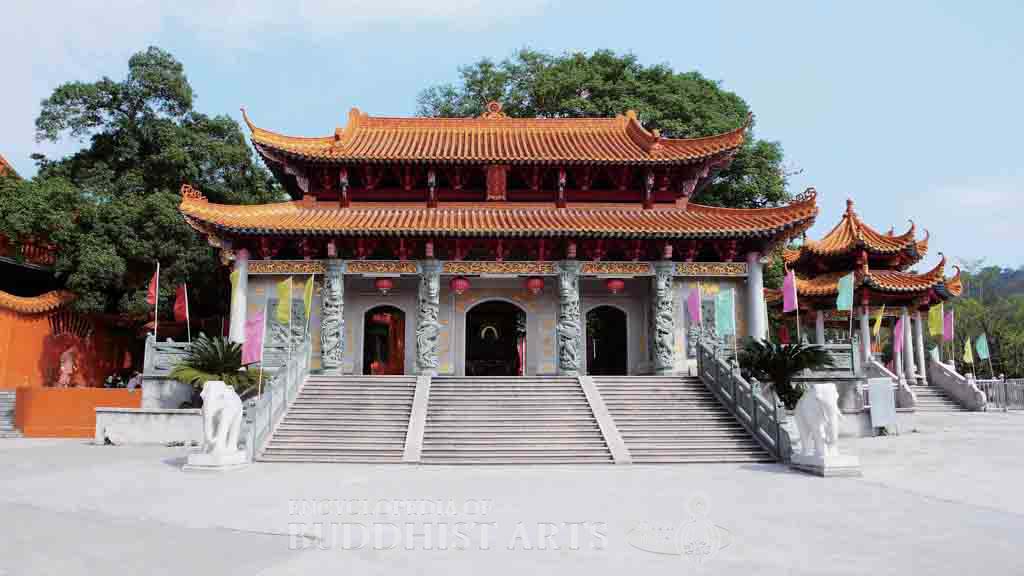
Lingshan Temple: Inner Temple Gate
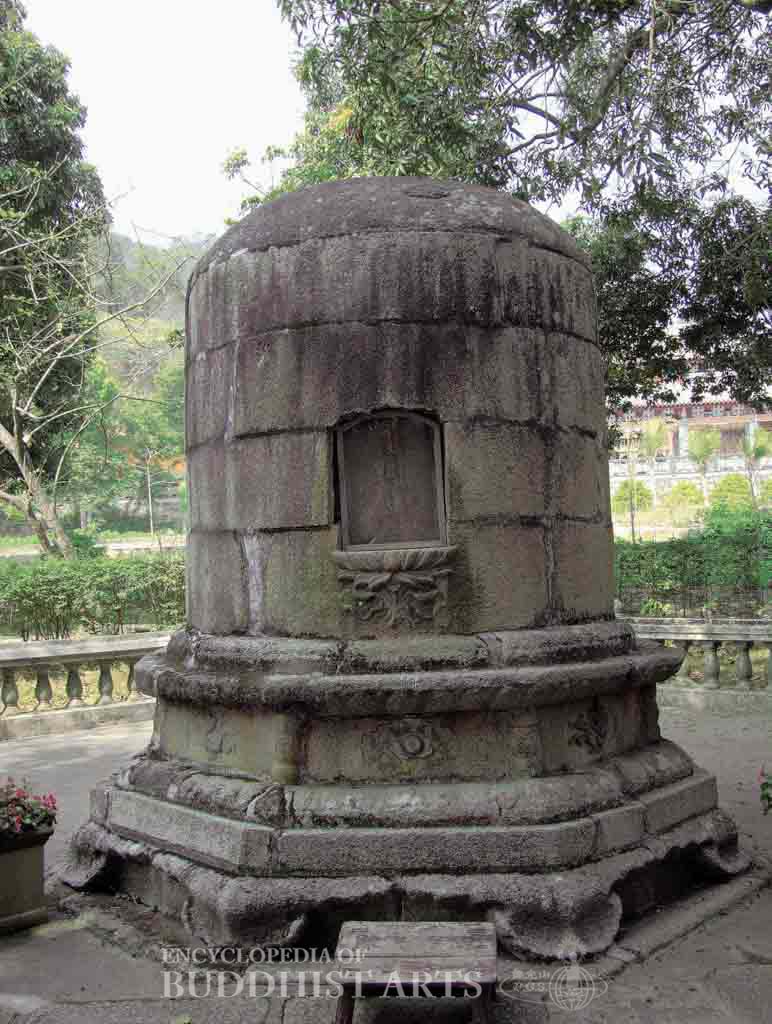
Lingshan Temple: Shejing Stupa
Lingshan Temple
CHINA, Guangdong, Shantou
Lingshan means Spiritual Peak, which refers to Vulture Peak in India. The temple was founded in 791 during the Tang dynasty by Chan Master Dadian, a third generation disciple of Master Huineng, the Sixth Chan Patriarch. The temple flourished and declined many times until the Qing dynasty when it underwent reconstruction between 1701 and 1706. The newly reconstructed temple consisted of three large courtyards, six medium-sized courtyards and nine small yards. The existing buildings were again reconstructed in 1980 based on the Qing dynasty layout. The temple was listed as a key Buddhist temple in the Han region of China in 1983.
The temple occupies 5,000 sq m and consists of an outer temple gate, inner temple gate, Avalokitesvara Hall, Great Hero Hall, Master Dadian Memorial Hall, and the sutra repository. Apart from the main buildings, there is also a series of structures collectively known as the Eight Sites of Lingshan: Shejing (Tongue Mirror) Stupa, Liuyi (Left Behind Clothing) Pavilion, Bamu (Removing Wood) Wall, Xiujing (Copying Sutra) Platform, Zhusheng (Praying for Emperor) Stele, Kaishan (Revealing Kindness) Repository, Baishi (White Stone) Trough, and Qianye Guo (Thousand Fruits of Karma). The names of these sites describe important events in Master Dadian’s life. In 1991 the Thousand Buddha Pagoda was built at the rear of the temple.
The inner temple gate was constructed in 2000. It has a double-eave hip-and-gable roof and is five bays wide. Four of the six columns have carvings of dragons in stone. The Shejing Stupa is constructed from 78 blocks of granite. It is 2.8 m high and the widest part is 1.8 m. Its octagonal Sumeru-shaped base is engraved with decorations of floral patterns, dragons, and animals. The pagoda body is in the form of an inverted bowl with a rectangular niche located at the front. The niche is engraved with the words “Stupa of Master Dadian from the Tang dynasty.”
For more details, go to the Encyclopedia of Buddhist Arts: Architecture G-L, page 667.
Cite this article:
author = Hsingyun and Youheng and Johnson, Peter and Mankuang and Lancaster, Lewis,
booktitle = {Encyclopedia of Buddhist Arts: Architecture G-L},
pages = 667,
title = {{Lingshan Temple}},
volume = 2,
year = {2016}}