
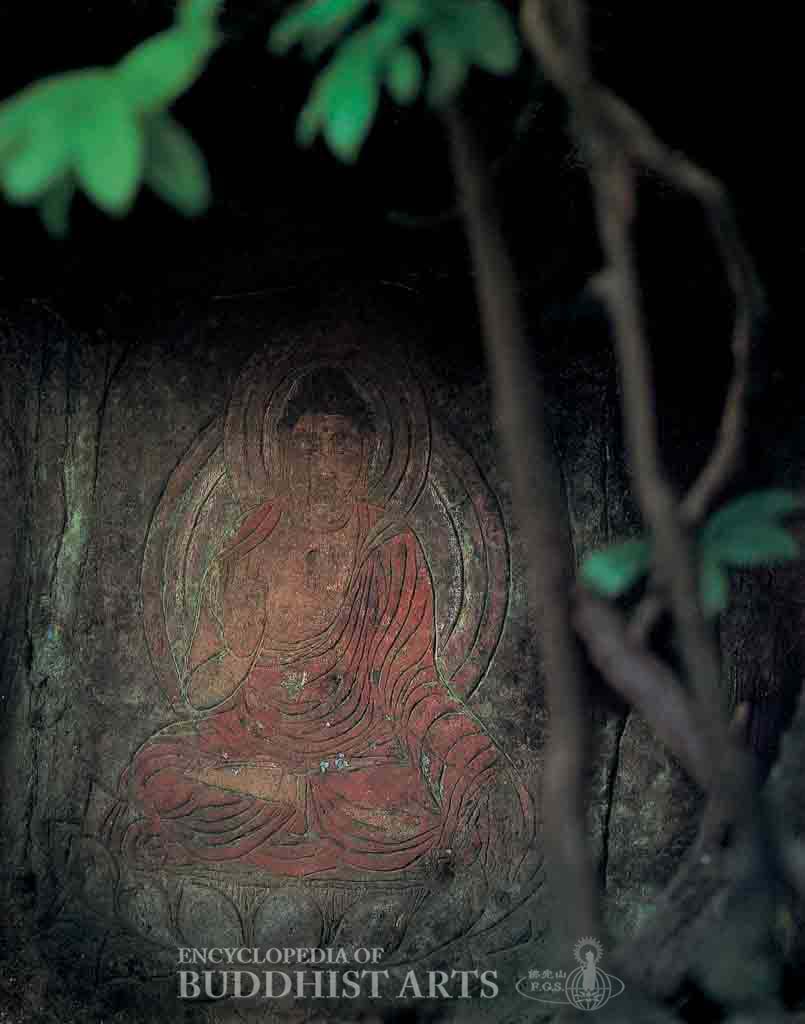
Jigokudani Valley Cave: Seated Buddha
Jigokudani Valley Cave
JAPAN, Nara
Jigokudani stands for Hell Valley. It is thought that the name of the site was derived from a legend which believes hell to exist below Mount Kasuga, on which the cave is located. Carved during the Heian period (794–1185), the cave is 1.2 m high. Engraved with fine lines in the center of the back wall is a seated Buddha, sided by a standing Bodhisattva to the right, and a standing Buddha to the left. There are additional line engravings depicting a total of six Buddhas and Bodhisattvas on the side walls.
The most well-preserved image is the seated Buddha in the center of the back wall. Behind the Buddha, who sits in full lotus position on a lotus throne, is a nimbus and an aureole comprised of three layers. The Buddha’s right hand is raised while his left hand forms the varada (wish-granting) mudra. A red kasaya is draped over the Buddha’s left shoulder, exposing a swastika on the center of his chest; remnants of gold coloration are visible throughout. The delicate line incisions that create the contours of cloth folds are smooth and detailed.
For more details, go to the Encyclopedia of Buddhist Arts: Caves R-L, page 436.
Cite this article:
author = Hsingyun and Youheng and Johnson, Peter and Mankuang and Huntington, Susan and Edson, Gary and Neather, Robert,
booktitle = {Encyclopedia of Buddhist Arts: Caves R-L},
pages = 436,
title = {{Jigokudani Valley Cave}},
volume = 6,
year = {2016}}