
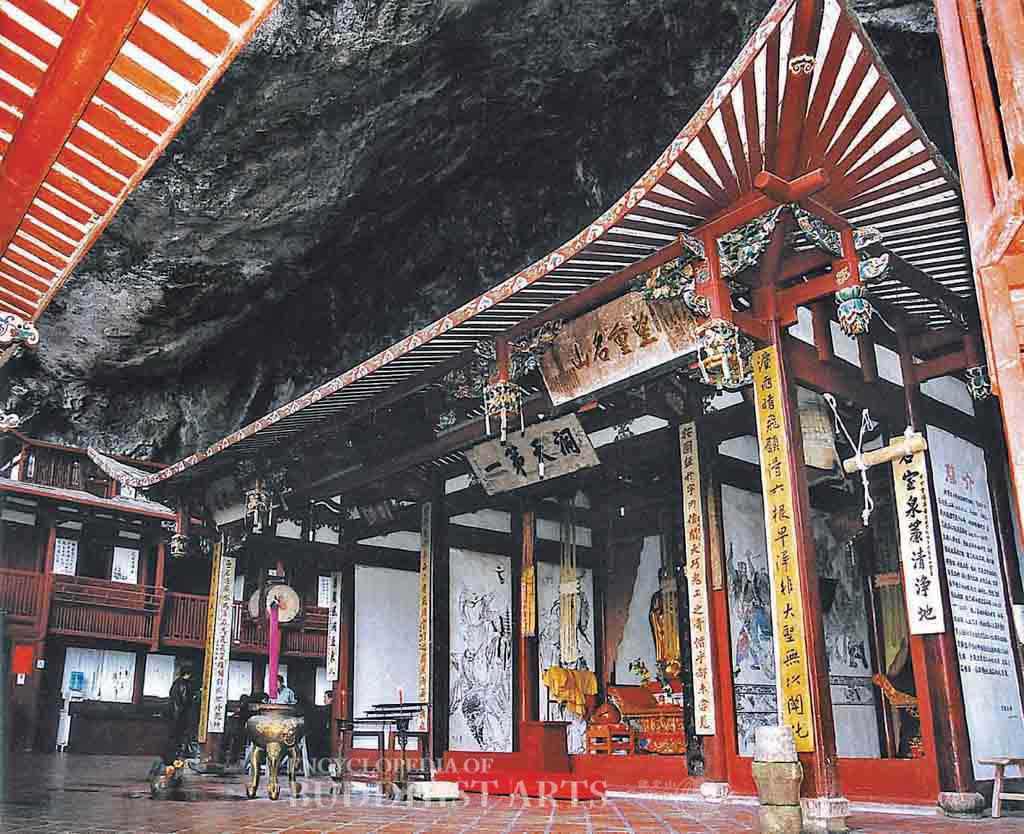
Fangguangyan Temple: Great Hero Hall
Fangguangyan Temple
CHINA, Fujian, Fuzhou
Fangguangyan means Wide and Vast Cliff. It is located halfway up Gelingshan (Ge’s Ridge Hill) and was originally built into a natural cave. In 961 during the Northern Song dynasty, local people built a small pavilion inside to house a statue of Avalokitesvara Bodhisattva. Between 1041 and 1048 during the Song dynasty, Huang Feixiong and the monks at the temple expanded the structure. It was destroyed in wartime and was repaired during the rule of Emperor Wanli (reigned 1573–1620) of the Ming dynasty.
The main buildings of the temple are the Great Hero Hall, Avalokitesvara Building, Transcendence Building, and Heavenly Spring Pavilion. The buildings were built onto the cliff face using a timber framework supported by massive struts, which makes them seem to be suspended in mid-air. There are inscriptions by renowned people from the Song dynasty (960–1279).
For more details, go to the Encyclopedia of Buddhist Arts: Architecture A-F, page 289.
Cite this article:
author = Hsingyun and Youheng and Johnson, Peter and Mankuang and Lancaster, Lewis,
booktitle = {Encyclopedia of Buddhist Arts: Architecture A-F},
pages = 289,
title = {{Fangguangyan Temple}},
volume = 1,
year = {2016}}