
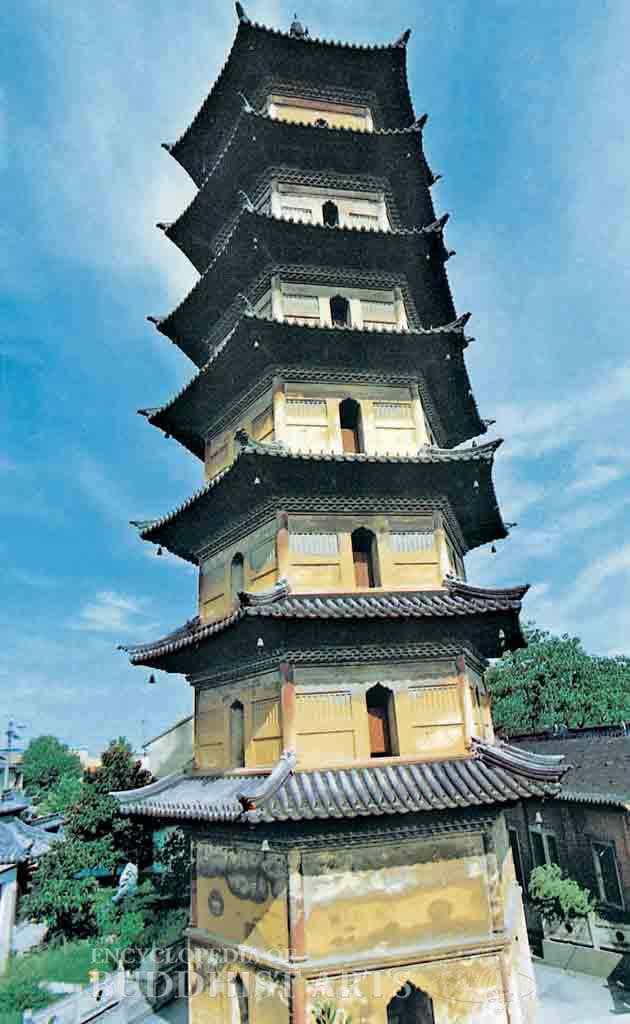
Tianshou Temple Pagoda
Tianshou Temple Pagoda
CHINA, Anhui, Xuancheng
The pagoda was constructed in 979 during the Northern Song dynasty, and was initially five stories high. It was destroyed in 1099, but was rebuilt with seven stories between 1100 and 1105. It was repaired in 1602 during the Ming dynasty, and in 1688, during the Qing dynasty. A fire in 1900 left only the brick pagoda body. The present pagoda was rebuilt between 1984 and 1986. It was listed as an Anhui Cultural Heritage Site in 1981.
The seven-story, hexagonal, wood and brick pagoda measures 40 m high. There is an ogee arched door on each story. From the second story upwards there are fake vertical bar windows on either side of the doors. The eaves, which are covered with glazed tiles, extend outwards. A bronze bell hangs from the corner of each eave. In 1983 a stone stele recording the history of the pagoda was discovered in the underground palace.
For more details, go to the Encyclopedia of Buddhist Arts: Architecture T-Z, page 1128.
Cite this article:
author = Hsingyun and Youheng and Johnson, Peter and Mankuang and Lancaster, Lewis,
booktitle = {Encyclopedia of Buddhist Arts: Architecture T-Z},
pages = 1128,
title = {{Tianshou Temple Pagoda}},
volume = 4,
year = {2016}}