
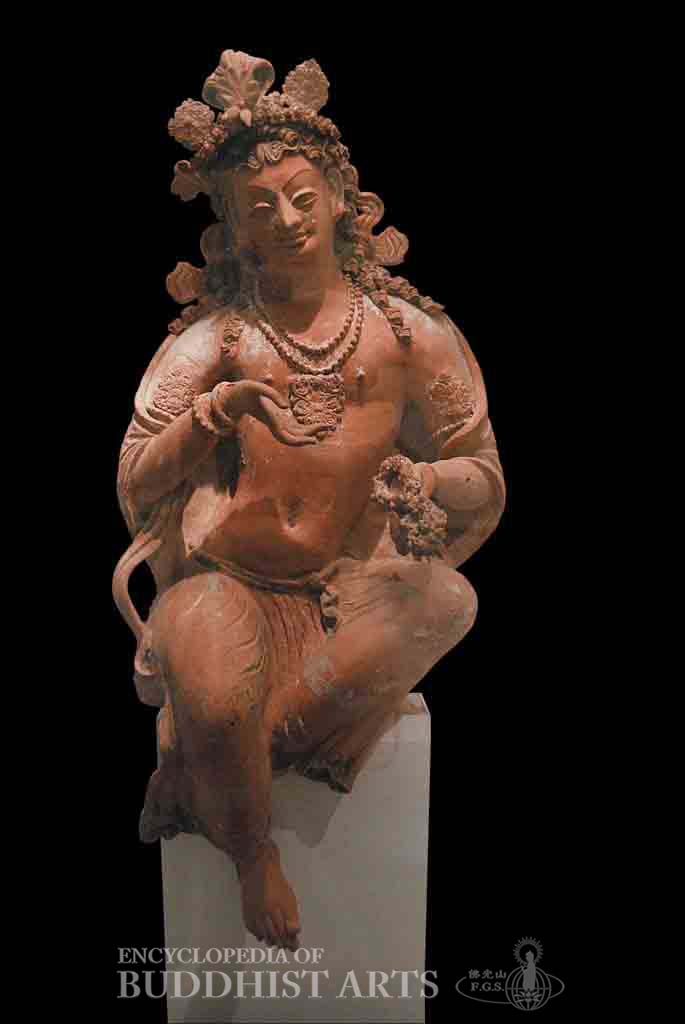
Fondukistan: Seated Bodhisattva
Clay
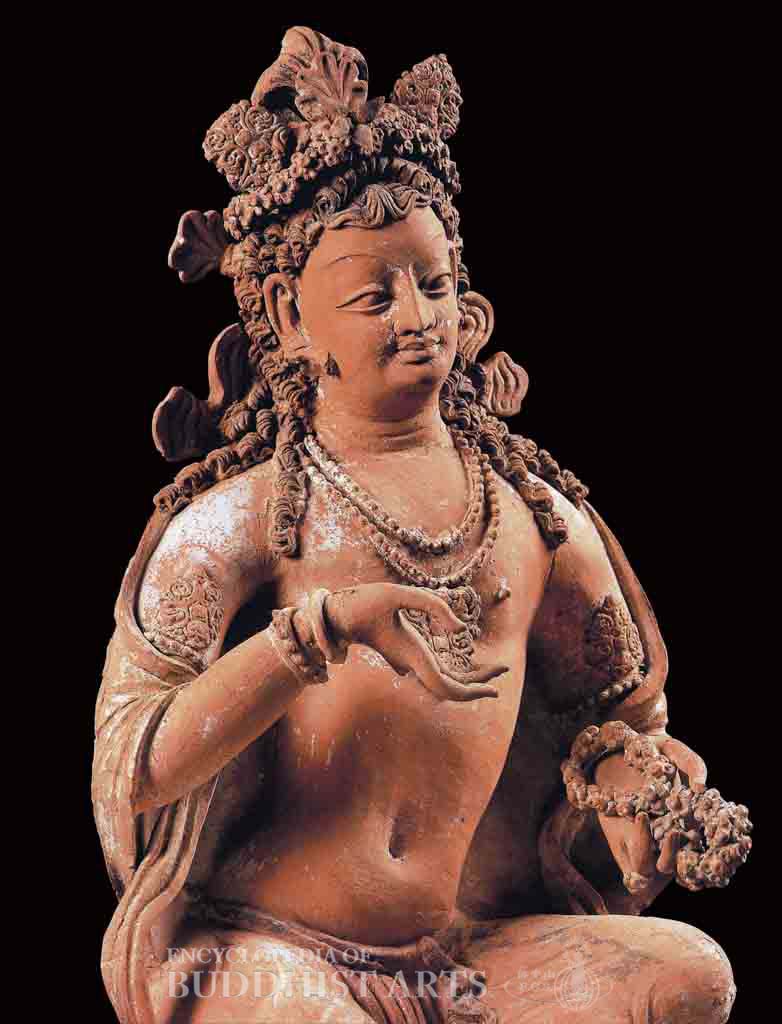
Fondukistan: Seated Bodhisattva
Fondukistan: Seated Bodhisattva
AFGHANISTAN, Parwan, Fondukistan
The site of Fondukistan where this figure was found was one of the most important places in the Bamiyan Valley. A French archaeological team discovered a stupa within a large courtyard at the site in 1937. Each side of the courtyard featured three arched niches with clay sculptures. This particular statue was one of those found in Niche D.
The mustached Bodhisattva wears a magnificent headdress and has ringleted hair that scatters over the shoulders. His head is tilted to one side and his sturdy torso is bare except for a stole and a double necklace with a floral pendant. There is more jewelry on the arms and the hands are raised to gesture eloquently. The skirted figure sits with the left ankle tucked behind the right calf.
The statue is in the Gandharan style. It appears that wheat stalks and horse hair were mixed into the unbaked clay prior to molding and then a coating of color applied. The headdress was made from individual pieces that were later glued together.
For more details, go to the Encyclopedia of Buddhist Arts: Sculpture A-F, page 346.
Cite this article:
author = Hsingyun and Youheng and Lovelock, Yann and Chou, Yuan and Huntington, Susan and Edson, Gary and Neather, Robert,
booktitle = {Encyclopedia of Buddhist Arts: Sculpture A-F},
pages = 346,
title = {{Fondukistan: Seated Bodhisattva}},
volume = 10,
year = {2016}}