
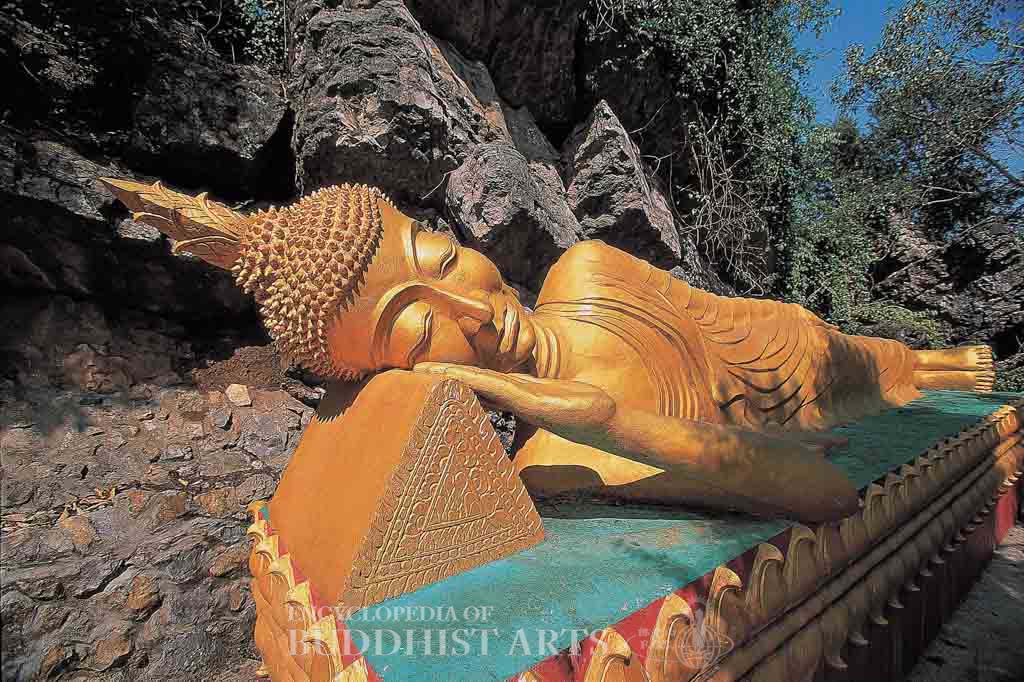
Phousi: Reclining Buddha
Stone
Phousi: Reclining Buddha
LAOS, Luang Prabang
Most of the temple buildings in Luang Prabang date from the 13th century. This statue overlooks the city from a hill temple terrace on Mount Phousi. The reclining pose is associated with the Buddha’s passing into parinirvana. As part of the town of Luang Prabang, it was listed as a UNESCO World Heritage in 1995.
The head, with pointed curls, rests upon a triangular pillow that has delicately engraved sides. The top of the usnisa blooms into an organic spiked decoration. The long face has raised eyebrows arching down to define the nose, with a mouth that depicts the thick lips of the regional sculptural style. The monastic robe leaves the right shoulder bare, while below it, the feet lie parallel on a rectangular bed bordered with two layers of lotus petals. The right hand is not placed beneath the cheek, as is usual in this scene, but rests on the pillow instead.
For more details, go to the Encyclopedia of Buddhist Arts: Sculpture N-Sr, page 813.
Cite this article:
author = Hsingyun and Youheng and Lovelock, Yann and Chou, Yuan and Huntington, Susan and Edson, Gary and Neather, Robert,
booktitle = {Encyclopedia of Buddhist Arts: Sculpture N-Sr},
pages = 813,
title = {{Phousi: Reclining Buddha}},
volume = 12,
year = {2016}}