
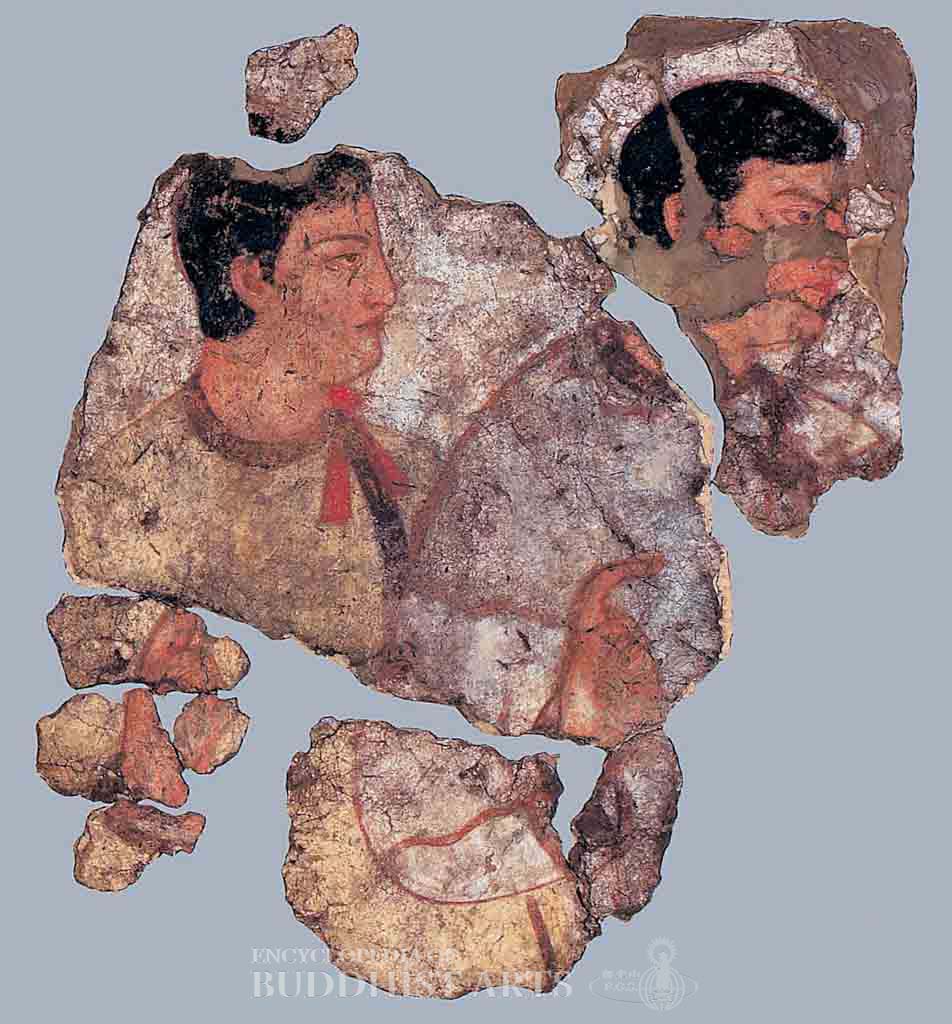
Fayaz Tepe: Figures Making Offerings
Fayaz Tepe: Figures Making Offerings
UZBEKISTAN, Surkhandarya, Termez
These fragments were originally part of a mural that was painted on the east wall of the temple hall. Besides images of figures making offerings, there was also a depiction of a standing Buddha. The colors are bright and vivid, and the figures bear the characteristics of local ethnic groups, similar to murals in neighboring Xinjiang, China.
These fragments show two figures standing in profile, looking to the right. Both have short hair and high-bridged noses. The figure on the right wears a white robe. His right arm is partially visible, with the hand raised in a pointing gesture. The figure on the left wears yellow clothing with a red ribbon tied at the collar. His right hand is also held up. Above his head there is the Greek word “faro” written in cursive script. Archaeologists speculate that the word refers to Pharro, a god of fertility during the Kushan period (circa 1st–3rd century).
For more details, go to the Encyclopedia of Buddhist Arts: Painting A-H, page 237.
Cite this article:
author = Hsingyun and Youheng and Youlu and Wilson, Graham and Manho and Mankuang and Huntington, Susan,
booktitle = {Encyclopedia of Buddhist Arts: Painting A-H},
pages = 237,
title = {{Fayaz Tepe: Figures Making Offerings}},
volume = 14,
year = {2016}}