
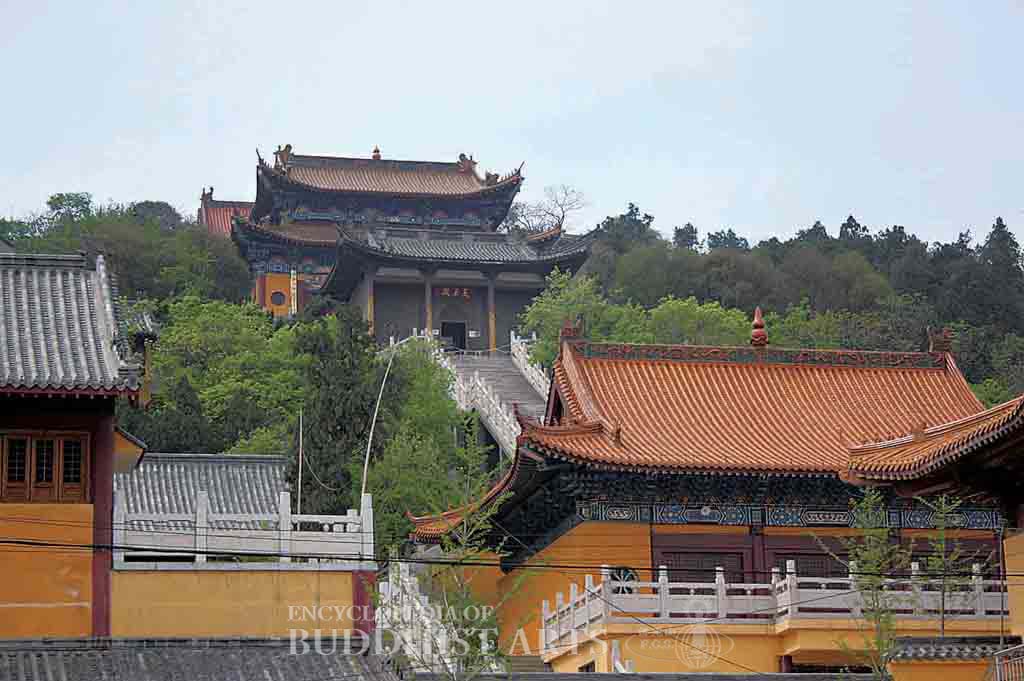
Xinghua Temple
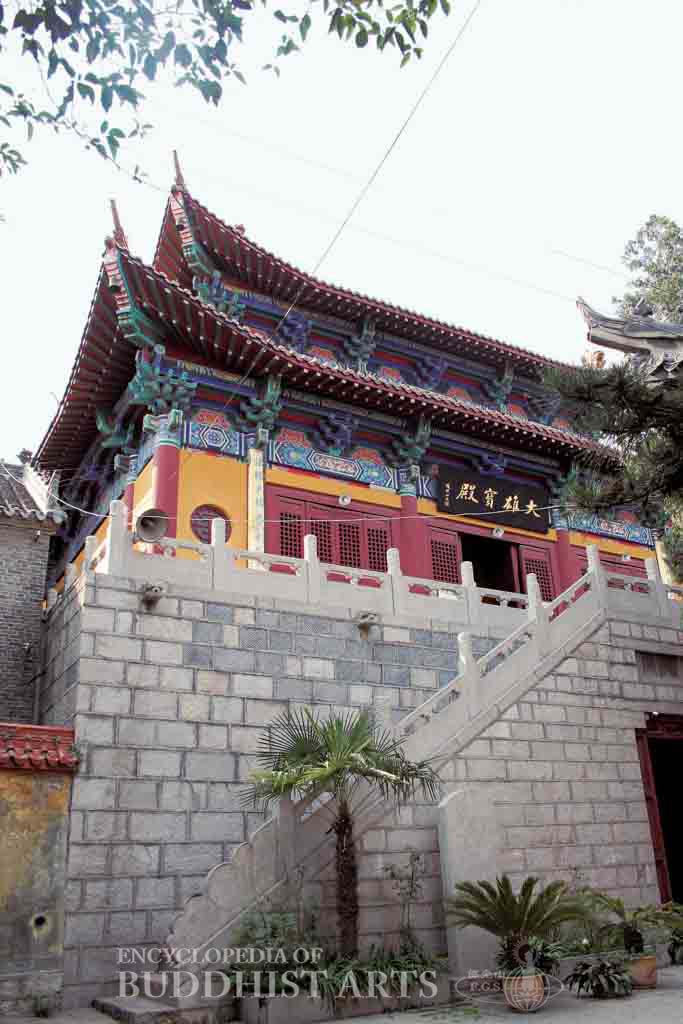
Xinghua Temple: Great Hero Hall
Xinghua Temple
CHINA, Jiangsu, Xuzhou
The temple is also called Stone Buddha Temple. According to stele inscriptions found at the temple, it was already in existence during the Liu Song (420–479) and Liang (502–557) dynasties. A stone Buddha sculpture on top of the hill is thought to have been carved out of the rock face in 451 during the Northern Wei dynasty. The sculpture originally consisted of only the head with a square face and large ears, but two arms and a chest were carved out in 1664 during the Qing dynasty. Beside the stone Buddha, there are nearly 1,000 small Buddha statues, as well as reliefs of Buddhist stories carved into the rock face. These were sculpted during the Tang (618–907) and Song (960–1279) dynasties. The temple was only built due to the presence of the stone Buddha. It was listed as a Municipal Cultural Heritage Site in 1982.
Built on the slope of the hill, the temple has six courtyards. The buildings include the main temple gate, Heavenly King Hall, bell and drum towers, Great Hero Hall, Great Buddha Hall, Hall of the Three Sages, sutra repository, and the Patriarch Hall. Apart from the Great Buddha Hall, the bell and drum towers, and the sutra repository, which are Ming dynasty (1368–1644) buildings, most of the other structures were constructed after 1986. The Great Buddha Hall was built in 1432 during the Ming dynasty. The rear of the hall is built into the rock face, so that the front wall is over 9 m high tall, while the back wall is merely three bricks high. There is a stele passageway with a valuable stele inscribed with the Preface to Sagely Teachings, which was composed by Master Xuanzang on the orders of Emperor Taizong (reigned 626–649) of the Tang dynasty.
For more details, go to the Encyclopedia of Buddhist Arts: Architecture T-Z, page 1322.
Cite this article:
author = Hsingyun and Youheng and Johnson, Peter and Mankuang and Lancaster, Lewis,
booktitle = {Encyclopedia of Buddhist Arts: Architecture T-Z},
pages = 1322,
title = {{Xinghua Temple}},
volume = 4,
year = {2016}}