
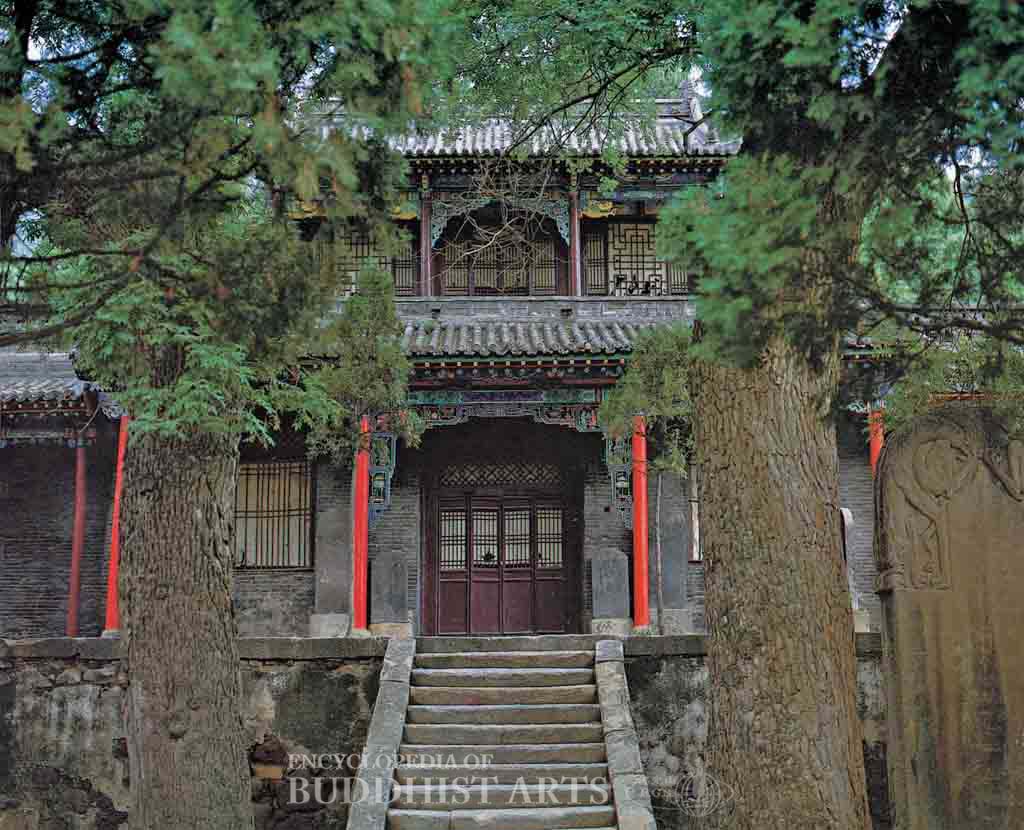
Taishan Temple: Great Hero Hall
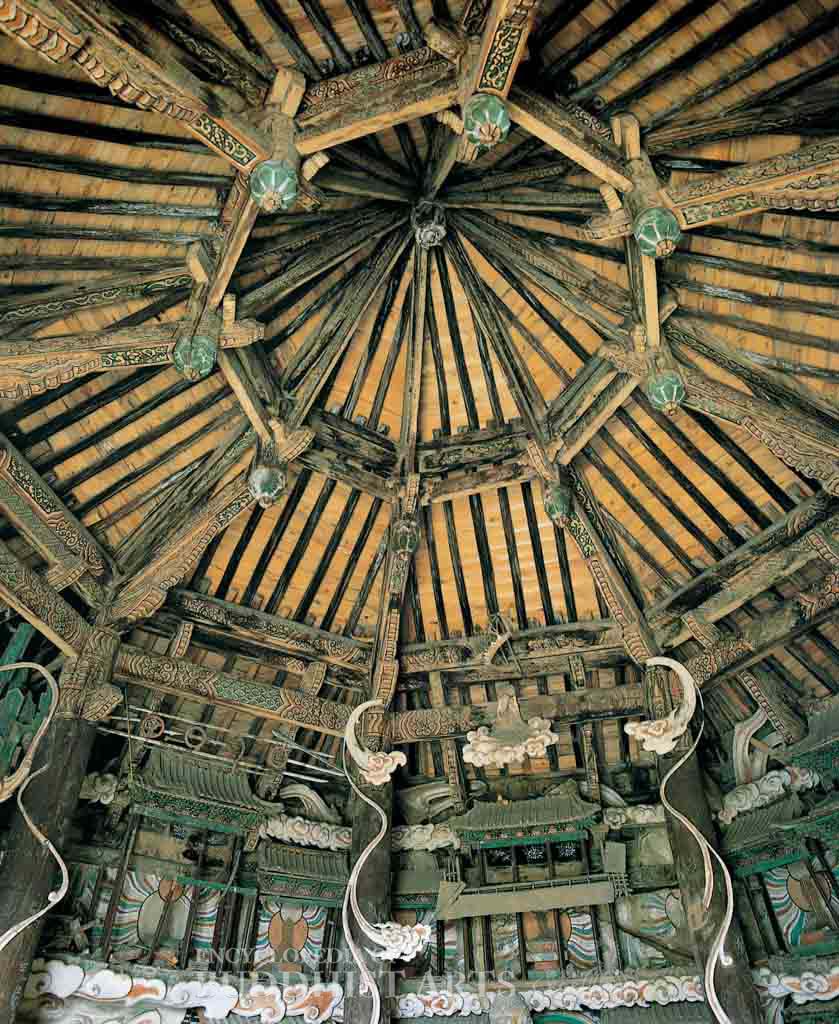
Taishan Temple: Avalokitesvara Pavilion (interior)
Taishan Temple
CHINA, Shanxi, Taiyuan
Taishan means Great Mountain. It was constructed as a Daoist temple in 710 during the Tang dynasty. It was then destroyed in wartime during the Jin (1115–1234) and Yuan (1271–1368) dynasties. In 1391 during the Ming dynasty, it was rebuilt as a Buddhist temple. It is listed as a Provincial Cultural Heritage Site.
The temple was built according to the contours of the mountain and faces south. Upon entering the main temple gate, the buildings, in order, are the bell and drum towers, side halls, the Great Hero Hall, Avalokitesvara Pavilion, Manjusri Hall, Samantabhadra Hall, and the Lotus Cave.
The five-by-three bay Great Hero Hall is two stories high. The Avalokitesvara Pavilion is octagonal. Inside a statue of Avalokitesvara Bodhisattva stands on a hexagonal lotus platform, while Eighteen Arhats line the sides. Four Dharma protectors stand on either side of the entrance. The walls are covered with hanging sculptures of people, temple halls, mountains, streams, plants, and flowers. It is currently the best-preserved Ming dynasty (1368–1644) hanging sculpture in Shanxi.
For more details, go to the Encyclopedia of Buddhist Arts: Architecture T-Z, page 1083.
Cite this article:
author = Hsingyun and Youheng and Johnson, Peter and Mankuang and Lancaster, Lewis,
booktitle = {Encyclopedia of Buddhist Arts: Architecture T-Z},
pages = 1083,
title = {{Taishan Temple}},
volume = 4,
year = {2016}}