
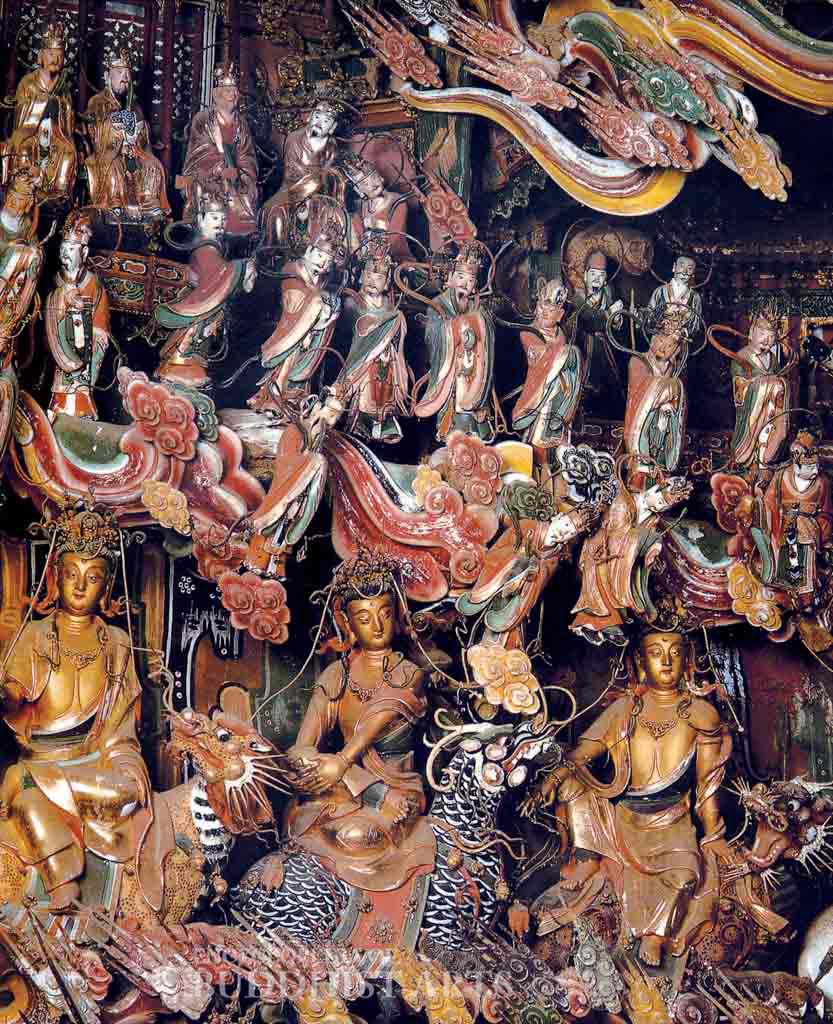
Guanyin Temple: Avalokitesvara Hall (interior)
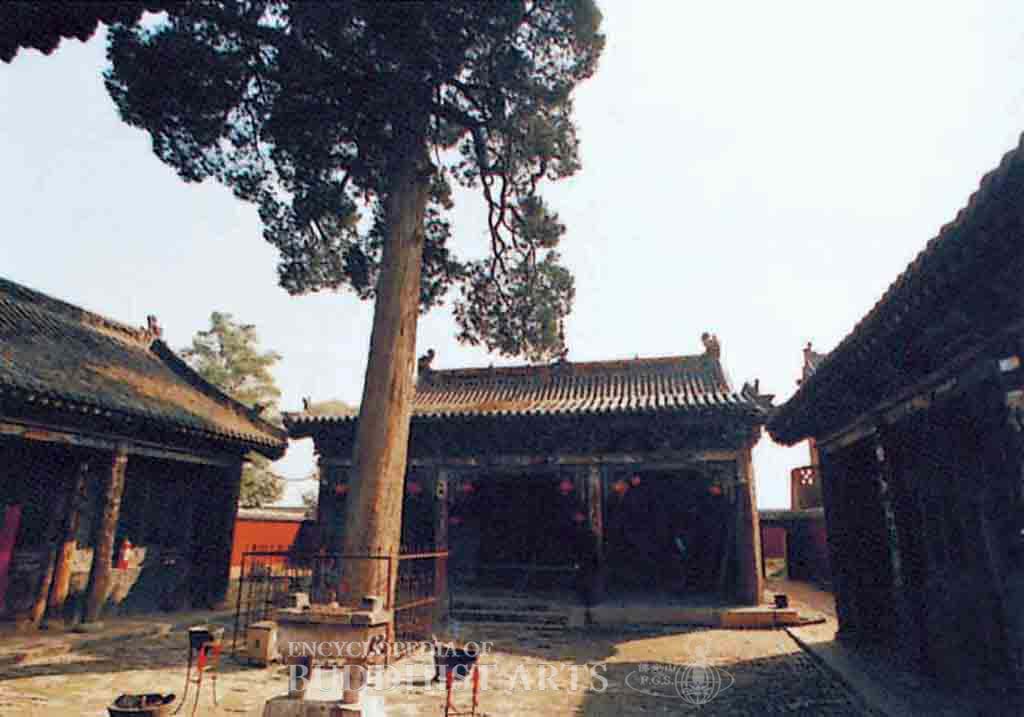
Guanyin Temple
Guanyin Temple
CHINA, Shanxi, Changzhi
Guanyin stands for Avalokitesvara. According to the records, the temple was established around 1581 during the Ming dynasty. The Avalokitesvara Hall is the original structure from the Ming dynasty (1368–1644), while the rest of the buildings are from the Qing dynasty (1644–1911). It was listed as a National Cultural Heritage Site in 2001.
The temple faces west and consists of two courtyards, occupying 7,400 sq m. The main buildings include the Heavenly King Hall, Avalokitesvara Hall, bell and drum towers, and the side halls. The three-bay wide Heavenly King Hall doubles as the main temple gate and has an overhanging gable roof. The Avalokitesvara Hall is the main building of the temple. It covers 62 sq m and has a single-eave overhanging gable roof and a three-bay by four-rafter structure. Inside the hall the realm of the Buddhas has been effectively portrayed in such a small space. The Three Great Bodhisattvas, Avalokitesavara, Manjusri, and Samantabhadra, are enshrined along the east wall. Sculptures fill the walls or are suspended in mid-air. The north and south walls, from the lower register upwards, feature the Eighteen Arhats, Twenty-Four Heavenly Beings, Twelve Perfect Enlightenment Bodhisattvas, and various Confucian and Daoist sages. In addition, the walls and beams are filled with hanging sculptures of Buddhas, Bodhisattvas, Sakra, and Heavenly Kings.
For more details, go to the Encyclopedia of Buddhist Arts: Architecture G-L, page 404.
Cite this article:
author = Hsingyun and Youheng and Johnson, Peter and Mankuang and Lancaster, Lewis,
booktitle = {Encyclopedia of Buddhist Arts: Architecture G-L},
pages = 404,
title = {{Guanyin Temple}},
volume = 2,
year = {2016}}