
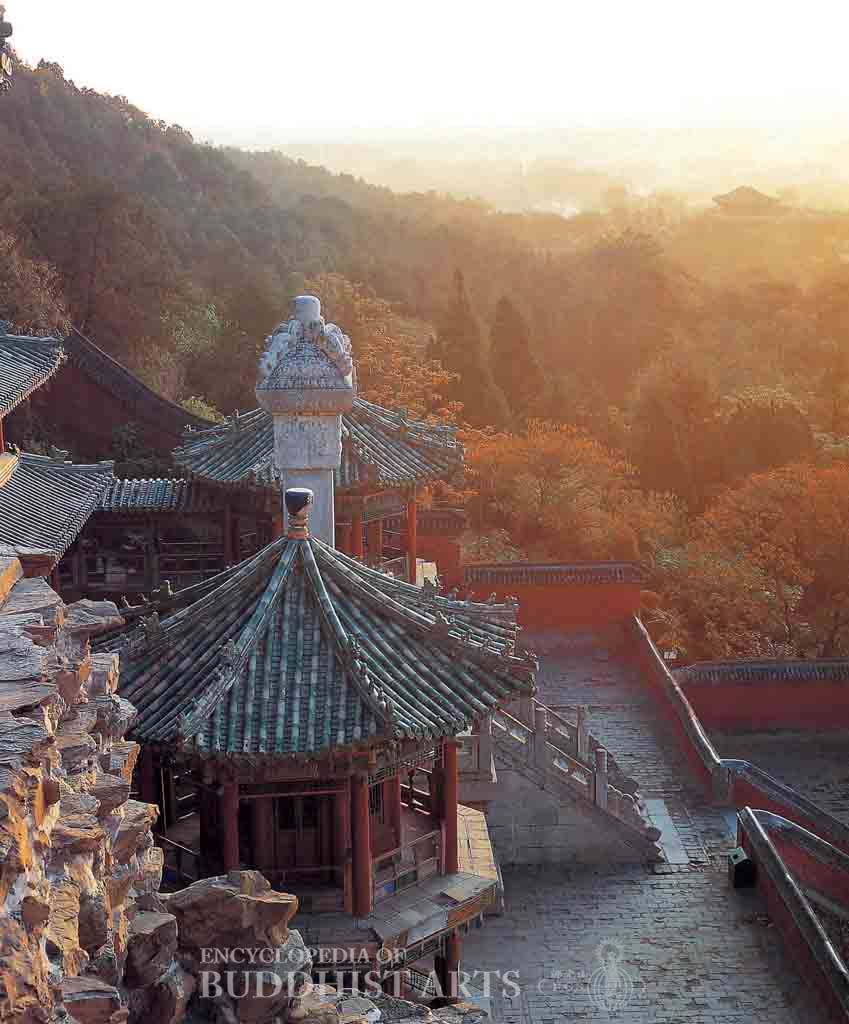
Summer Palace Revolving Sutra Repository
Summer Palace Revolving Sutra Repository
CHINA, Beijing
Located to the east of Foxiang Pavilion, the revolving sutra repository was reconstructed between 1735 and 1796 during the Qing dynasty. It was based on the Song dynasty (960–1279) design of the sutra repository in Fayun Temple in Hangzhou. It was burnt down in 1860 but was rebuilt during the rule of Emperor Guangxu (reigned 1875–1908) of the Qing dynasty. It became a place where the emperor and his family came to pay their respects. As part of the Summer Palace, it was listed as a UNESCO World Heritage Site in 1998.
The structure consists of a main hall and two side pavilions. The three-bay wide main hall has a triple-eave hip-and gable roof. The two side pavilions are linked to the main building by curved walkways.
The side pavilions are two stories high with single-eave, octagonal pyramidal roofs. Within each pavilion there is a two-tier revolving sutra case, which is used to store sutras and Buddhist artifacts.
For more details, go to the Encyclopedia of Buddhist Arts: Architecture M-S, page 1066.
Cite this article:
author = Hsingyun and Youheng and Johnson, Peter and Mankuang and Lancaster, Lewis,
booktitle = {Encyclopedia of Buddhist Arts: Architecture M-S},
pages = 1066,
title = {{Summer Palace Revolving Sutra Repository}},
volume = 3,
year = {2016}}