
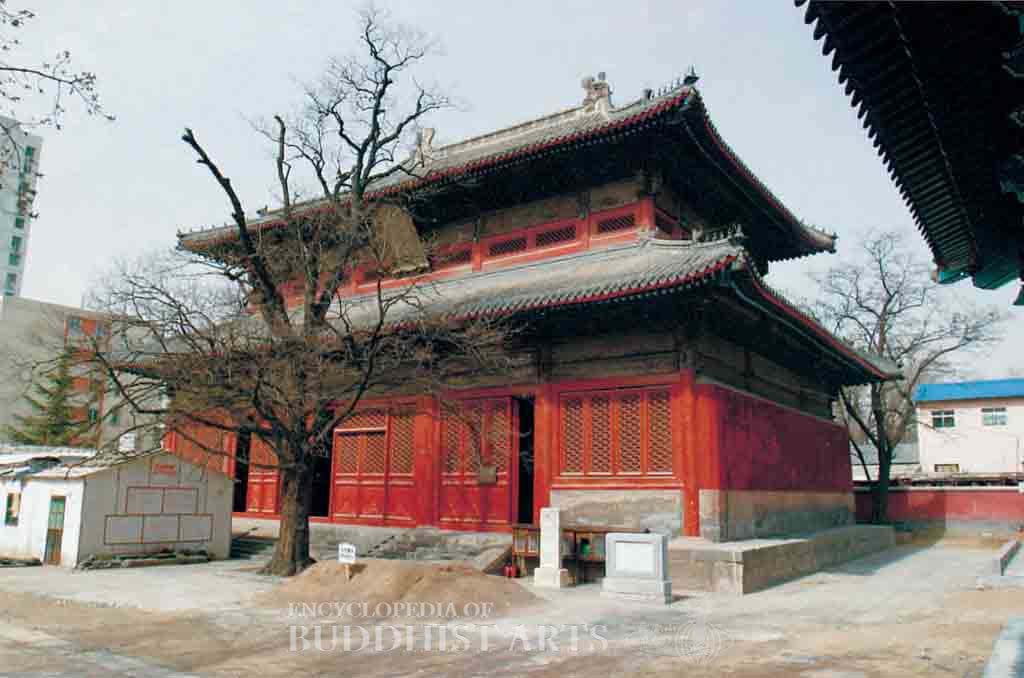
Dahui Temple: Great Compassion Hall
Dahui Temple
CHINA, Beijing
Dahui means Great Wisdom. The temple was built in 1513 during the Ming dynasty. During the 20th century it gradually declined and now only the Great Compassion Hall is left standing. It was listed as a National Cultural Heritage Site in 2001.
The five-by-three bay Great Compassion Hall faces south. It has a double-eave hip roof and is around 30 m high. It once housed a bronze statue of a Thousand-Armed, Thousand-Eyed Avalokitesvara cast during the Ming dynasty (1368–1644) but it disappeared during wartime. Painted wooden statues of the standing Buddha with two attendants were added later. Statues of the Twenty-Eight Heavenly Beings can be found on the east and west walls, as well as upon the Sumeru throne in front of the back wall. These sculptures were created during the Ming dynasty and are about 3 m high. The walls behind the statues are painted with scenes depicting acts of good deeds that will result in a good rebirth and Buddhahood. These murals were painted during the Ming dynasty and feature subjects that are rarely seen in temples.
For more details, go to the Encyclopedia of Buddhist Arts: Architecture A-F, page 192.
Cite this article:
author = Hsingyun and Youheng and Johnson, Peter and Mankuang and Lancaster, Lewis,
booktitle = {Encyclopedia of Buddhist Arts: Architecture A-F},
pages = 192,
title = {{Dahui Temple}},
volume = 1,
year = {2016}}