
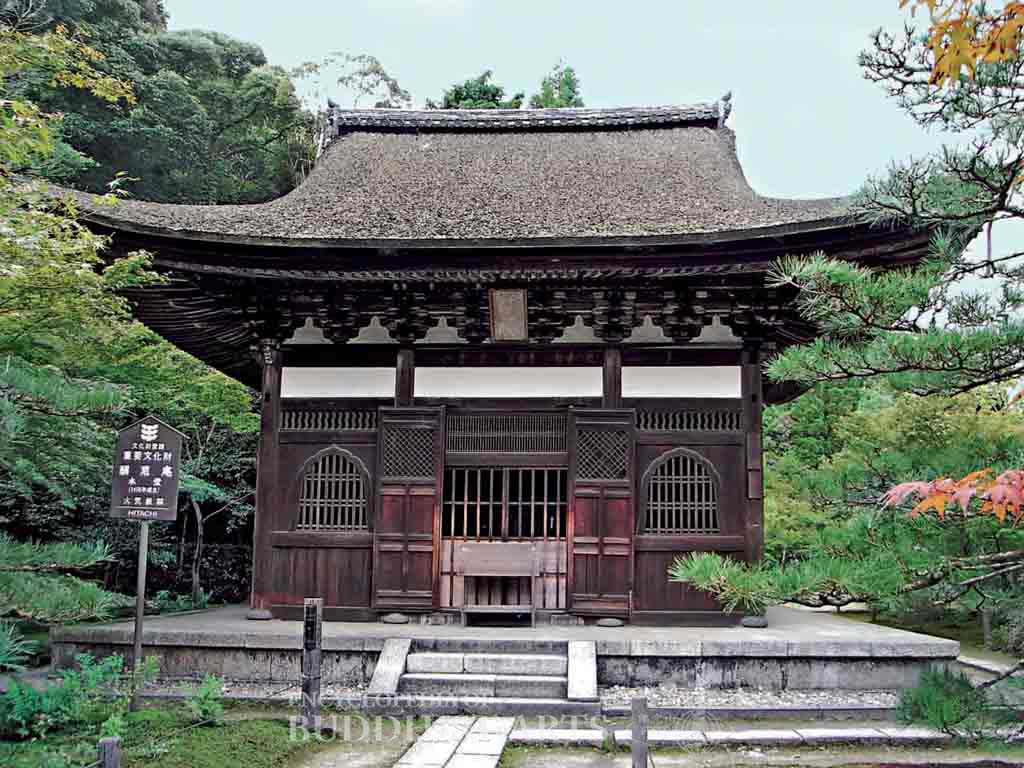
Shuonan Ikkyuji Temple: Main Hall
Shuonan Ikkyuji Temple
JAPAN, Kyoto, Kyotanabe
This Zen temple belongs to the Daitokuji branch of the Rinzai school of Japanese Buddhism. It was constructed between 1288 and 1293 during the Kamakura period by Nanbo Shomyo, but was later damaged and neglected due to warfare. In 1456 Master Ikkyu Sojun revived it and built his own temple to commemorate the kindness of his master. A shrine was built in the temple in memory of Ikkyu, who passed away there at 88 years of age.
The temple buildings include the main hall, Chinese gate, middle gate, abbot’s quarters, monastic quarters, and bell tower. Except for the main hall, the structures were built during the first half of the 17th century. The main hall was built between 1429 and 1441 during the Muromachi period by General Ashikaga Yoshinori. The three-by-three bay hall has a single-eave hip-and-gable roof covered with cypress bark. It has thick eaves supported by three-tier bracket sets at the top of sturdy columns. The corners of the eaves curve upwards and the beams are exposed on all sides. The central bay has lattice doors flanked by ogee arch windows on each side. A statue of Sakyamuni Buddha, along with statues of Manjusri and Samantabhadra Bodhisattvas, are enshrined within the hall.
For more details, go to the Encyclopedia of Buddhist Arts: Architecture M-S, page 1010.
Cite this article:
author = Hsingyun and Youheng and Johnson, Peter and Mankuang and Lancaster, Lewis,
booktitle = {Encyclopedia of Buddhist Arts: Architecture M-S},
pages = 1010,
title = {{Shuonan Ikkyuji Temple}},
volume = 3,
year = {2016}}