
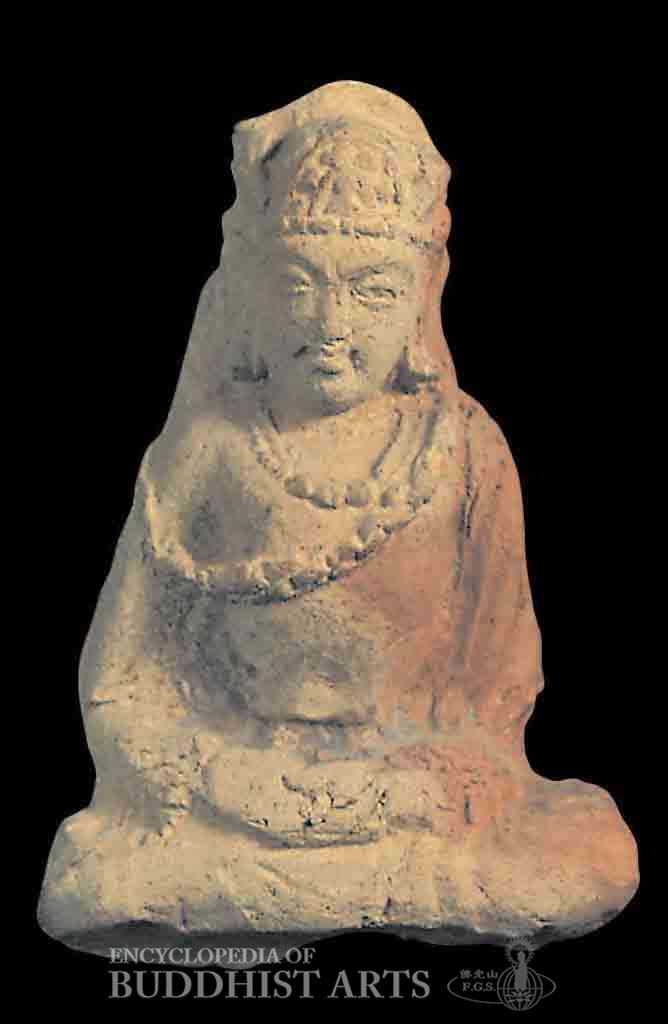
Merv: Seated Bodhisattva
Terracotta
Merv: Seated Bodhisattva
TURKMENISTAN, Mary
The sculpture was discovered in the ruins of a stupa located on the ancient site of Merv in 1946. Under Kushan (circa 1st–3rd century) rule for a while, this oasis town on the Silk Road remained a major place of Buddhist learning for many centuries under the succeeding Sassanid Empire (224–651).
The figure sits cross-legged with hands in the dhyana (meditation) mudra. The headdress is fronted with a Buddha, suggesting that this might be Avalokitesvara. The head is tilted slightly to one side and has features common to Kushan sculpture such as thick eyebrows that meet to define a prominent nose beneath which is a small mouth with a thick lower lip. The Bodhisattva wears heavy earrings and a necklace as well as a garland crossing the chest. The remains of a nimbus are visible behind the head.
For more details, go to the Encyclopedia of Buddhist Arts: Sculpture G-M, page 718.
Cite this article:
author = Hsingyun and Youheng and Lovelock, Yann and Chou, Yuan and Huntington, Susan and Edson, Gary and Neather, Robert,
booktitle = {Encyclopedia of Buddhist Arts: Sculpture G-M},
pages = 718,
title = {{Merv: Seated Bodhisattva}},
volume = 11,
year = {2016}}