
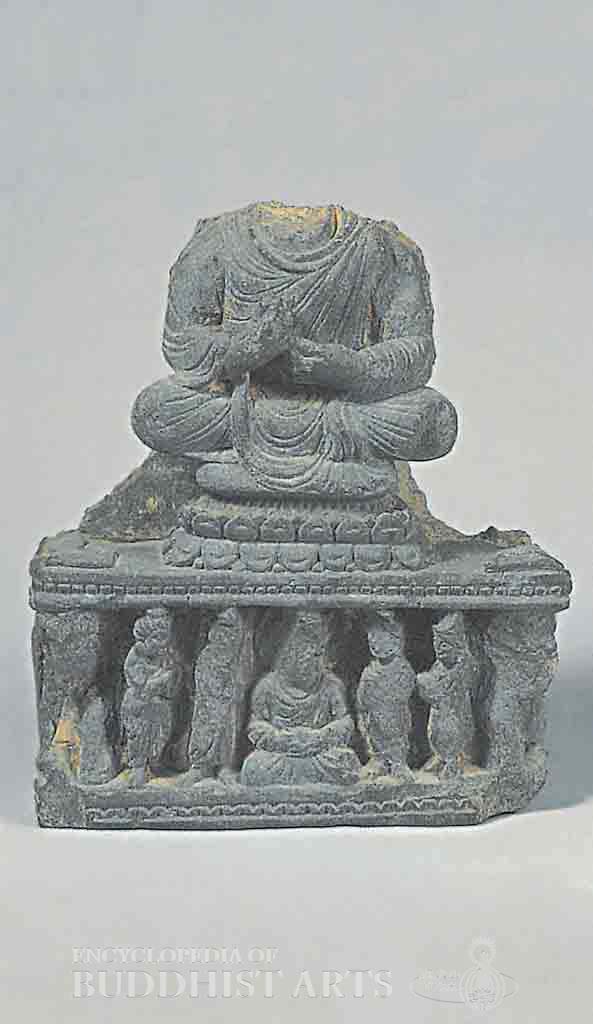
Merv: Seated Buddha
Schist
Merv: Seated Buddha
TURKMENISTAN, Mary
The statue was discovered among the remains of a stupa at the ancient city of Merv in 1946. Other finds from that excavation includes a number of copper coins from the Kushan period (circa 1st–3rd century). This shows that the Kushan influence extended over this part of Central Asia. The sculpture’s strong Gandharan characteristics also suggest that it was brought to the site after completion, rather than made locally.
The Buddha sits cross-legged on a rock with the knees suspended above its edges. Beneath the figure is a cushion supported on a double lotus throne. The Buddha’s hands form a mudra. The figure wears a heavy monastic robe covering both shoulders and with the end lapping over the ankles. The composition rests on a rectangular pedestal with decorative edges that enclose worn figures carved in high relief. Here a meditating Buddha is flanked to the left and right by two pairs of disciples paying reverence.
For more details, go to the Encyclopedia of Buddhist Arts: Sculpture G-M, page 718.
Cite this article:
author = Hsingyun and Youheng and Lovelock, Yann and Chou, Yuan and Huntington, Susan and Edson, Gary and Neather, Robert,
booktitle = {Encyclopedia of Buddhist Arts: Sculpture G-M},
pages = 718,
title = {{Merv: Seated Buddha}},
volume = 11,
year = {2016}}