
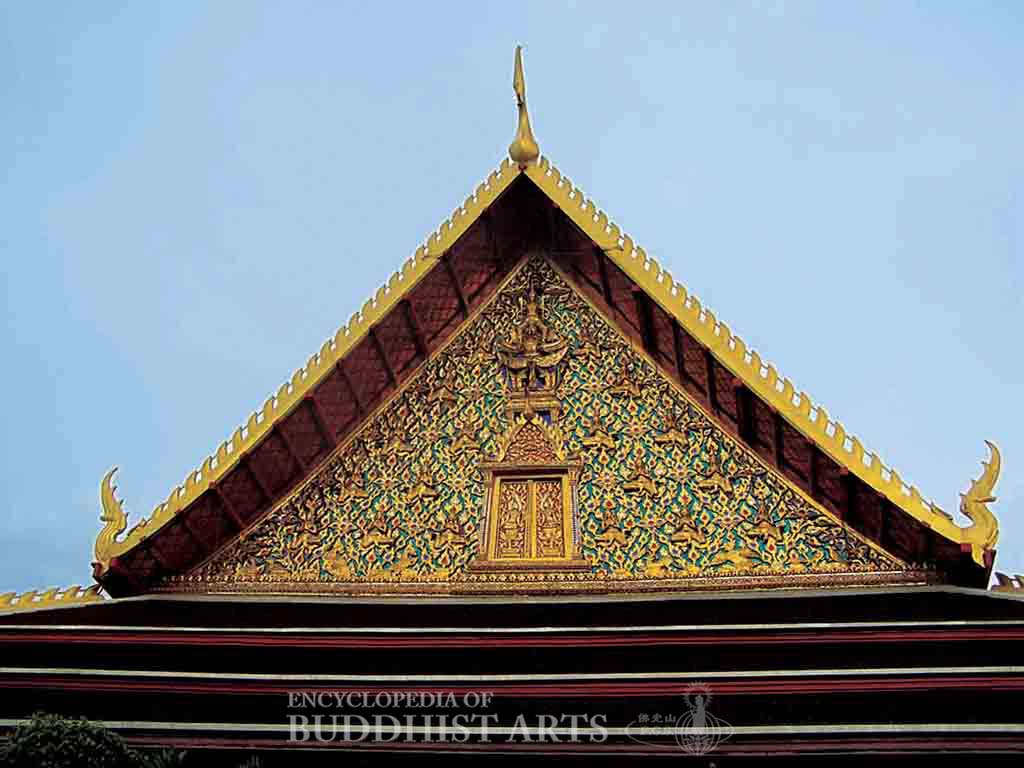
Wat Chana Songkhram: Ordination Hall - Pediment
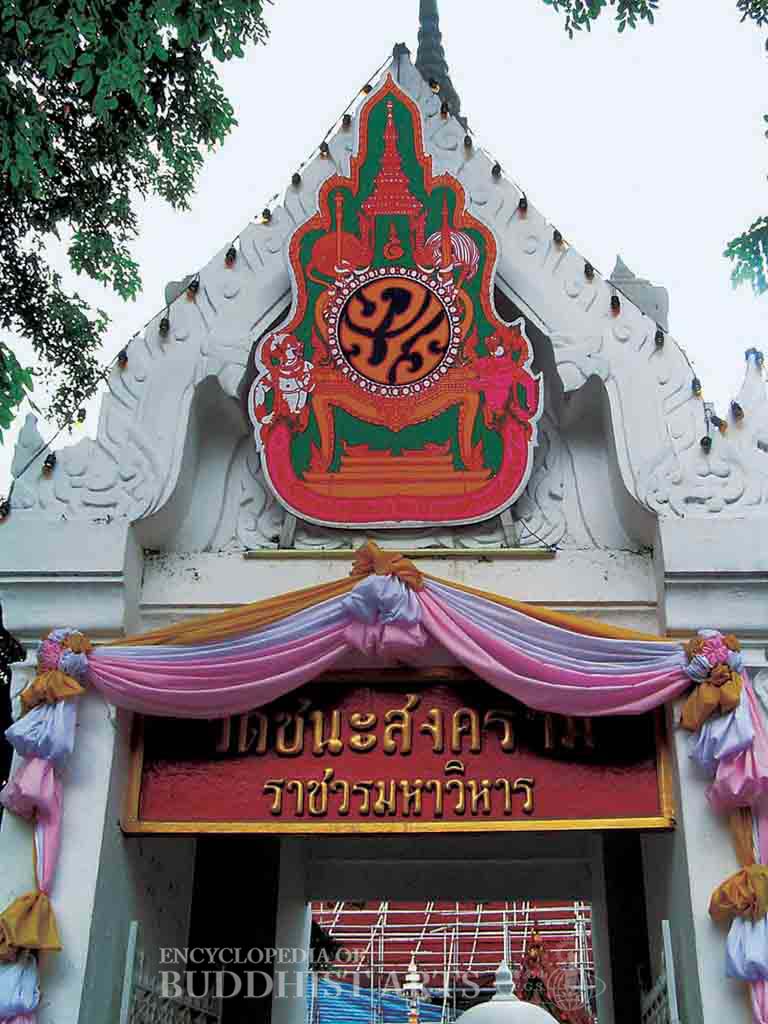
Wat Chana Songkhram: Main Temple Gate (detail)
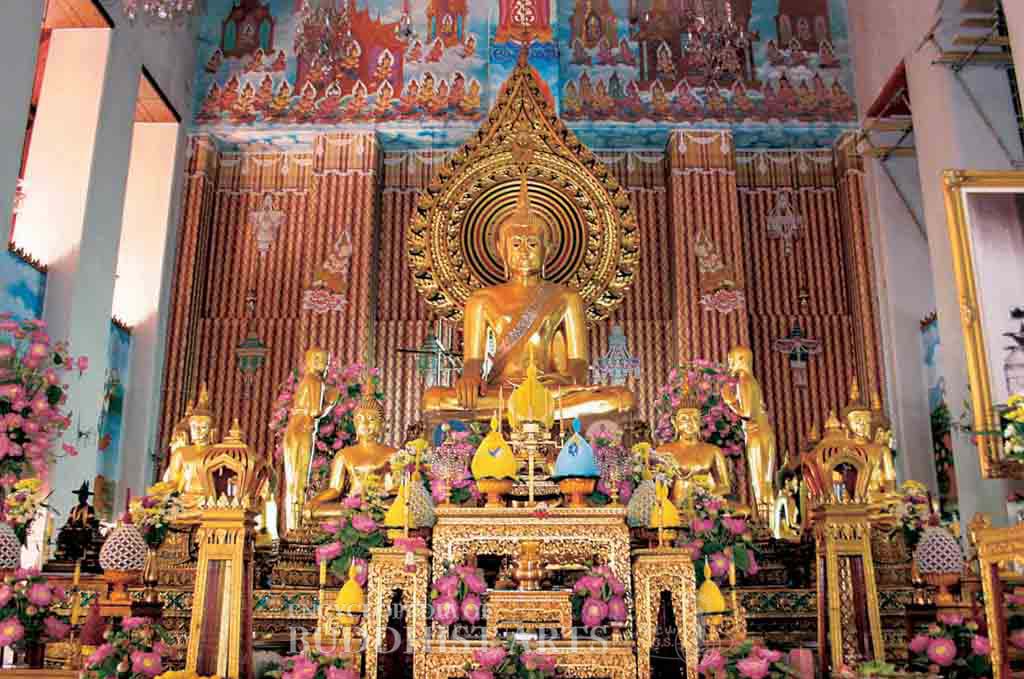
Wat Chana Songkhram: Ordination Hall (interior)
Wat Chana Songkhram
THAILAND, Bangkok
Chana Songkhram means Victory in War. Construction of this temple began during the Ayutthaya period (circa 1350–1767) and it was originally called Wat Klang Na (Temple in the Paddy Field). In 1787 King Rama I (reigned 1782–1809) renovated the temple and renamed it in recognition of the triumph of Prince Surasinghanat and his Mon troops over the Burmese in three battles. Mon monks were allowed to reside at the temple and Mon people were permitted to live in the local area. It was upgraded to a second class royal temple with the full name of Wat Chana Songkhram Ratchaworamahawiharn.
The major buildings of the temple include the main temple gate, ordination hall, Buddha hall, Hall of the Buddha’s Footprint, stupa, and lecture hall. The ordination hall is the main building and contains a statue of Sakyamuni Buddha, locally known as Phra Buddha Norasee. It is the largest ordination hall in the area with a height of 30 m, a width of 27 m, and a length of 41 m. The roof consists of four eaves, with the lower three eaves at a much gentler pitch, providing a wider space inside. The pediments are decorated with gold paint, with a relief of a canopy at their apex. Below the canopy, there is a depiction of Narayana standing on a garuda. The garuda, in turn, stands on two nagas, whose tails are held in the upstretched arms of the garuda. A relief of a doorway is sculpted below the garuda and nagas. Numerous heavenly beings with joined palms occupy the rest of the pediments. The tympanum above the main temple gate has a decorative panel which graphically depicts the throne, emblem, and crown of King Rama IX (reigned 1946–present), thus asserting the temple’s royal status.
For more details, go to the Encyclopedia of Buddhist Arts: Architecture T-Z, page 1191.
Cite this article:
author = Hsingyun and Youheng and Johnson, Peter and Mankuang and Lancaster, Lewis,
booktitle = {Encyclopedia of Buddhist Arts: Architecture T-Z},
pages = 1191,
title = {{Wat Chana Songkhram}},
volume = 4,
year = {2016}}