
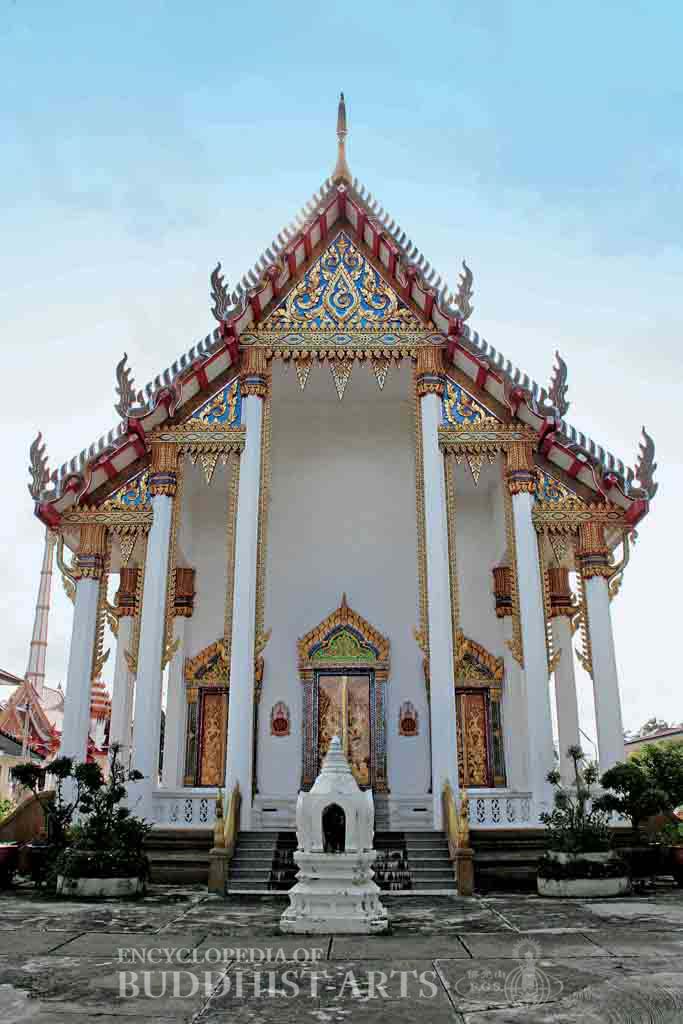
Wat Ketukaram: Ordination Hall
Wat Ketukaram
THAILAND, Samut Songkhram
This temple is located on the west side of the Mae Klong River and belongs to the Dhammayut school. It is believed to have been built in the Ayutthaya period (circa 1350–1767). After being abandoned for many years, it was restored in 1890, and was continually expanded thereafter. In 1984 it was listed as a third class royal temple.
The major structures at the temple include the ordination hall and Buddha hall. The ordination hall houses relics from the Buddha, as well as a statue of the Buddha protected by Mucalinda. The boundary of the ordination hall is marked with boundary stones spaced at intervals around the veranda. The teak doors and windows are carved with heavenly beings and vine patterns decorated with gold leaf, giving the white building an elegant finish. The capitals of the columns consist of golden inverted lotuses. The columns at the front and rear porticos have golden nagas running down their sides from the capitals. The roof consists of three sections with three sets of eaves and it is covered in red, orange, and green glazed tiles. On the pediments the use of blue glass as a background accentuates the extravagant gold decorative carvings.
For more details, go to the Encyclopedia of Buddhist Arts: Architecture T-Z, page 1198.
Cite this article:
author = Hsingyun and Youheng and Johnson, Peter and Mankuang and Lancaster, Lewis,
booktitle = {Encyclopedia of Buddhist Arts: Architecture T-Z},
pages = 1198,
title = {{Wat Ketukaram}},
volume = 4,
year = {2016}}