
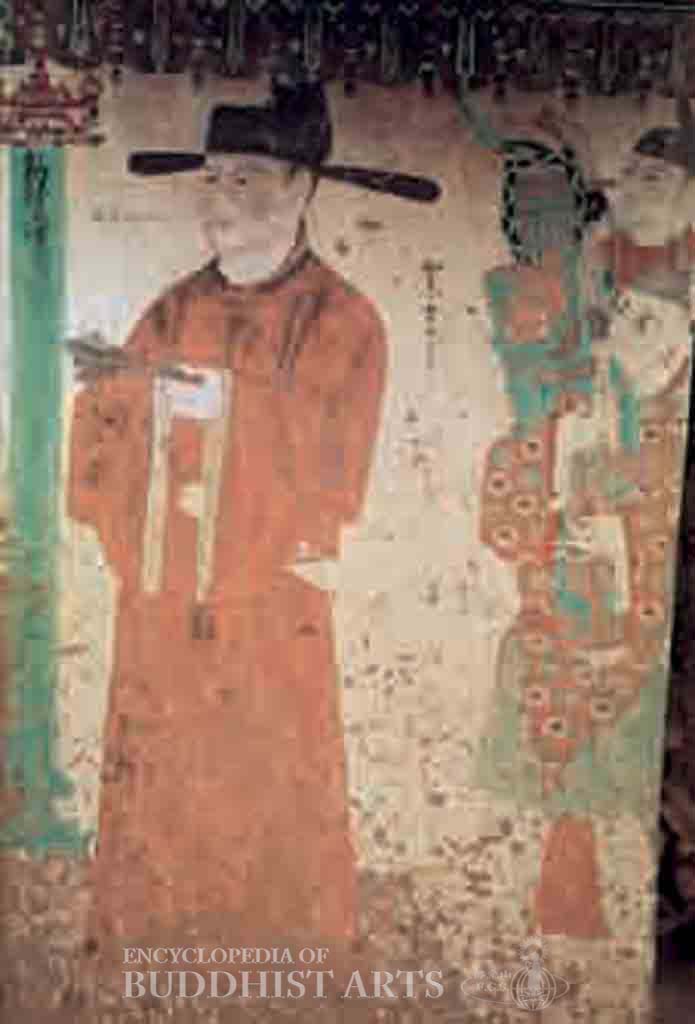
Yulin Cave 16: Cao Yijin and Uighur Princess as Donors - Cao Yijin
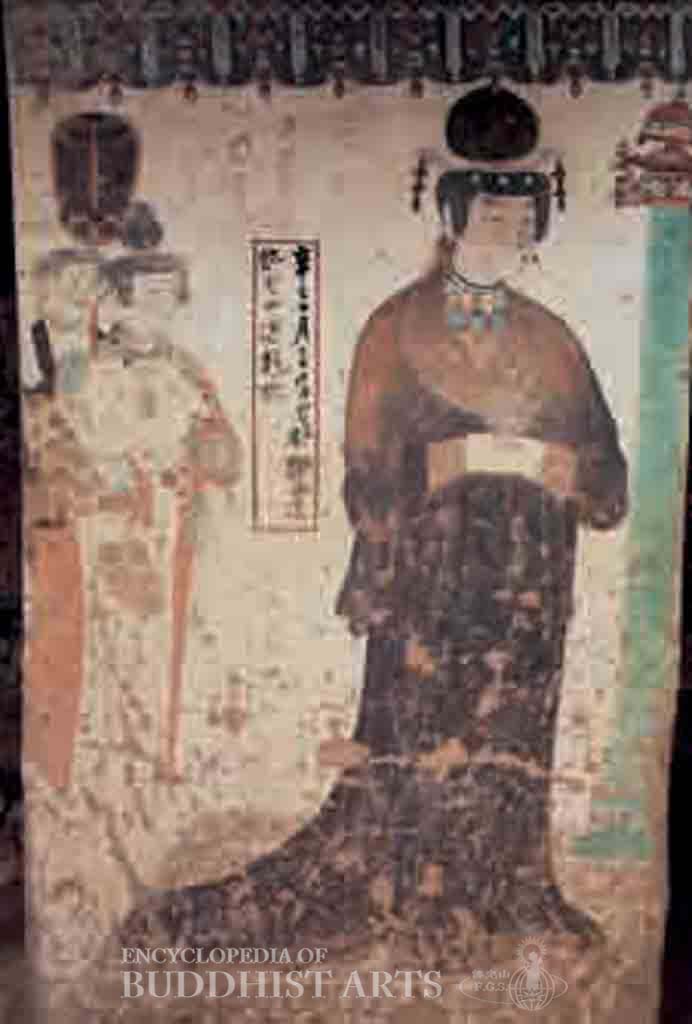
Yulin Cave 16: Cao Yijin and Uighur Princess as Donors - Uighur Princess
Yulin Cave 16: Cao Yijin and Uighur Princess as Donors
CHINA, Gansu, Guazhou; Five Dynasties
These murals are located on the north and south walls of the corridor which leads to the main chamber. In 914 the areas of Guazhou and Shazhou came under the control of Governor Cao Yijin, whose successors ruled the area for more than 120 years, ending with his great-great grandson, Cao Xianshun. During this time, the Cao regime played an important role in maintaining a harmonious relationship between the people of the northwest and the Han Chinese, and were especially keen on the development of Buddhist culture in the area. The Cao family built and repaired more than 70 caves within the Mogao and Yulin sites, including 28 caves within the Yulin Caves.
The figure on the south wall is 1.67 m in height and depicts Cao Yijin making an offering to the Buddha, as indicated by the accompanying cartouche. The figure is garbed in crimson robes and wears an official’s hat. He holds an incense burner in both hands. Two servants in attendance behind him carry his bow bag, a quiver, and sword. Also depicted on the south wall of the corridor is his eldest son, Cao Yuande, who is also making an offering.
The portrait on the north wall depicts Cao Yijin’s wife, a Uighur princess, who holds an incense burner in offering. The figure is 1.66 m high. Her hair is tied in an elaborate topknot and she has two prominent moles on her face. She wears a long robe with tight sleeves and a down-turned collar, in accordance with the fashion at the time. Female servants holding a mirror and fan are depicted behind the princess. During the Five Dynasties (907–960), Cao Yijin was in the midst of consolidating his power in Shazhou. He took a Uighur princess from Gansu as his wife, then married his daughter into the Khotan royal family.
For more details, go to the Encyclopedia of Buddhist Arts: Caves T-Z, page 1591.
Cite this article:
author = Hsingyun and Youheng and Johnson, Peter and Mankuang and Huntington, Susan and Edson, Gary and Neather, Robert,
booktitle = {Encyclopedia of Buddhist Arts: Caves T-Z},
pages = 1591,
title = {{Yulin Cave 16: Cao Yijin and Uighur Princess as Donors}},
volume = 9,
year = {2016}}