
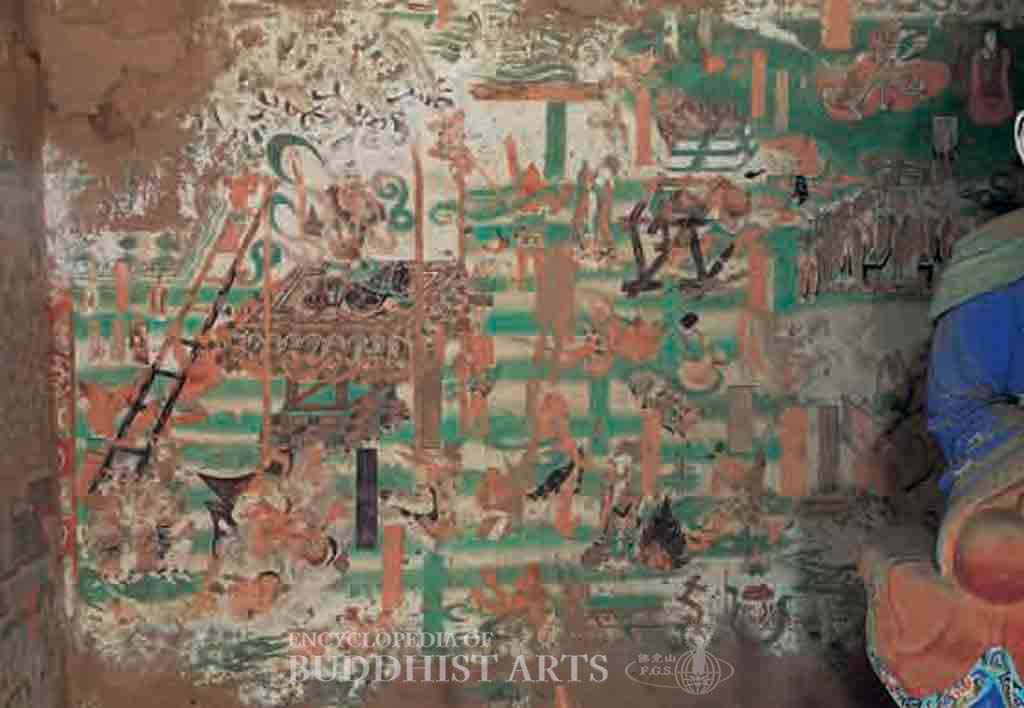
Yulin Cave 16: Battle Between Sariputra and Raudraksa (back wall, left side)
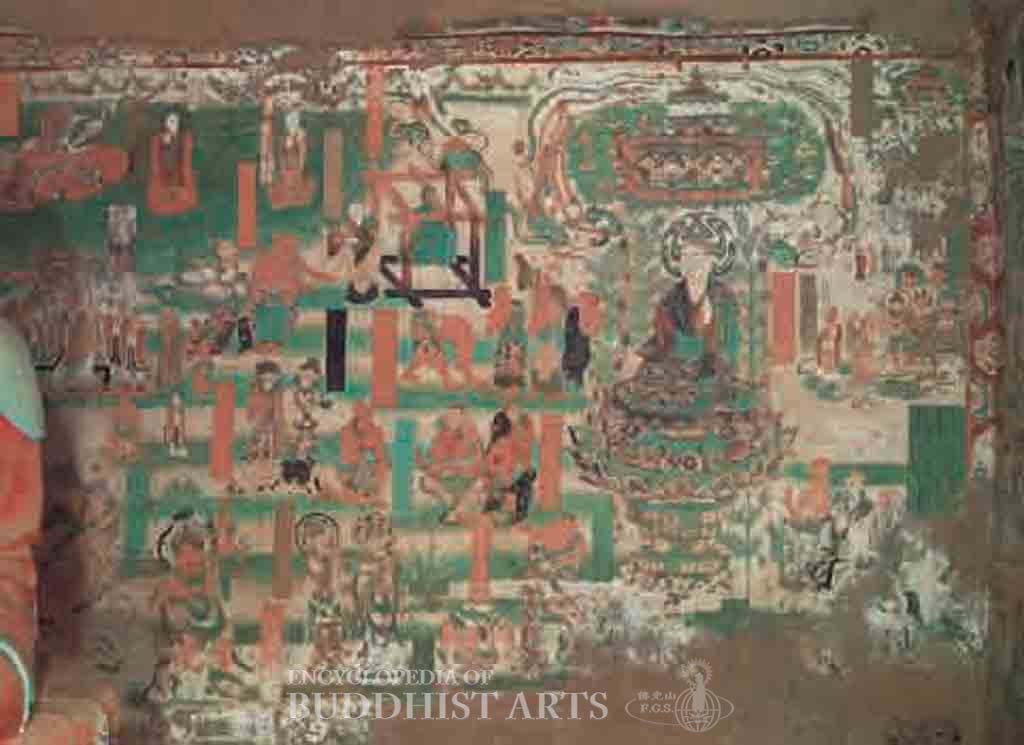
Yulin Grotto 16: Battle Between Sariputra and Raudraksa (back wall, right side)
Yulin Cave 16: Battle Between Sariputra and Raudraksa
CHINA, Gansu, Guazhou; Five Dynasties
This mural, located on the back (east) wall of the main chamber, depicts the battle between Sariputra and Raudraksa. The theme first appeared in murals of the Early Tang period (618–712), and by the 9th century, these murals had become significantly large and complex. The story behind the image concerns Sudatta, a wealthy elder of Sravasti, who purchased a piece of land from Prince Jeta by covering the land with gold. The elder intended to build a monastery where the Buddha could teach the Dharma. Some local people used the king’s power to oppose this plan, and proposed a one-on-one battle between Sariputra and Raudraksa, in order to determine whether the monastery should be built.
Raudraksa was an illusionist who conjured up various objects and beings such as a tree, pond, mountain, dragon, bull, and finally a yaksa. Each illusion was countered by Sariputra, who summoned various forces to oppose Raudraksa which included a gust of wind, a six-tusked white elephant, a warrior, a garuda, a golden lion, and Vaisravana, Heavenly King of the North. After being defeated, Raudraksa was so filled with admiration for his opponent that he converted to Buddhism. In conformity with the style of Late Tang paintings of this story, both opposing parties in the struggle are depicted in the mural. Raudraksa is depicted on the left side of the painting, sitting upon a square wooden platform surrounded by non-Buddhists. The surrounding figures are depicted in a disorganized, chaotic fashion. By contrast, the right side of the image depicts Sariputra, sitting cross-legged on a round lotus throne. A canopy hangs above Sariputra and is surrounded by foliage, giving an impression of composure and serenity. The figures surrounding Sariputra are depicted in an organized fashion. The overall image is clearly intended to portray a contrast between the two opposing figures and their supporters.
For more details, go to the Encyclopedia of Buddhist Arts: Caves T-Z, page 1590.
Cite this article:
author = Hsingyun and Youheng and Johnson, Peter and Mankuang and Huntington, Susan and Edson, Gary and Neather, Robert,
booktitle = {Encyclopedia of Buddhist Arts: Caves T-Z},
pages = 1590,
title = {{Yulin Cave 16: Battle Between Sariputra and Raudraksa}},
volume = 9,
year = {2016}}