
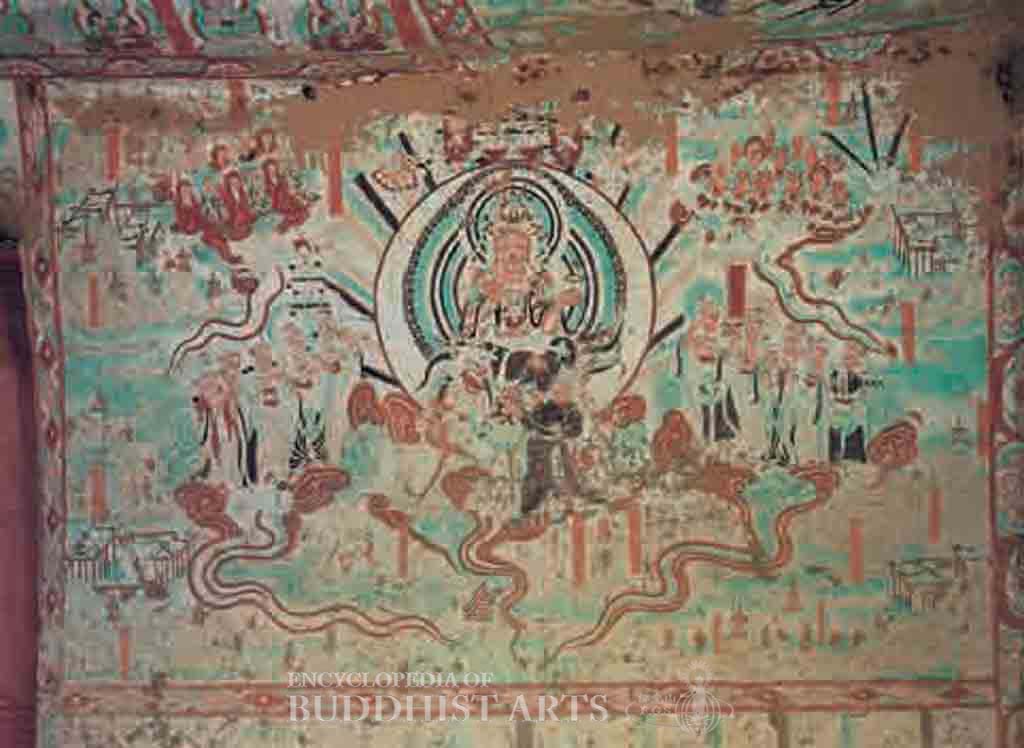
Yulin Cave 32: Manjusri Bodhisattva and Attendants
Yulin Cave 32: Manjusri Bodhisattva and Attendants
CHINA, Gansu, Guazhou; Five Dynasties
This mural is located on the right side of the front (east) wall within the main chamber. During the period of Tibetan rule over Dunhuang (781–847), illustrations of Wutaishan started appearing in the caves. This illustration of Manjusri Bodhisattva is particularly interesting as it presents a greater focus on Wutaishan than was typically seen in earlier representations of the same subject.
Manjusri is depicted seated upon a lion traveling through the clouds. The Bodhisattva wears a headdress featuring a Buddha and holds a lotus flower in one hand. Instead of the usual lion keeper, the driver of the animal is a Khotanese King, who wears long robes and a Vaisravana headdress. Bodhisattvas and attendants carry banners, offer flowers, and play music on both sides and above them are nagas and monastics that have come to listen to the Dharma.
Wutaishan in the background is adorned with temples and stupas on every peak. In the valleys are flowing streams that link together as they descend the sacred mountain. This illustration is similar in style to the illustration of Samantabhadra found on the left side of the wall. Depictions of Buddhist imagery within geographical sites were first introduced by the Khotans and heralded such works as the famous Wutaishan illuration in Mogao Cave 61.
For more details, go to the Encyclopedia of Buddhist Arts: Caves T-Z, page 1624.
Cite this article:
author = Hsingyun and Youheng and Johnson, Peter and Mankuang and Huntington, Susan and Edson, Gary and Neather, Robert,
booktitle = {Encyclopedia of Buddhist Arts: Caves T-Z},
pages = 1624,
title = {{Yulin Cave 32: Manjusri Bodhisattva and Attendants}},
volume = 9,
year = {2016}}