
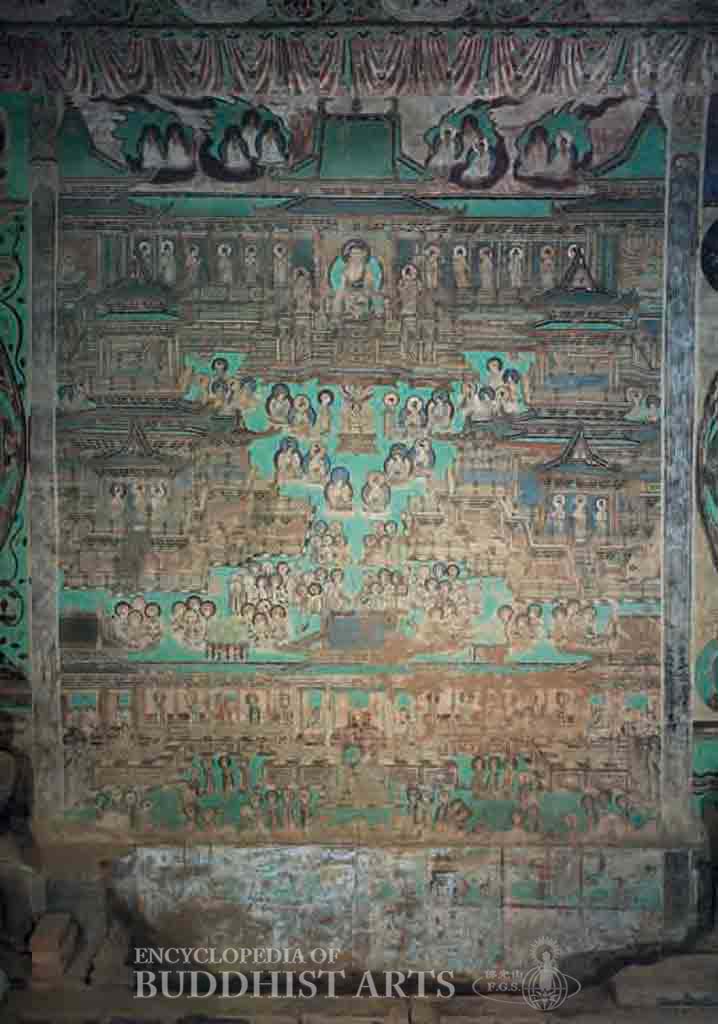
Yulin Cave 3: Illustration of the Amitayurdhyana Sutra
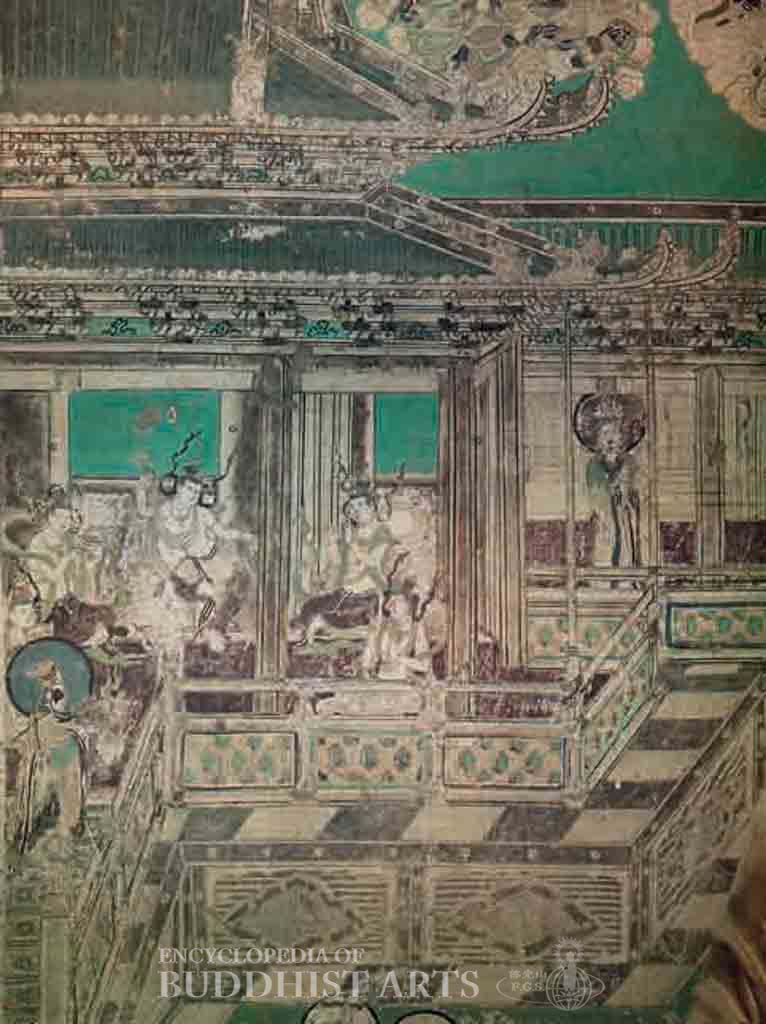
Yulin Cave 3: Illustration of the Amitayurdhyana Sutra (detail) (right side)
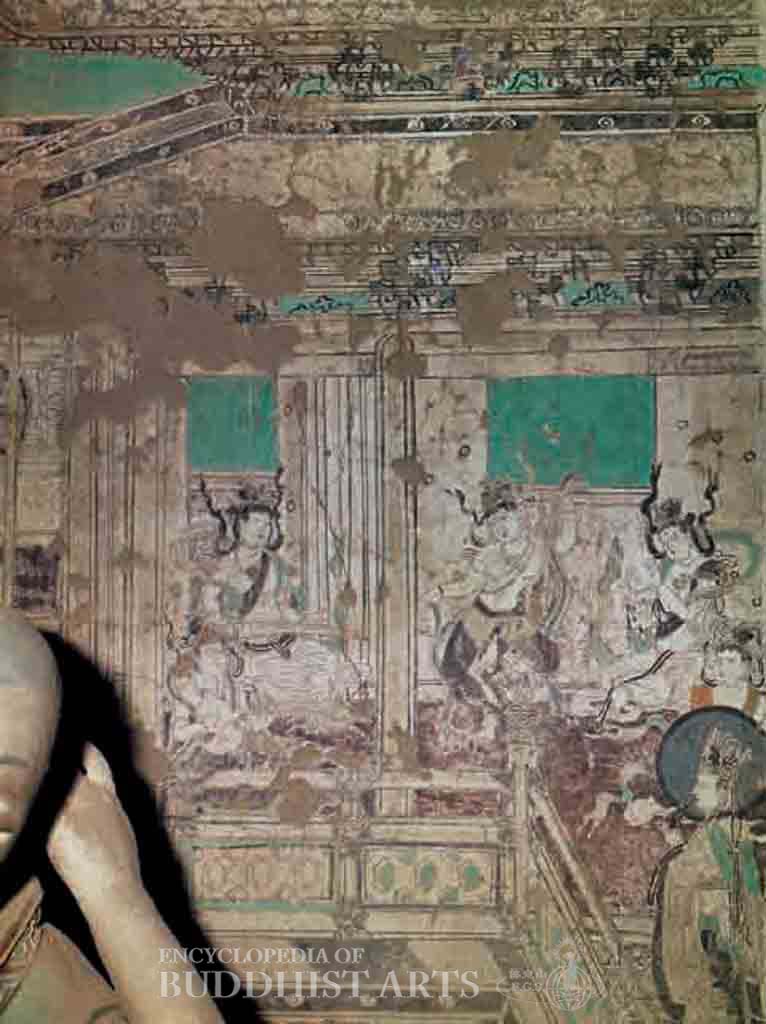
Yulin Cave 3: Illustration of the Amitayurdhyana Sutra (detail) (left side)
Yulin Cave 3: Illustration of the Amitayurdhyana Sutra
CHINA, Gansu, Guazhou; Western Xia period
This mural is located at the center of the south wall. The overall layout, color, and style of this rendition are markedly different from other illustrations of the Amitayurdhyana Sutra created during the Tang (618–907) and Song (960–1279) dynasties. The only clear similarities are the architectural features and the series of narrative illustrations of the Sixteen Contemplations along the bottom of the image.
The mural depicts the front, middle, and rear buildings in the lower, middle, and upper registers of the painting. The Amitabha BuddhaTriad has been shifted from a central position to the rear building in the upper register of the painting. The dancers have also been shifted from the central platform to the interior of the front buildings located on either side. Finally, the figures listening to the Dharma, who would usually encircle the Buddha triad are in the center and form an X shape. More figures are scattered within the portico and courtyard. Almost all of the figures face forward.
The artist has created detailed portrayals of the characters and architecture, with decorative elements included throughout. The Bodhisattvas have tall, strong physiques and oval faces, characteristic of the Western Xia people. The dancing scenes within the east and west buildings at the front are detailed, despite their small size. Within the east building, a figure dances to the music of the cymbals, panpipe, and ocarina. In the west building, the dancer waves a stole and musicians play a zither, moon-shaped lute, waist drum, and clappers.
For more details, go to the Encyclopedia of Buddhist Arts: Caves T-Z, page 1570.
Cite this article:
author = Hsingyun and Youheng and Johnson, Peter and Mankuang and Huntington, Susan and Edson, Gary and Neather, Robert,
booktitle = {Encyclopedia of Buddhist Arts: Caves T-Z},
pages = 1570,
title = {{Yulin Cave 3: Illustration of the Amitayurdhyana Sutra}},
volume = 9,
year = {2016}}