
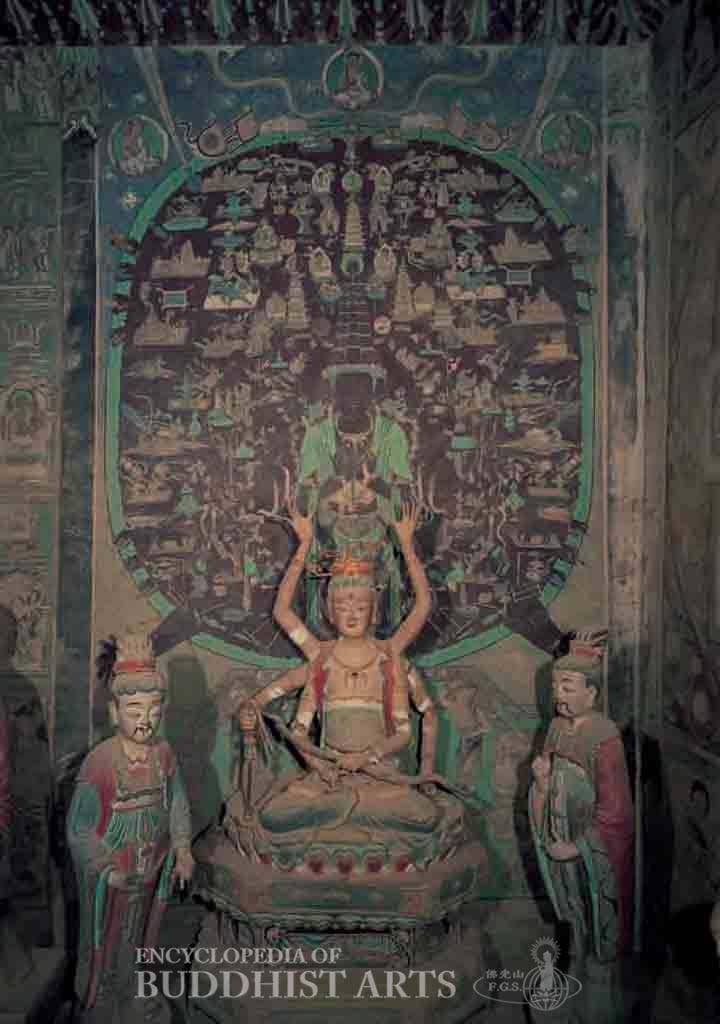
Yulin Cave 3: Fifty-One-Headed, Thousand-Armed Avalokitesvara
Yulin Cave 3: Fifty-One-Headed, Thousand-Armed Avalokitesvara
CHINA, Gansu, Guazhou; Western Xia period
This mural is located on the right side of the back (east) wall. According to the Surangama Sutra, Avalokitesvara Bodhisattva can take on numerous manifestations, which include forms with up to 84,000 heads and up to 84,000 arms. In this image, the 51 heads are distributed in ten tiers, with a Buddha’s head at the very top. The arms hold various objects and extend around the figure like a large oblong mandorla. This mural was painted in the Vajrayana Buddhist tradition and the inclusion of items such as common tools makes it a unique piece within the artwork of Dunhuang.
Among the objects held by the Bodhisattva are the seven jewels, musical instruments, weapons, tools, flowers, and trees. Of particular interest are scenes which depict various acts of cultivation. The tools utilized include ploughs, hoes, harrows, and hatchets. The scenes include hulling rice, forging iron, making wine, doing business, farming, and creating art. Art is one of the five areas of knowledge that a Bodhisattva undertakes, which also include mechanical skills and scientific study. The mural contributes valuable information about the social and economic life of the Western Xia period (1032–1227).
Also depicted among the Bodhisattva’s arms are three seven-tier pagodas. The pagoda at the center has a Buddha image at the top. Mount Sumeru emerges above the Buddha and at the top of the mountain is a palace from Trayastrimsa Heaven, along with another image of the Buddha surrounded by auspicious clouds and flowers. Painted on one side of the lotus platform at the bottom of the mural is Mahadevi, who holds a plate with bouquets of flowers; on the other side is Vasu, who holds a staff.
For more details, go to the Encyclopedia of Buddhist Arts: Caves T-Z, page 1567.
Cite this article:
author = Hsingyun and Youheng and Johnson, Peter and Mankuang and Huntington, Susan and Edson, Gary and Neather, Robert,
booktitle = {Encyclopedia of Buddhist Arts: Caves T-Z},
pages = 1567,
title = {{Yulin Cave 3: Fifty-One-Headed, Thousand-Armed Avalokitesvara}},
volume = 9,
year = {2016}}