
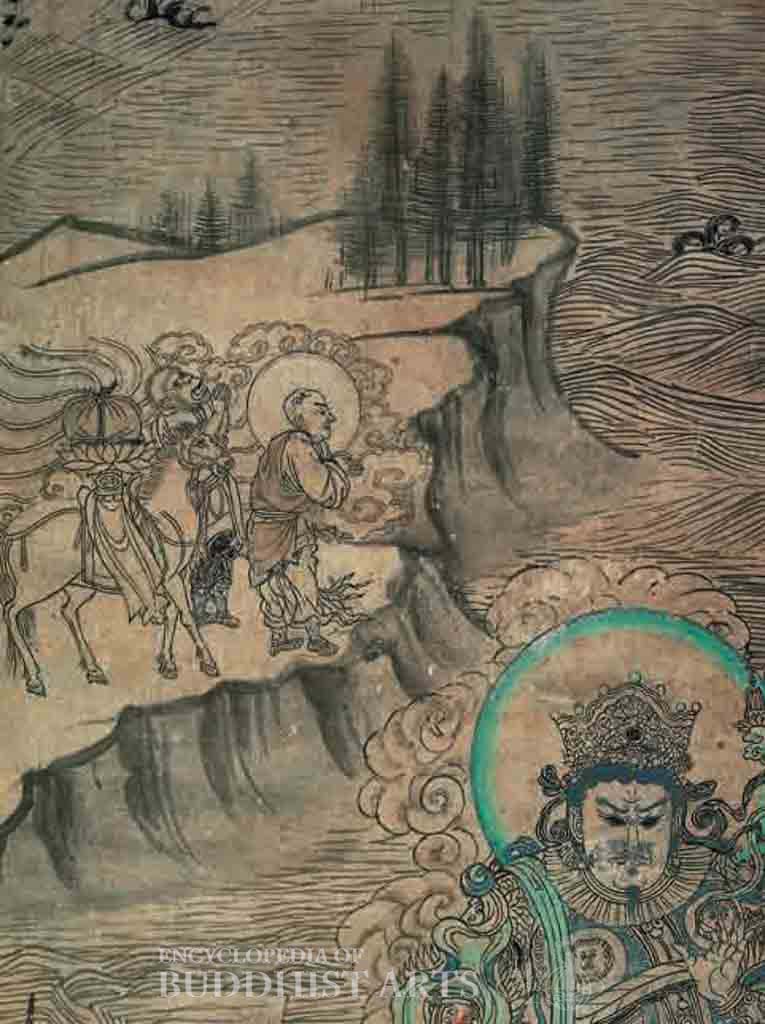
Yulin Cave 3: Samantabhadra Bodhisattva and Attendants - Master Xuanzang’s Journey to Obtain the Sutras
Yulin Cave 3: Samantabhadra Bodhisattva and Attendants - Master Xuanzang’s Journey to Obtain the Sutras
CHINA, Gansu, Guazhou; Western Xia period
This scene is located on the left part of the illustration of Samantabhadra Bodhisattva and Attendants. The image depicts the journey of Master Xuanzang, a famous Tang dynasty (618–907) monk, to obtain the sutras from India. He stands on a cliff with palms joined. Large, rolling waves are seen below the cliff. A white horse and a monkey-like disciple follow behind Xuanzang. The disciple looks skyward and the horse beside him carries the sutras that were brought back from India. The sutras are placed on top of a lotus saddle and emit a glowing light. Both master and apprentice are dressed for travel and wear hemp shoes.
During the late Western Xia period (1032–1227), murals of Xuanzang’s journey began to appear within the Dunhuang Caves. The four surviving murals are located in Guazhou, within Yulin Caves 2, 3, and 29, and Eastern Thousand Buddha Cave 2. Their appearance was probably a consequence of the retelling of the epic story in the Tang Master Obtains the Sutras, written during the Song dynasty (960–1279). The image may also have been influenced by dramas from the Jin dynasty (1115–1234) on the same subject. These murals appeared 300 years before the creation of the novel, Journey to the West, which was written by Wu Cheng’en during the Ming dynasty (1368–1644). It is thought that these murals may have influenced Wu’s writing.
For more details, go to the Encyclopedia of Buddhist Arts: Caves T-Z, page 1576.
Cite this article:
author = Hsingyun and Youheng and Johnson, Peter and Mankuang and Huntington, Susan and Edson, Gary and Neather, Robert,
booktitle = {Encyclopedia of Buddhist Arts: Caves T-Z},
pages = 1576,
title = {{Yulin Cave 3: Samantabhadra Bodhisattva and Attendants - Master Xuanzang’s Journey to Obtain the Sutras}},
volume = 9,
year = {2016}}